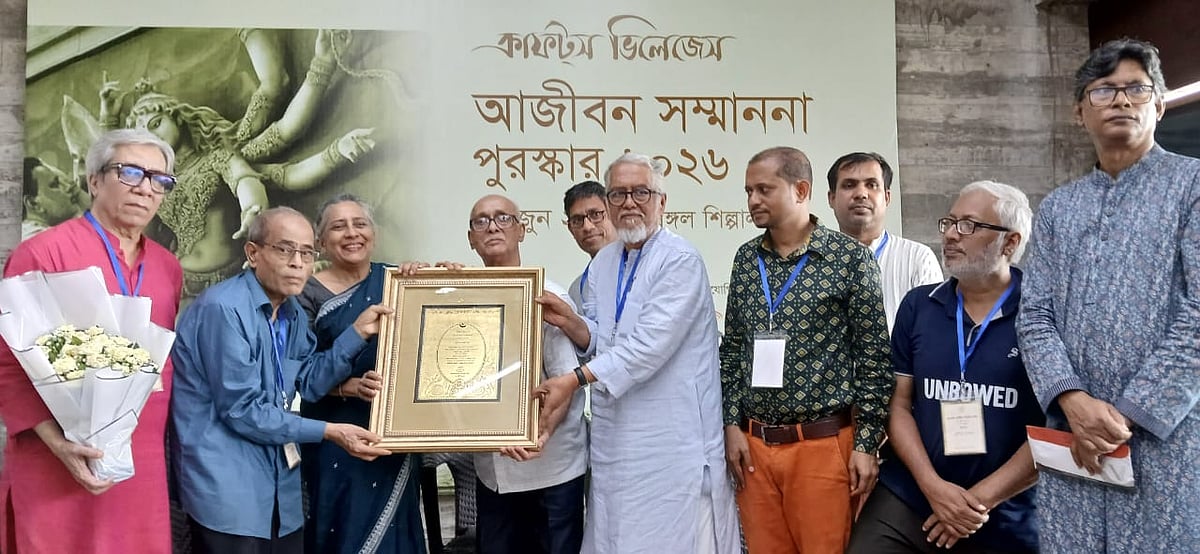
Recognition, resilience and respect for tradition unfolded at Bengal Shilpalay Auditorium on Saturday afternoon. It was not merely an award ceremony; it was a collective acknowledgment of Bangladesh’s centuries-old craft heritage, its struggles, and its aspirations for the future.
Organised by the National Crafts Council of Bangladesh (NCCB) with support from Bengal Foundation, the event celebrated the Crafts Villages Lifetime Honour 2026, dedicated this year to the art of idol sculpture. The prestigious honour was awarded to legendary sculptor Haripada Pal, who received a commemorative crest, a bouquet of flowers, and a cash award of BDT 100,000.
From the outset, it became evident that the occasion was more than a formal recognition. It was a heartfelt tribute to artisans whose contributions often remain overlooked despite their invaluable role in preserving cultural traditions.
In her welcome address, Farhana Sharmin Suchi, General Secretary of the National Crafts Council of Bangladesh, noted that the organisation’s activities had slowed in recent years due to financial, political, and global challenges. However, she emphasised that the council has renewed its commitment to supporting artisans and safeguarding traditional crafts. The Lifetime Honour, she said, symbolises this renewed journey.
Vice President of the Council, Shahid Hussain Shamim, reflected on the organisation’s history. Since its establishment in 1985, the council has worked to recognize and celebrate outstanding craftspeople. Although the continuity of awards was disrupted over time, efforts to honor artisans never completely ceased.
Tarun Kumar Pal, Managing Director of Crafts Villages Limited, the sponsor of the event, described crafts as more than a profession. “Crafts are an essential part of our national identity,” he said. “Clay, bamboo, cane, wood, handloom, and Nakshi Kantha each carry stories of people, history, and culture.” He highlighted the organization’s ongoing efforts to connect rural artisans, women entrepreneurs, and marginalised creative communities with international markets.
One of the most significant discussions of the event centered on the protection of craft heritage and artisans’ rights. Dr. Masood Imran Mannu, Professor of Archaeology at Jahangirnagar University and a researcher in heritage diplomacy, raised an important question: Is declaring something as heritage enough to protect it?
He pointed out that many Bangladeshi crafts possess strong international market potential, yet artisans continue to suffer due to the absence of adequate Geographical Indication (GI) protection, design safeguards, and intellectual property rights. Traditional motifs and techniques, passed down through generations, are often appropriated without recognition or benefit to the original creators. He warned that without stronger protection mechanisms, Bangladesh could face significant losses in the global marketplace.
The discussion prompted reflection among attendees about whether the country has truly provided its artisans with the respect and protection they deserve.
The realities faced by artisans became even clearer through remarks by journalist Sushanta Ghosh, who has worked extensively with pottery communities in southern Bangladesh and has personally honored more than two hundred artisans over the past decade. He described the irony that clay, the most essential resource for sculptors and potters, has become increasingly difficult for them to obtain. Artisans often face unofficial fees and bureaucratic obstacles when collecting clay, despite using it for cultural creation rather than commercial brick production.
Professor Uday Shankar Biswas of Rajshahi University’s Department of Folklore presented a paper on Bangladesh’s idol sculptors and their communities. He described idol makers as one of the most marginalised groups within the artistic community. Religious festivals depend heavily on their craftsmanship, yet they rarely share in the celebrations they help create. Most artisans must finance materials such as clay, bamboo, paint, and structural components themselves, often taking loans because advance payments are uncommon. By the time the work is completed, many are burdened with debt. Despite these challenges, they continue creating remarkable works of art.
Among them stands Haripada Pal.
Born into a traditional artisan family in Kurulia village of Ashulia, near Dhaka, Haripada Pal began learning sculpture from his father and grandfather at an early age. Seeking deeper artistic knowledge, he later trained in Kolkata’s renowned Kumartuli, mastering the intricate techniques of idol making. Returning to Bangladesh on the eve of independence, he established his own workshop in Shankharibazar, Old Dhaka. Over six decades, countless idols, sculptures, and artistic creations from his hands have found homes across the country.
Yet the life of an artist is not only about creation, it is also about endurance.
Haripada Pal’s personal life has been marked by profound sorrow. He lost his eldest daughter to pneumonia and his only son during the COVID-19 pandemic. He continues to care for his chronically ill wife. Despite such immense grief, his dedication to art has never faltered.
The most emotional moment of the afternoon came when he rose to speak after receiving the honour.
With a trembling voice, he said, “I only wish that as long as my hands can work, I may continue to bring the feeling of the divine to people through clay. Keep me here as long as I can create; when I can no longer do so, then take me away.”
A deep silence filled the hall. Many in the audience were visibly moved. In that moment, Haripada Pal transcended the identity of an idol sculptor and became a symbol of artistic devotion itself, a man who sees art not as a profession, but as a form of prayer.
Luva Nahid Choudhury, Director General of Bengal Foundation, perhaps captured the essence of the occasion best when she remarked, “No award can truly honour a person. Through such recognition, it is we who become honoured.”
Her words reflected the spirit of the event: honoring an artist means honoring the history, culture, struggles, and future that accompany that individual’s work.
Additional remarks were delivered by Professor Bazrul Rashid Khan, Dean of the Faculty of Fine Arts at Jagannath University, and Bisweshwar Pal, recipient of the Lifetime Honour in 2016.
In his closing speech, Chandrasekhar Saha, President of the National Crafts Council of Bangladesh, expressed gratitude to guests, artisans, and members of the media. The event was moderated by executive member of the NCCB, crafts rights activist and Haal Fashion consultant Sk. Saifur Rahman.
At a time when rapid modernisation and market pressures threaten many forms of traditional heritage, the gathering served as a reminder that crafts are not relics of the past, they are living traditions. In clay, wood, thread, and color reside the stories of a nation. Artisans like Haripada Pal are the quiet guardians of those stories. Through their hands, clay comes alive; through their creations, people reconnect with their roots.
This honour, therefore, was not merely an award. It was a promise that Bangladesh will not forget its crafts, its artisans, or the heritage they so faithfully preserve.