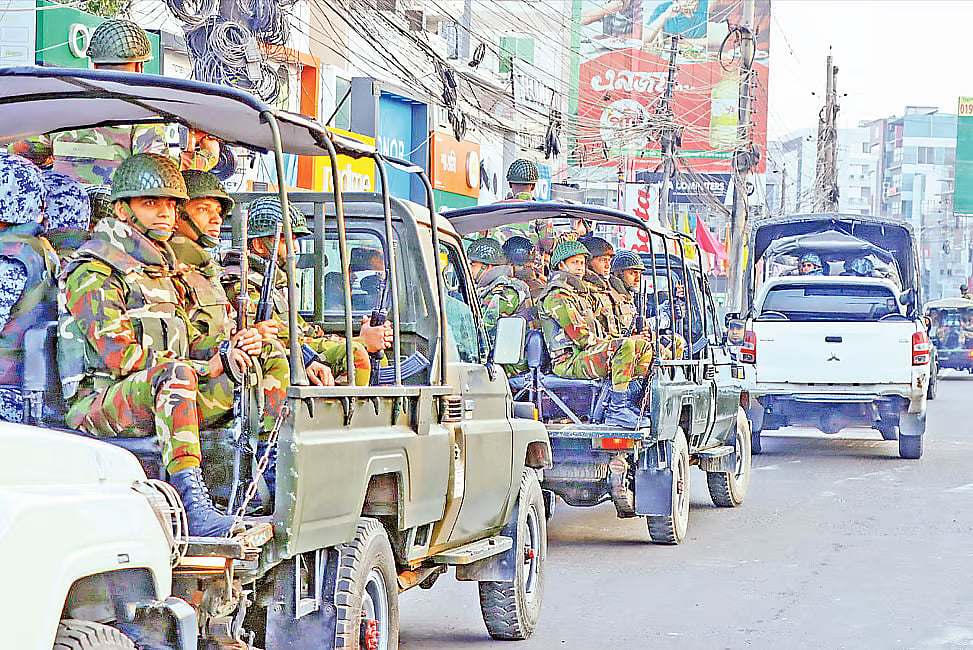
Law enforcement agencies alert ahead of election
Ahead of the 13th National Parliamentary Election and the referendum, the armed forces, including the Bangladesh Army, and other law enforcement agencies have intensified their activities.
In connection with the election, law enforcement agencies will remain on special operational alert in the field until 14 February. Joint forces have already strengthened operations to recover illegal weapons.
Voting for the 13th National Parliamentary Election will take place on 12 February.
On the same day, a referendum will also be held on the implementation of constitutional reform proposals under the July National Charter.
From the outset, the Election Commission (EC) has considered the maintenance of law and order a major challenge for this election.
Approximately 900,000 members from various forces will perform duties to maintain law and order during the election.
The Army has already deployed nationwide under the provisions of “in aid to the civil power” and has now formally begun election-centred duties.
Yesterday, Sunday afternoon, Army personnel were seen conducting patrols in different parts of the country.
To ensure law and order during the election, the government has appointed 1,051 executive magistrates to operate mobile courts across the country. They also began field-level operations yesterday, Sunday.
There is no risk of vote rigging. The election would take place in a very peaceful, fair and festive atmosphere.Md Jahangir Alam Chowdhury, home affairs adviser
On Saturday, Shafiqul Alam, press secretary to the chief adviser of the Interim Government, told journalists that around 108,000 members of the armed forces are on duty for this election.
In addition, more than 37,000 members of the Border Guard Bangladesh (BGB), over 3,500 members of the Coast Guard, approximately 157,000 police personnel, and 567,000 Ansar members will be deployed. Members of the Rapid Action Battalion (RAB) will also perform duties.
If any complaint or incident of violence occurs inside or outside a voting centre, the Electoral Security App will immediately transmit a message, enabling rapid intervention. Authorities will also use body-worn cameras.
Army to be deployed at voting centres if necessary
In previous parliamentary elections, Army personnel mainly served as a “striking force”.
For this election, authorities have amended the Representation of the People Order relating to national elections and have included the three services within the definition of law enforcement agencies.
As a result, members of the armed forces will be able to perform duties inside voting centres, like other law enforcement personnel. The Army’s magisterial powers will remain in force until 28 February.
Earlier, in a circular issued by the Ministry of Home Affairs in January, authorities stated that members of the armed forces would be stationed at nodal points and other convenient locations in every district, upazila and metropolitan area.
In coordination with Returning Officers, they will conduct patrols and other operational activities as required.
Depending on security sensitivity, they may deploy statically at specific voting centres or, in the second phase of centre-based deployment, cover several centres through mobile patrols.
Mobile and striking forces will maintain peace and order within voting centre premises when necessary. In coastal areas, the Navy will perform duties as required and coordinate with the Coast Guard according to the designated areas of responsibility.
On Sunday, after a meeting on law and order in Rangpur aimed at ensuring the smooth conduct of the 13th National Parliamentary Election and the referendum, Home Affairs adviser Md Jahangir Alam Chowdhury told journalists that, "There is no risk of vote rigging. The election would take place in a very peaceful, fair and festive atmosphere."
When journalists asked whether the current law and order situation would allow a fair election, the Home Affairs adviser replied, “We have taken preparations appropriate to the situation in each area.”
16,000 risk-prone voting centres
According to police data, the country has 16,359 risk-prone voting centres in this election. Authorities have identified 17,656 polling centres as general, meaning they carry no specific risk.
Under the circular issued by the Ministry of Home Affairs, authorities will deploy 16 to 17 members of law enforcement agencies at each general voting centre outside metropolitan areas, and 17 to 18 members at each risk-prone centre.
In city areas, each general voting centre will have 16 personnel, while each risk-prone centre will have 17.
In designated areas of 25 districts declared hard-to-reach, authorities will deploy 16 to 18 personnel at each voting centre. These personnel will remain on duty from two days before polling day until the day of voting.