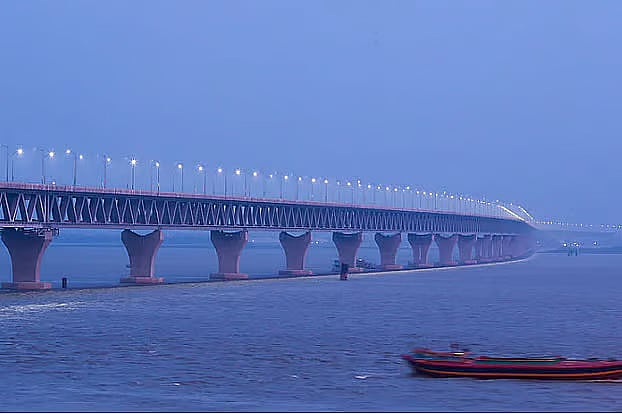
Built at a cost of Tk 307.7 billion, the Padma Bridge has generated more than Tk 30 billion in toll revenue over 43 months.
According to data from the Bangladesh Bridge Authority, the revenue was earned from the bridge’s inauguration on 25 June 2022 up to Tuesday.
All types of vehicles are required to pay tolls to cross the Padma Bridge. Separate toll rates have been fixed for different types of vehicles, including motorcycles, private cars, buses, and trucks.
Sources at the bridge authority said that around 22,000 vehicles cross the bridge daily on average. Average daily toll collection stands at Tk 25 million. In December alone, nearly Tk 820 million was collected in tolls.
The Padma Bridge, the country’s longest, connects Munshiganj and Shariatpur and links the southern and south-western regions with the capital. People from 21 districts in the region are benefiting from the bridge.
The bridge authority said that since the bridge became operational nearly four years ago, both vehicle movement and revenue have increased steadily.
They said that in addition to saving travel time, the bridge has created employment and is having a positive impact on the country’s GDP growth. Significant changes have been seen particularly in the transportation of agricultural, fisheries, livestock, and industrial products.
Electronic toll collection (ETC) systems are in operation at the toll plazas on both ends of the bridge at Mawa and Jazira. Under this system, tolls are paid automatically without vehicles stopping, reducing waiting time at the plazas. Automatic toll collection through radio frequency identification (RFID) cards has made travel faster and more convenient.
In a statement sent by the bridge authority, thanks and gratitude were expressed to vehicle owners, drivers, workers, members of law enforcement agencies on both sides of the bridge, and institutions involved in bridge operation and maintenance for achieving this toll collection “milestone”.
The total cost of the Padma Bridge project stood at Tk 307.7 billion. When the project was first undertaken in 2007, the estimated cost was around Tk 101.62 billion. The cost increased following multiple revisions to the project proposal.
The Padma Bridge project was implemented with self-financing. The government’s finance ministry provided the construction funds to the bridge authority as a loan. Under the agreement with the finance ministry, the loan is to be repaid over 35 years with 1 per cent interest. Installments are being paid every three months, with the full amount, including principal and interest, to be repaid in 140 installments.
Sources at the Bridges Division said that 15 per cent of the toll revenue goes to the government exchequer as VAT. After that, expenses are incurred for the contractor appointed to collect tolls. Korea Expressway Corporation has been appointed for five years at a cost of Tk 6.93 billion. In addition, periodic maintenance and repair costs of the bridge must be met.
The remaining amount is then used to repay the loan installments to the finance ministry.