On 22 January in Dhaka, police arrested an arms trader named Md Azgar Ali, alias Bhola, 55, along with two foreign-made pistols and 21 rounds of ammunition. The Detective Branch (DB) of Dhaka Metropolitan Police said that during interrogation Azgar revealed the pistols had been brought through Benapole in Jashore from the Indian border for sale.
Earlier, on 1 December, police in Chapainawabganj town conducted a raid on a CNG-run auto-rickshaw in the Birshreshtha Captain Mohiuddin toll area and arrested another individual, Royel Hasan, with a foreign pistol, five bullets, and two magazines. Police said the weapon and ammunition had reached Royel via Monakasha on the Indian border.
From interrogations of those detained with illegal firearms, law enforcement agencies learned that the weapons were brought in with the intention of violence during the upcoming 13th parliamentary election.
Border Guard Bangladesh (BGB) said the detainees carried weapons across the border for commissions and handed them over to local traffickers. Passing through these networks, the arms eventually reached unscrupulous political leaders, criminals, extremists, robbers, land grabbers and others.
Security analysts said that while some shipments are occasionally seized along the border, most firearms evade law enforcement detection and enter the country. These weapons are used in election-related violence, killings, dominance struggles, and extortion.
Border points used for smuggling
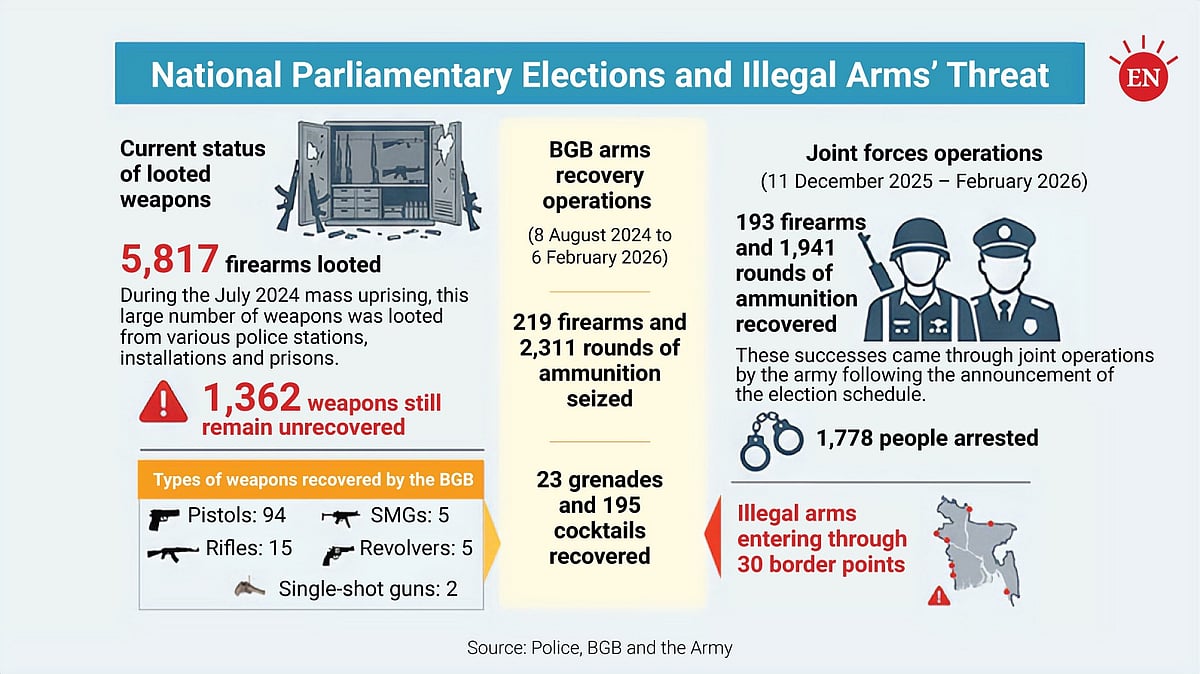
According to BGB, police, and RAB sources, illegal arms are entering through at least 30 points along the Bangladesh–India and Bangladesh–Myanmar borders. These include:
Rohanpur, Raghob Bati, Gopalpur, Monakasha, Sona Masjid, Azmatpur, Bilbhatia (Shibganj, Chapainawabganj); Jululi (Maheshpur, Jhenaidah); Taluigacha (Kalaroa, Satkhira); Benapole and Chowgacha (Jashore); Godagari, Paba, Bagha and Charghat (Rajshahi); Darshana (Chuadanga); Shakara (Satkhira); Meherpur; Sarail (Cumilla); Naikhongchhari (Bandarban); Khurer Dwip and Ukhiya (Teknaf, Cox’s Bazar); Charchilamari (Daulatpur, Kushtia); Kanaighat, Minatila (Jaintapur), and Katrir area of Jaflong (Sylhet); Chhanbari Bazar and Charagaon (Sunamganj); Gilbari (Dinajpur); and Taradaram border in Barolekha, Moulvibazar.
During the July 2024 mass uprising, 5,817 firearms were looted from police facilities, stations, and prisons; 1,362 remain unrecovered. After the interim government assumed office, between August 2024 and December 2025, as many as 2,393 cases were filed under the Arms Act across the country over the recovery of illegal firearms.
Inspector General of Police (IGP) Baharul Alam told Prothom Alo that because weapons are entering through the borders, some are being recovered daily in operations by police and the army inside the country. With elections ahead, police patrols and checkpoints are active to recover illegal arms. He added that weapons looted from police stations and prisons would not affect the national election.
Surveillance stepped up
Multiple law enforcement officials said most illegal arms enter through vulnerable border districts along India. Weapons are also transported by fishing trawlers and boats. They are first stockpiled in smugglers’ hideouts and later distributed across the country, including Dhaka, through various networks.
Officials said many individuals involved in illegal cross-border movement also assist arms smugglers. To move large consignments safely, traffickers sometimes allow smaller shipments to be seized by police, keeping them occupied while bigger consignments reach their destinations.
During the July 2024 mass uprising, 5,817 firearms were looted from police facilities, stations, and prisons; 1,362 remain unrecovered. After the interim government assumed office, between August 2024 and December 2025, as many as 2,393 cases were filed under the Arms Act across the country over the recovery of illegal firearms.
On 30 December, at BGB Day in Dhaka’s Pilkhana headquarters, Home Affairs Adviser Lt Gen (retd) Jahangir Alam Chowdhury said surveillance had been intensified to prevent firearms from entering through borders ahead of the parliamentary election.
By 7 January, 15,936 people had been arrested, though the number of identified major or professional criminals apprehended remained very low. During the operation, 236 weapons were recovered.
BGB sources noted that the Bangladesh–India border stretches 4,427 kilometres. About 3,000 kilometres on the Indian side are fenced, but the remainder is not.
As recently as Friday, BGB seized two foreign pistols, eight rounds of ammunition, four magazines, along with narcotics and electronic goods in an operation along the Rajshahi border.
Lt Col Md Mahbub Murshed Rahman, Director (Operations) at BGB headquarters, said BGB operates within eight kilometres inside the border area and that increased vigilance has led to the interception of arms consignments entering the country.
‘Borders must be secured’
On 12 December, a day after the election schedule was announced, Osman Bin Hadi, convener of the Inqilab Moncho, was shot in the capital’s Purana Paltan area. He later died in Singapore on 18 December.
His death was followed by attacks, arson, and looting at the offices of Prothom Alo and The Daily Star, as well as assaults on cultural organisations Chhayanaut and Udichi.
Police have learned that weapons used in killings after the election schedule announcement were foreign-made.
Following the shooting of Osman Bin Hadi, “Operation Devil Hunt Phase-2” began on 13 December. By 7 January, 15,936 people had been arrested, though the number of identified major or professional criminals apprehended remained very low. During the operation, 236 weapons were recovered.
Most recently, on Friday, a joint forces team arrested Mehdi Hasan alias Dipu—an associate of top criminal Subrata Bain—from a house in North Badda, Dhaka, seizing 11 sophisticated foreign weapons including pistols and revolvers.
ANM Muniruzzaman, president of the Bangladesh Institute of Peace and Security Studies and a retired major general, told Prothom Alo that the failure to recover looted police weapons remains a major challenge and threat. If illegal arms continue to enter through borders, the risk will increase further.
He said the current security situation is somewhat fragile, requiring more active law enforcement and enhanced intelligence surveillance. Securing the borders is essential to maintaining control of the situation and ensuring a peaceful election.