Poverty drives them to migration
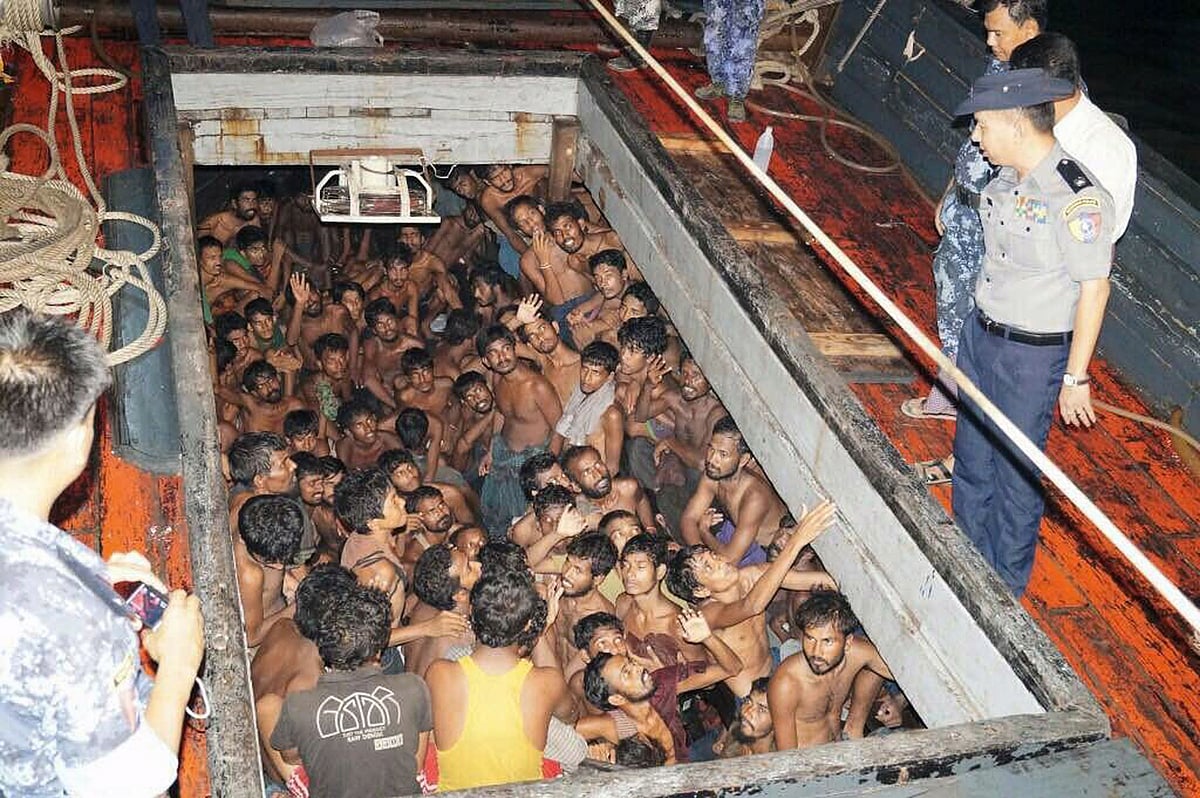
Rohingya Muslims in Myanmar are driven to migration due to ethnicity-related oppression and threats to their lives by the military junta.
But why are the Bangladeshis risking their lives to migrate like the Rohingyas?
"Poverty, unemployment, and inability to support the families are the causes," says Selim Uddin, a migrant from Chuadanga.
Selim and Rafique started for Malaysia with the help of agents, but landed up at Rattaphum district jail in Thailand.
On 9 May, the Thai police rescued them from the jungles.
This reporter talked to at least 50 Bangladeshis in different prisons in Southern Thailand and also spoke over the phone to some other migrants who managed to return home after paying ransom.
Most of them said they left their homes due to poverty and unemployment.
Some said the traffickers lured them with promises of high wages.
Thus the traffickers of Bangladesh, Myanmar, Thailand and Malaysia continue with their lucrative ransom racket.
The migrants in various detention camps in Thailand came up with three different stories about their migration.
Firstly, some willingly paid the agents in advance, but were later tortured by the traffickers to collect ransom from their families.
Secondly, the agents persuaded many of them to go abroad and did not take any advance payment.
Thirdly, many of them were abducted or lured with promises of highly paid jobs in the ships. But this was hardly the case with Bangladeshis.
Raihan, a Bangladeshi migrant from Siraganj who studied up to higher secondary level, willingly contacted the agents to go to Malaysia for a job. He sol his land and paid the agents Tk 2.20 lakh (Tk 220 thousand).
"I thought I will travel to Malaysia in a ship which cabins like five-star hotels, with carpets and beds, and there would be a job waiting for me once I reach there. But it was a three-storeyed wooden boat," said desolate Raihan.
"We were imprisoned in the boat and then reached the Thai jungles. Here I was imprisoned again with no food, no water, no baths, only torture for ransom. There is no end to the story," he lamented.
Asked if he hadn't of heard such torture and misery through media, Raihan said the agents told him that these stories were all made up by the journalists.
Raihan is now languishing in a Thai prison.
Like Raihan, Rafique also dismissed the media reports.
The agents said he need not pay in advance money and could pay in installments after getting a job in Malaysia.
Like Raihan and Rafique, most of the victims rescued from the jungles of Thailand fell into the same trap.
Nur Nabi, who managed to return home after paying the ransom, said the traffickers took him forcefully.
Asked how it was possible, Nur Nabi said he and two friends - Rafique from Feni and Mithu from Chittagong - used to earn a living by taking pictures of the tourists along the Cox's Bazar beach.
He said their earning had plummeted during the the continuous hartal and blockade before the 5 January elections in 2014.
At that time, one of the brokers in Teknaf told them that there was plenty of employment opportunities in Malaysia. They would have to pay nothing in advance and could repay the money after getting jobs.
The agents told tem they would even be able to save from Tk. 5,000 to Tk. 10,000 for their families every month after paying the installments.
Nur Nabi claimed that he did not agree to the offer, although his friends Rafique and Mithu did.
He said he was forced abroad the vessel when he went to see off his two friends at Teknaf.
"I cried, but no one came to help. They kept me in the boat with other Rohingyas and Bangladeshis. And the journey began after three days," Nur Nabi said.
It took eight days and eight nights to reach the Thai coast, he continued.
He said, they had to walk a long distance before they caught a vehicle to reach the Badam Besar jungle camp near the Malaysian border.
"We became weak and tired without food and water. They also tortured us," Nur Nabi said.
"The agents asked for Tk. 2.40 lakh (Tk 240 thousand) from my brother at home, which he managed after selling our land," Nur Nabi said.
He was finally rescued by the Thai police from the detention camps and he returned home after serving in jail, Nur Nabi said.
Life in Thai jail was of another misery for him, he said.
"Some of the people died at sea. Others died of torture, sickness and starvation. Some others went missing," Nur Nabi narrated.
However, the Thai government started a combined operation against the human traffickers after 32 skeletons were recovered from the mass graves in the jungle camps on 1 May.
Some Thai government officials and the people concerned with trafficking said the Bangladeshis were coming by sea, although in smaller numbers.
The number of Rohingyas, the main victims of sea trafficking, has been growing since 2009, the Thai officials said. The number of Bangladeshis increased from 2013.
Arakan born Thai citizen Ameen Saiyak, who works as an interpreter whenever a Rohingya or Bangladeshi is arrested in Sonkhola province, said, "70% of the people trafficked here are young ones from Bangladesh."
"Rohingyas have nothing. They are detained in the jungle camps for months as they cannot pay the ransom. But the Bangladeshis can pay quick ransom. Consequently, the traffickers are more interested in Bangladeshis," Ameen Saiyak said.
In a report, the London-based Economist claimed that half of the trafficked victims at sea were Bangladeshis.
They are migrating only for financial reasons, the report said.
According to the UN, 25,000 people from Myanmar and Bangladesh left their country by sea within the first three months of the year 2015, among whose 3000 died.
Harun-ur-Rashid, regional coordinator of Keram Asia, which works for the rights of the migrant workers, said, Bangladeshis could be found in every corner of Malaysia.
He said a number of Bangladeshis who managed to reach Malaysia after paying the ransom, landed up in the jail after being arrested by police.
Few others get work at the rubber plantations or in the palm oil plantations, he said in a UN conference on human trafficking.
"Some get jobs in restaurants, but are always in fear of police. They work hard and are paid poorly," he observed.
Ameen Saiyak said he met people from Chittagong and Cox's Bazar of Bangladesh while working as an interpreter. But in the last one year, he met people from other districts as well.
He said, "I saw dead people of your country in the jungles. But the government of your country did not bother as they considered them Rohingyas."
He said, it is a perception in Malaysia for long that the majority of the Bangladeshi people coming to the country are actually Rohingyas.
This reporter's investigations revealed that people from 15 districts of Bangladesh are imprisoned in five jails of southern Thailand.
The districts are Cox's Bazar, Chittagong, Sirajganj, Bogra, Sunamganj, Narsingdi, Narayanganj, Kishoreganj, Jessore, Khulna, Satkhira, Chuadanga, Magura and Kushtia.
Bangladesh does not have ethnic violence like Myanmar, nor does it have military dictatorship. While talking with the 37-member Commonwealth Parliamentary Delegation team on Tuesday, prime minister Sheikh Hasina said democracy of Bangladesh is standing on a strong foundation.
The Bangladesh Bureau of Statistics (BBS) in their provisional estimate said the country's total Gross Domestic Product (GDP) is rising continuously.
Why then are the Bangladeshis lining up with the Rohingyas to go to Malaysia by illegal means?
Imtiaz Ahmed, professor of international relations at Dhaka University, said, there is a basic difference between trafficking Rohingyas and Bangladeshis.
"The Rohingyas have no citizenship in any country. The Bangladesh government often claims that the country is developing rapidly and will be a middle income country within a short time. But this claim loses meaning when its citizens leave the country in such a risky manner," Imtiaz Ahmed said.
The professor observed that human trafficking through the sea route will tarnish the image of Bangladesh worldwide.