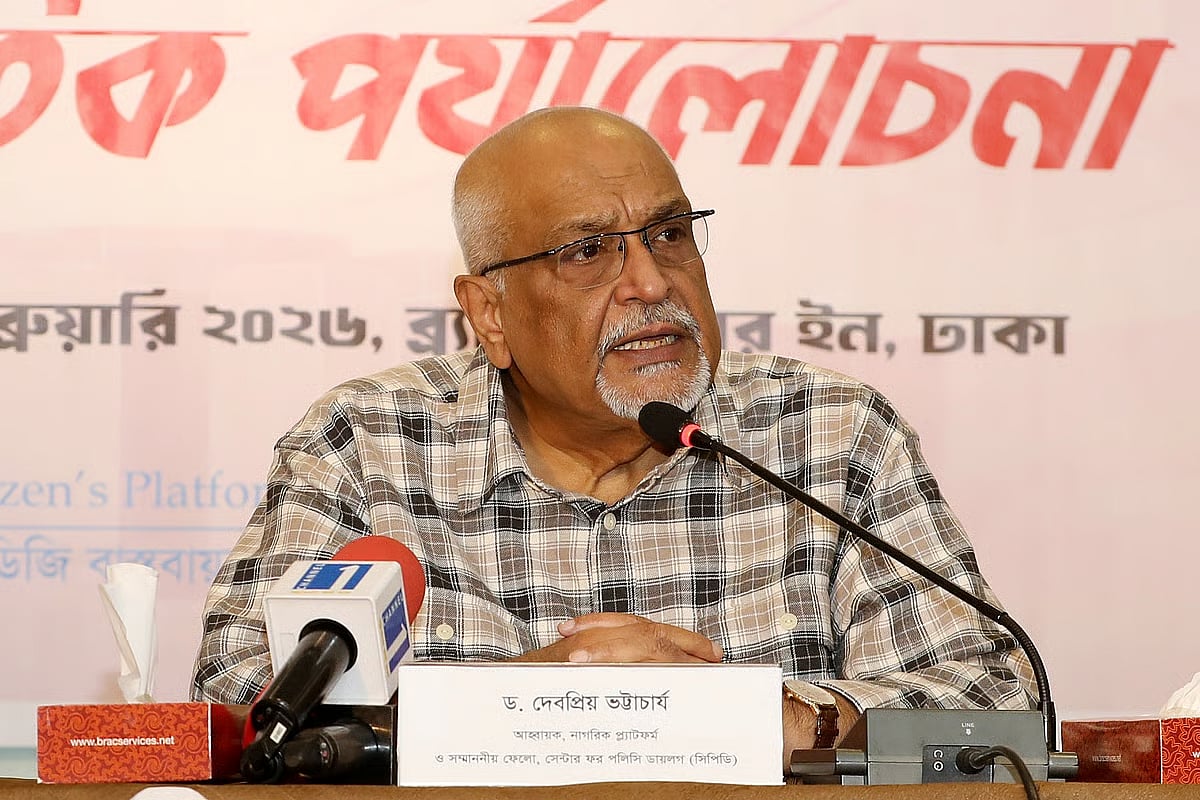
Govt must exercise fiscal restraint: Debapriya Bhattacharya
Debapriya Bhattacharya, distinguished fellow of the Centre for Policy Dialogue (CPD), has advised the new government to maintain restraint in financial management.
He said the government currently has no scope to take populist measures and must implement austerity in the budget. If austerity is not possible, it must at least demonstrate fiscal restraint.
He made the remarks today, Thursday, at a media briefing titled ‘Starting Point of the New Government: An Economic Review’, organised by the Citizen’s Platform at BRAC Centre Inn in Mohakhali area of the capita.
CPD distinguished fellow Mustafizur Rahman also spoke at the event while, CPD additional director (research) Towfiqul Islam Khan presented the keynote paper.
As convener of the Citizen’s Platform, Debapriya Bhattacharya said, “It was necessary to review whether there had been any irregularities in procurement agreements signed by the previous interim government.
"The former government had entered into various foreign agreements, not only with the United States or in relation to port matters, but also in other areas that may not yet be publicly known. These foreign agreements should be reconsidered," he added.
He advised the new government to form a transitional team. The primary task of this team would be to conduct a forensic review of the financial management during the tenure of the Awami League and the interim government, and to prepare a document or briefing paper. Based on that, various state institutions could take appropriate measures.
Debapriya Bhattacharya also suggested that by the end of March next year the government should present a financial statement in parliament.
He noted that The Public Finance and Budget Management Act enacted in 2009, contains specific provisions regarding such a statement.
This financial statement, he said, would serve as the strongest safeguard for the government’s fiscal transparency and management.
Referring to reports that the government would proceed with a 180-day action plan, he cautioned against rushing into financial decisions.
He urged patience, recommending that no new measures be introduced in the current fiscal year; instead, proper planning should be undertaken for the next fiscal year. If fiscal restraint is maintained, he said, the government would be able to overcome inflation and other economic difficulties more effectively in the coming year.
Debapriya Bhattacharya also addressed the issue of syndicates in the supply chain. He said data indicate that there is sufficient supply of essential goods for the month of Ramadan. However, politically influenced syndicates remain active in the supply chain of essential commodities.
Leaders of the new ruling party have pledged to dismantle these syndicates, he said adding, “We are waiting to see that from the very first day.”
Speaking at the event, Mustafizur Rahman said that incentives provided on remittances should gradually be reduced, as they are creating pressure on revenue. If remittances amount to 30 billion US dollars and a 2.5 per cent incentive is provided, it requires nearly Tk 90 billion in subsidies. “We must account for this economic burden,” he said.
He suggested that alongside reducing incentives, the exchange rate could be made more market-oriented. Expatriates would then receive more taka per dollar. Therefore, a modest depreciation of the currency, he argued, would not negatively affect remittance inflows.
Presenting the keynote paper, Towfiqul Islam Khan said the economy is currently passing through a major crisis and that the new government has assumed office at a critical time. He identified three key challenges: macroeconomic stability is weak; private sector investment and employment are not on a reliable footing; and the government’s fiscal capacity is severely constrained.
In this context, CPD has made several policy recommendations. It said the exchange rate should be gradually depreciated, incentives for remittances and exports should be reduced, and the current year’s budget should be revised realistically to ensure proper preparation for the next fiscal year.
Towfiqul Islam Khan said the government’s first task should be to revise the 2024 budget in order to restructure the economic framework. Only then should it move gradually towards implementing its electoral pledges, and that too in phases, taking fiscal capacity into account.