Govt awaits UAE response regarding Benazir Ahmed’s repatriation: Home Minister
Bangladesh is awaiting the decision of the United Arab Emirates (UAE) government regarding the return of former Inspector General of Police (IGP) Benazir Ahmed, who was recently arrested in Dubai, said the Home Minister Salahuddin Ahmed on Friday (26 June).
“Bangladesh government has already sent all the necessary documents. We have not yet received any response from the UAE government. We hope to hear from them soon,” the minister said.
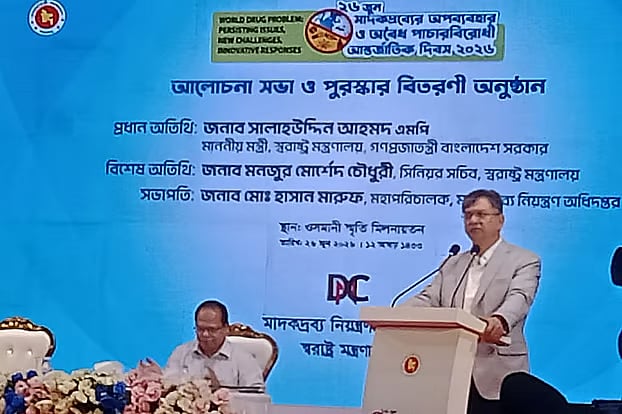
The Home Minister made these remarks while speaking to reporters after a discussion and award-giving ceremony marking the International Day Against Drug Abuse and Illicit Trafficking 2026 at Osmani Memorial Auditorium in Dhaka on Friday morning. The programme was organised by the Department of Narcotics Control.
"We are now waiting for a response from the UAE government. As far as we know, he (Benazir Ahmed) remains in the custody of the federal police. I do not have any other information," the minister added.
Responding to a question regarding the ministry's measures to prevent ongoing "push-ins" along the Bangladesh-India border, the home minister said that the BGB is on high alert at the border and no one has been allowed to enter Bangladesh by force.
Emphasising that both Bangladesh and India should follow international and diplomatic protocols regarding border-related issues, the Minister noted that if any Bangladeshi national is staying in India illegally, there is an established diplomatic process to repatriate them after verifying their identity. However, he said that pushing anyone into Bangladesh through the border without nationality verification is unacceptable.
Salahuddin Ahmed added that if the Indian government provides a list of Bangladeshi nationals, Bangladesh will verify their identities through legal procedures and accept them accordingly. However, he stressed that no one can be pushed into Bangladesh by force. Attempts to send people across the border without proper verification could also negatively affect bilateral relations between the two countries, he said.
In response to another question about efforts to bring back the accused in the murder of Inqilab Mancha spokesperson Sharif Osman Hadi, who was arrested in India, the Home Minister said that all necessary documents, including the arrest warrant, have been sent to the Indian government through the Ministry of Foreign Affairs as per the extradition treaty. He expressed hope that the government would be able to bring him back to Bangladesh for the sake of the investigation.
Special tribunal for swift trial of drug cases
Earlier, in his speech at the event, Salahuddin Ahmed said that not only law enforcement but also legal and institutional capacities will be strengthened to prevent the spread of drugs in the country. To this end, an initiative has been taken to amend the Narcotics Control Act.
He said the proposed amendments would provide officials of the Department of Narcotics Control with modern weapons, training and the necessary authority to conduct effective operations against armed drug traffickers. The amendments also include provisions for establishing special tribunals to expedite the disposal of a large number of drug-related cases that have remained pending for years.
The minister noted that drug trafficking has increasingly become a technology-driven crime. Online platforms, digital transactions and mobile financial services are being misused to facilitate the drug trade and money laundering, he said, adding that existing laws are not adequately equipped to address such offences.
Salahuddin Ahmed said new legal measures are being introduced to identify the sources of drug money, confiscate illicit assets and prevent money laundering. Initiatives have also been taken to establish modern drug-testing laboratories in every district, form dog squads, enhance drug-detection capabilities and expand the forensic laboratory facilities of the Criminal Investigation Department.
The minister remarked that the government's goal is not just drug recovery or arrests, but to build a drug-free society. He said that drug addicts will be considered patients rather than criminals, and scope for their treatment and rehabilitation will be further expanded.
Calling for a social movement against drugs, he said that necessary laws, infrastructure and institutional reforms will be implemented step-by-step to make the country gambling and drug-free, in accordance with the government's election pledges.
At the event, Senior Secretary of the Ministry of Home Affairs, Monzur Morshed Chowdhury, said that although Bangladesh is not a drug-producing country, it is at risk of being used as a transit route by international drug traffickers due to its geographical location. The influx of yaba and crystal meth from Myanmar and the flow of marijuana, heroin and various synthetic drugs from neighboring countries, have become major threats to the country's public health and security. He noted that these drugs can be produced at a low cost and are not easily detectable, making the situation even more challenging, he added.
Monzur Morshed Chowdhury said that the government is working on an integrated strategy for drug prevention based on three pillars: supply reduction, demand reduction, and harm reduction.
Md. Hasan Maruf, Director General of the Department of Narcotics Control (DNC), delivered the welcome speech noting that the department is working to implement the government's ‘zero tolerance’ policy against drugs.
He stated that 30,744 anti-drug operations were conducted from February to May this year, resulting in 9,291 cases. A total of 9,685 people were arrested during these operations. Legal action is also being taken against the principal financiers of the drug trade under the Money Laundering Prevention Act. Furthermore, assets worth nearly Tk 220 million have been seized through nine money laundering cases.
The ‘International Day Against Drug Abuse and Illicit Trafficking’ is observed annually on 26 June across 193 UN member states. The decision to observe this day was taken during a UN General Assembly session in 1987 to increase public awareness for a drug-free world. This year's theme is ‘World Drug Problem: Persistent Issues, New Challenges, Innovative Responses.’
During the ceremony, 21 students, three officials, and three drug rehabilitation centres were awarded for their contributions and achievements in various anti-drug initiatives and competitions.
Prior to the discussion session, an anti-drug rally was held. The programme began with the screening of the Department of Narcotics Control’s theme song, “Say No to Drugs,” as well as an awareness video produced by the department.