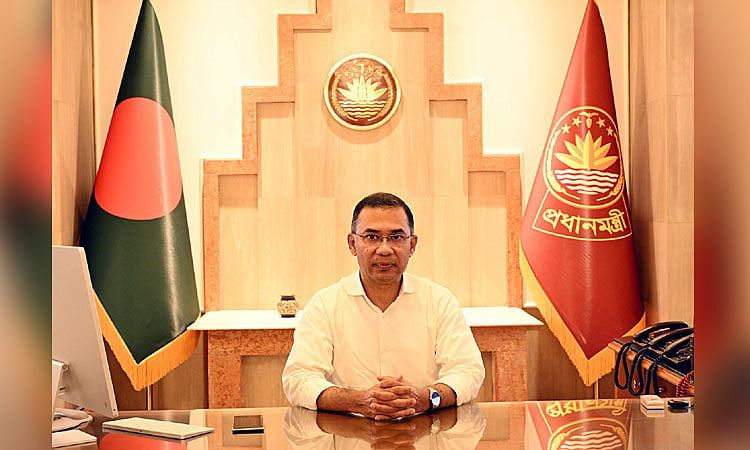
In recent years, particularly before and after Bangladesh's political transition in 2024, Japan has focused on qualitatively strengthening its relationship with Bangladesh.
As part of that effort, Japan hopes to host Prime Minister Tarique Rahman in Tokyo within the next two months. Before that, the foreign secretaries of the two countries will meet in Dhaka during the first half of August, where discussions are expected to provide greater clarity regarding the Prime Minister's visit. Diplomatic sources in Dhaka and Tokyo have confirmed these developments.
Japan's Ambassador to Bangladesh, Saida Shinichi, paid a courtesy call on Foreign Minister Khalilur Rahman on 28 June. During the meeting, he expressed Japan's interest in inviting Prime Minister Tarique Rahman to visit the country.
Later, on 1 July, a Japanese delegation led by Parliamentary Vice-Minister for Foreign Affairs Shimada Tomoaki visited Bangladesh. During a meeting with the Prime Minister, Shimada Tomaki formally invited him to visit Japan.
When asked about the matter, Foreign Minister Khalilur Rahman told Prothom Alo, "Japan has already informed us of its intention to host Prime Minister Tarique Rahman on an official visit. The two countries are currently discussing the matter."
According to diplomatic sources from both countries, Tarique Rahman's forthcoming visit to Tokyo will mark another step in transforming bilateral relations from a framework centred on development cooperation to one based on trade, investment and strategic economic partnership.
In particular, following his visit to China in June, the Tokyo visit may represent the next significant step in Bangladesh's balanced foreign policy.
From development cooperation to strategic partnership
Japan has remained one of Bangladesh's most dependable friends since the country's emergence as an independent nation.
Over the past five decades, Japan has consistently ranked Bangladesh among the top recipients of its Official Development Assistance (ODA).
Over time, however, the relationship has evolved beyond development cooperation towards a strategic partnership.
Japan has played a key role in several landmark infrastructure projects in Bangladesh, including the country's first metro rail system, the deep-sea port at Matarbari, and the construction of Hazrat Shahjalal International Airport.
The two countries elevated their relationship to a Strategic Partnership in 2023. Subsequently, during the 2025 visit of Chief Adviser Dr Muhammad Yunus to Tokyo, Japan reaffirmed its political commitment to strengthening bilateral ties.
In February this year, just one week before Bangladesh's 13th National Parliamentary Election, the signing of the Economic Partnership Agreement (EPA) between the two countries established a new foundation for bilateral relations.
Indications of a strategic balance
In recent years, considerable attention has focused on which country a Bangladeshi prime minister chooses for their first overseas visit.
Prime Minister Tarique Rahman's recent visit to Beijing was no exception. Ultimately, he travelled to China via Malaysia on his first official state visit.
The visit to China carried significant political importance. Prime Minister Tarique Rahman held meetings with Chinese President Xi Jinping, Premier Li Qiang, and the chairman of the National People's Congress.
The Bangladesh Nationalist Party (BNP) and the Communist Party of China (CPC) signed a Memorandum of Understanding. The two countries also issued a joint statement for the third time in the 51-year history of bilateral relations.
Alongside expanding political engagement, Bangladesh joined President Xi Jinping's Global Development Initiative (GDI), one of his four major global initiatives.
China also officially announced its participation in technical work, including feasibility studies, for the large-scale Teesta River development project.
In addition, President Xi proposed an economic corridor linking China and Bangladesh through Myanmar to promote economic growth and regional connectivity.
Alongside growing political engagement, Bangladesh has steadily expanded cooperation with China in trade, investment and connectivity.
At the same time, the government is focusing on deepening its partnership with Japan in areas such as technology and manufacturing.
Through these parallel efforts, the government aims to establish a strategic balance in Bangladesh's relations with both China and Japan.
Bangladesh in a new geopolitical landscape
The interests of four major powers—China, Japan, the United States and India, in Bangladesh are becoming increasingly evident amid evolving regional and global geopolitical realities.
Competition among these countries now extends beyond geopolitics and security to encompass trade, investment, manufacturing, supply chains, connectivity and economic security.
Bangladesh's strategic geographical location and rapidly expanding economy have made it an important partner in this emerging landscape.
China seeks to build a long-term partnership with Bangladesh through the Belt and Road Initiative (BRI), economic corridors, manufacturing, ports and infrastructure development.
Meanwhile, Japan aims to deepen its relationship with Bangladesh under its Free and Open Indo-Pacific (FOIP) vision by promoting supply chain diversification, economic security, advanced infrastructure and industrial investment.
The United States remains primarily interested in Bangladesh's large export market, labour standards, stability in the Indo-Pacific region and maritime security.
For India, Bangladesh holds strategic importance because of connectivity with its north-eastern states, border management, the sharing of transboundary river waters and regional security.
Diplomatic analysts say that although the interests of these four powers are competitive, they are not mutually exclusive in every area.
Notably, while India and the United States continue to compete strategically with China, both countries also maintain relationships of mutual economic interdependence with Beijing through trade and investment.
As a result, each country prioritises and safeguards its own national interests. This evolving environment presents Bangladesh with both opportunities and challenges.
When asked about the issue, Geopolitical Analyst ANM Muniruzzaman, president of the Bangladesh Institute of Peace and Security Studies (BIPSS), told Prothom Alo, "Japan has been our development partner for many years. More recently, the signing of a defence cooperation agreement between the two countries has made this relationship multidimensional. It will open new avenues for cooperation."
In his view, maintaining regional balance is of critical importance for Bangladesh.