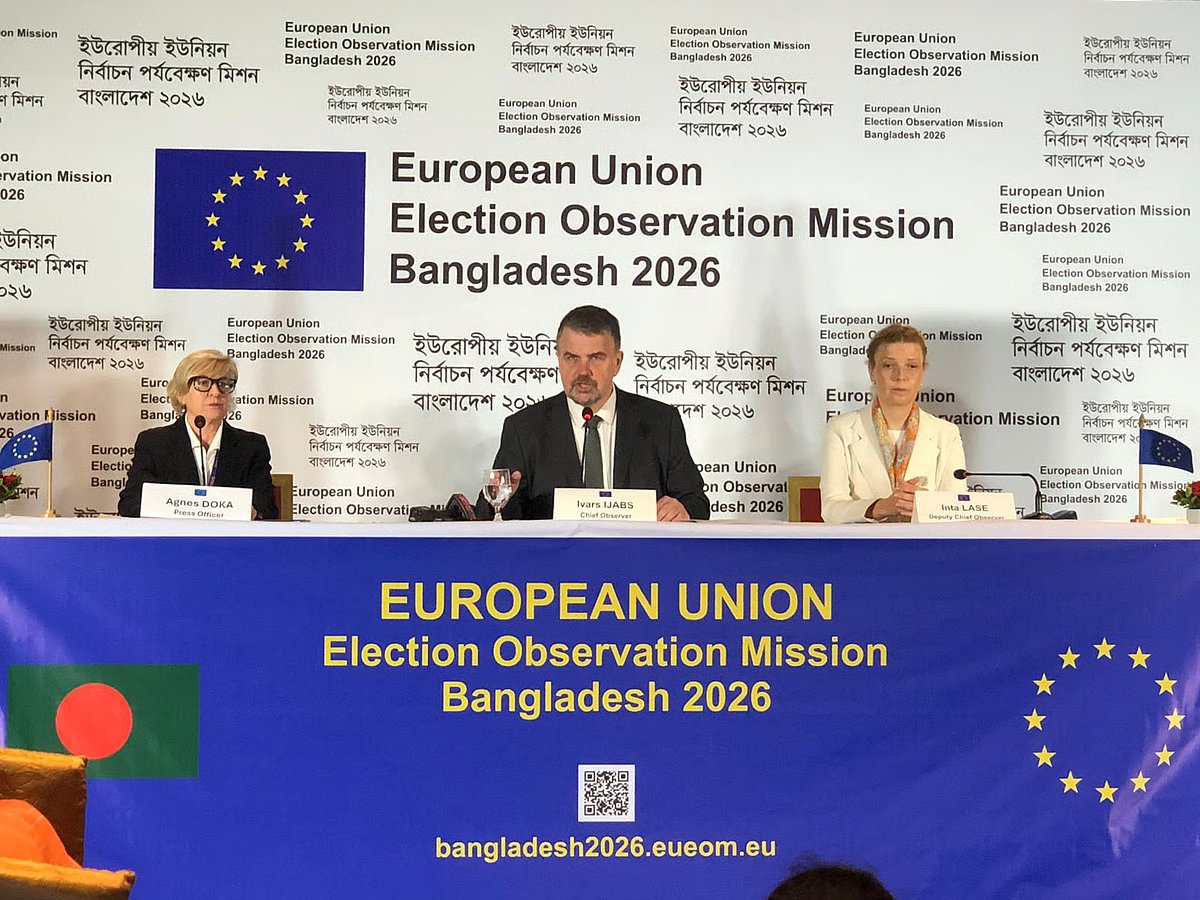
EU mission makes 19 recommendations to ensure integrity of future elections in Bangladesh
European Union Election Observation Mission (EU EOM) has made 19 recommendations aimed at reinforcing the integrity of future electoral processes of Bangladesh.
The EU EOM has put forward six priority recommendations in line with Bangladesh’s international commitments to democratic elections.
Chief Observer of the EU EOM and a Member of the European Parliament, Ivars Ijabs, shared this today, Tuesday at a press conference at a hotel in the capital.
The event was organised to mark the publication of the mission’s final report on the 13th parliamentary election.
The full EU EOM Bangladesh Final Report and all 19 recommendations are published on EU EOM website.
Meanwhile, the EU EOM said in a press release on its website that the report is based on a two-month-long, country-wide observation and offers a detailed analysis and assessment of the entire electoral process.
The EU EOM Chief Observer, Ivars Ijabs, Member of the European Parliament, stated: “These credible and competently managed elections marked a pivotal step toward restoring democratic governance and the rule of law, reflecting a shared commitment to democratic processes among all stakeholders. Although elections bolstered public trust, legal and procedural gaps remain, signalling the need to continue the reform process in line with the July National Charter and beyond.”
The mission noted several positive developments, attesting to the resilience of Bangladesh’s democracy. The renewed legal framework was largely aligned with international standards for democratic elections, the Bangladesh Election Commission (EC) worked professionally, demonstrated openness and successfully enfranchised some 770,000 voters living abroad.
The Electoral Enquiry and Adjudication Committees were pro-active in upholding the campaign rules. The mission also saw a revitalised civic space and took note of important national initiatives to counter disinformation.
However, more efforts to foster accountability and electoral inclusion are needed. Women candidates were almost absent from these elections, signalling lack of political will to promote women in decision making positions.
The inconsistent enforcement of the EC’s campaign regulations and limited accountability and oversight in campaign finance laws contributed to an uneven playing field. Incidents of digital-led violence and harassment alongside inadequate police protection curbed media freedom and social media platforms appeared ill-prepared to safeguard digital information integrity.
“Now, it is time to turn the focus to the reform process to strengthen transparency and rule of law, to show political will in promoting women in public and political life and to foster an environment for a pluralistic and secure public debate, both online and offline. The European Union stands ready to support Bangladesh in those efforts, in line with the recently initialled Partnership and Cooperation Agreement, and reaffirming our unwavering commitment to democratic principles,” said Ivars Ijabs.
The six priority recommendations include a comprehensive revision of electoral legal framework, introduction of robust campaign financing rules and oversight, introduction of affirmative action to enhance women participation in public and political right, as well as wide-ranging reforms to promote a safe digital environment.
The mission also recommends the EC take steps to ensure transparency throughout all stages of the vote tabulation and to consider extending eligibility for postal voting to other categories of voters.
The EU EOM was present in Bangladesh between 28 December 2025 to 4 March 2026, at full strength comprising 223 international observers from all EU Member States, Canada, Norway and Switzerland, deployed to all 64 administrative districts of Bangladesh.