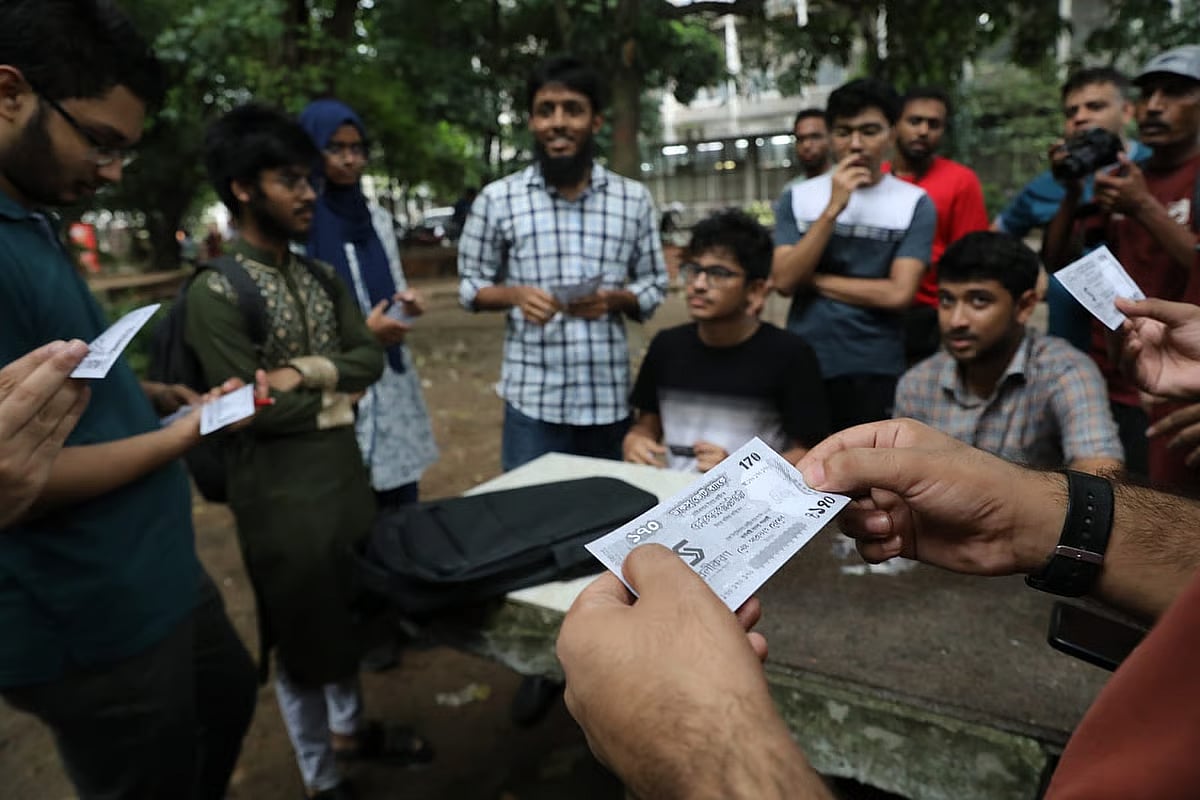
DUCSU election: Candidates print leaflets that looks like banknotes and dollars
Campaigning has been running in full swing for the Dhaka University Central Students’ Union (DUCSU) and hall union elections.
Candidates are struggling to make their names and ballot numbers known to the voters within the stipulated campaign period. Some, therefore, have resorted to ingenious strategies—printing campaign leaflets designed to resemble Bangladeshi banknotes or US dollars in order to attract the attention of the voters.
According to the official schedule, candidates may campaign until 7 September. In the male halls, campaigning is permitted from 10:00am to 11:00pm, while in the female halls it is limited to 10:00pm.
The candidates must do so by observing codes of conduct strictly. Under these regulations, candidates may distribute handbills, posters and leaflets, but may not paste or hang them anywhere on campus.
As a result, aside from leaflets, there has been little scope for visible campaigning, leaving candidates at something of a disadvantage.
In this context, several candidates have adopted unconventional methods. One such is Mohammad Arafat Hossain, a marketing student standing for a member’s post in the DUCSU election. His ballot number is 170. To secure voters’ attention, he has printed campaign leaflets that look like Tk 1,000 banknotes.
On the front of this leaflet, the words Bangladesh Bank have been replaced by DUCSU Vote Bank. Where the original note states On demand, the bearer will be paid Tk 1000, the leaflet declares: On demand, this candidate will be obliged by casting a vote at ballot 170. Where the governor’s name appears on the genuine note, this version reads: Candidate for Member, Dhaka University Central Students’ Union, Mohammad Arafat Hossain, with the designation Entrepreneur.
There are 217 candidates standing for member posts this time. Voters cannot possibly remember all the names and ballot numbers. I felt I had to do something distinctive to grab attention.Mohammad Arafat Hossain, a marketing student and a member candidate in the DUCSU election
The reverse side features Curzon Hall in place of the Parliament building, which appears on the real note. Beside there is a QR code linking to his election manifesto. Where the denomination is normally displayed on the four corners, the ballot number 170 has been printed instead.
Speaking outside Madhur Canteen on Saturday afternoon, Arafat explained to Prothom Alo how the idea came to him.
“There are 217 candidates standing for member posts this time. Voters cannot possibly remember all the names and ballot numbers. I felt I had to do something distinctive to grab attention. Since people have a fascination with money, I designed my leaflet in the likeness of banknotes. The response has been overwhelming—voters are approaching me directly for leaflets, and many are even contacting me via social media to obtain one,” he said.
Asked why he described himself as an entrepreneur, Arafat replied, “I am the founder of a platform called Sorolikaron (Simplification). Through this, we assist students in managing important documents—certificates, transcripts, testimonials—and also deliver hospital reports, purchase and deliver books, authenticate and submit papers, and other personal tasks. The service mainly caters to students from outside Dhaka who cannot come here on short notice. We work with utmost trust. Beyond Dhaka University, the service is now active at Chittagong University, Rajshahi University and KUET.”
Meanwhile, in the Sir AF Rahman Hall union election, independent vice-presidential candidate Naimur Rahman has also opted for a currency-style leaflet, modelled on the US one-dollar bill. His ballot number is 1, hence the choice of denomination.
There are clear electoral guidelines. Within them, there is no problem with this form of campaigning.Professor Golam Rabbani, convenor of the DUCSU and hall union election code of conduct taskforce
In the four corners of the leaflet, where the denomination would usually appear, the number “1” is printed. At the top it reads Federal Reserve Note. The centre bears the inscription Upcoming DUCSU and Hall Union Election 2025, with Independent Candidate for Vice-President, Sir AF Rahman Hall beneath.
The leaflet further states: Naimur Rahman, Department of Philosophy, Session 2019–20. A QR code alongside directs scanners to his Facebook profile. The bottom line reads One Dollar, signifying his ballot number.
Speaking to Prothom Alo by mobilephone on Saturday, Naimur said, “Traditional leaflets fail to catch students’ attention and often annoy them. Initially I considered imitating the Bangladeshi note. But the code of conduct prohibits coloured leaflets, and monochrome Bangladeshi notes look unattractive. On a senior’s advice, I chose the dollar instead. Using its colours avoids breaching the rules, and the result looks good. Since my ballot number is one, the one-dollar motif made perfect sense.”
He added that the response had been huge. “Most voters in AF Rahman Hall are non-residential students. This leaflet has helped me reach them effectively. Many have contacted me directly to collect copies. Students from other halls are also requesting them.”
Asked whether such campaigning breaches electoral rules, Professor Golam Rabbani, convenor of the DUCSU and hall union election code of conduct taskforce, told Prothom Alo, “There are clear electoral guidelines. Within them, there is no problem with this form of campaigning.”
According to the schedule, voting in the DUCSU and hall union elections will be held on 9 September.
This year, 471 candidates, including 62 females, are contesting for 28 DUCSU posts.
The member posts are the most competitive, with 217 candidates. Across the 18 halls, 1,035 candidates are contesting 13 positions.