Crime in Dhaka
8,000 arrested, still crime remains unabated at Mohammadpur, Adabor
After the interim government assumed office, law enforcement agencies arrested more than 8,000 criminals from Mohammadpur and Adabor in the capital over a period of just over a year and a half. During this time, over 2,000 cases, ranging from extortion to mugging, were filed in the two police stations. Yet, crime has shown no signs of abating.
Following the political upheaval triggered by the July mass uprising in 2024, the country’s policing system effectively collapsed. Taking advantage of the situation, professional criminal groups re-emerged in Mohammadpur, Adabor and Basila.
Alongside killings, there were repeated incidents of wielding of arms, including firearms, opening gunfires during attempts to occupy various establishments illegally, and violent attacks. Various criminal gangs also began engaging in rampant extortion.
Subsequently, joint force operations brought the situation somewhat under control, prompting many offenders to go into hiding. However, some of them were later seen participating in campaign activities for different political parties during the 13th Jatiya Sangsad (national parliament) elections.
According to field-level police officials, these same criminals are now attempting to regain influence under political shelter following the election.
Since 12 February, at least 10 incidents, including extortion, mugging, drug-related clashes, and violent attacks linked to disputes over setting up shops illegally, involving those criminal gangs have been reported in Mohammadpur and Adabor.
In the most recent incident, on the night of 8 March, Motahar Hossain, Director General of the Anti-Corruption Commission, was mugged while walking near Residential Model College after Tarawih prayers.
During this period, a total of 2,102 cases were filed across the two stations, some 1,775 at Mohammadpur and 327 at Adabor. Among those, 52 lawsuits were linked to the anti-discrimination student movement that took place in July–August in 2024, with 35 at Mohammadpur and 17 at Adabor.
The assailants attacked him with sharp weapons and made off with his mobile phone, wallet, and other valuables. Police later arrested two suspects from Geneva Camp, identifying them as active members of a mugging ring.
Earlier, on the night of 21 February, a group of criminals attacked the Abir Embroidery Factory in the Mansurabad Housing area of Adabor. The assault occurred after the factory management refused to pay extortion money and prevented the gang from snatching workers’ mobile phones.
In protest, the factory’s owners and workers surrounded the Adabor police station that very night. Police subsequently arrested five individuals involved in the attack, including Rohan Khan Rasel.
On the same afternoon, in the Mayurvila area on Basila Road of Mohammadpur, a gang hacked with sharp weapons two men, Md Rasel and Md Mamun, for obstructing extortion attempts. They were attacked for obstructing the criminals from extorting money from the roadside shopkeepers in the area.
At around 10:30 pm on the next day, on 22 February, Ibrahim Khali, 29, a witness in the July murder case, was attacked with weapons and seriously injured in the same Basila Road area.
Sohel alias Garage Sohel, allegedly linked to both of the incidents, was later arrested by the Rapid Action Battalion (RAB). The law enforcement also recovered a foreign revolver and sharp weapons from him.
In this context, Mohammadpur and Adabor police reported that, due to election-related distractions, arrest operations had temporarily slowed, allowing teenage gangs, mugging groups, and extortionists in these areas to become active again. With the support of the top criminals in the locality, they were particularly active ahead of Eid. Police have now resumed operations to restore control.
Many individuals are repeatedly arrested and, after obtaining bail, resume the same criminal activities. If this cycle continues, crime in the area cannot be effectively controlled.Rakibuzzaman Talukdar, Inspector (Investigation) of Mohammadpur Police Station
Following the formation of the new government, Ali Hossain Fakir assumed office as the Inspector General of Police. On the night of 26 February, he personally inspected the Mohammadpur area and announced renewed operations.
The IGP told journalists that the activities of teenage gangs, muggers, and drug traffickers had left ordinary residents fearful. To address this, he has personally been monitoring the situation on the streets. Special block raids are being conducted after sunset to bring muggers and drug-related offenders under the law.
Recounting his own experience during his university days of being mugged in the Geneva Camp area, Mohammadpur, Ali Hossain Fakir noted that Mohammadpur has long been a crime-prone area, with a proliferation of various illegal businesses.
Over 8,000 arrests across 2 police stations
According to the Tejgaon Division of the Dhaka Metropolitan Police (DMP), over a period of more than one and a half years under the interim government, law enforcement agencies arrested more than 8,000 criminals from the areas under the jurisdiction of Mohammadpur and Adabor police stations in the capital.
The majority of those arrested were involved in extortion, mugging, armed robbery, and theft, though many later secured bail.
During this period, a total of 2,102 cases were filed across the two stations, some 1,775 at Mohammadpur and 327 at Adabor. Among those, 52 lawsuits were linked to the anti-discrimination student movement that took place in July–August in 2024, with 35 at Mohammadpur and 17 at Adabor.
According to police data, of the 1,775 cases recorded at Mohammadpur, 37 were for extortion, 40 for armed robbery, six for mugging, and 51 for theft and robbery. At Adabor, of the 327 cases, eight were for extortion, 22 for armed robbery, 28 for theft, 15 for attempted robbery, and 13 for attempted armed robbery.
Commenting on the figures, Jewel Rana, Additional Deputy Commissioner of Mohammadpur region of the DMP, told Prothom Alo that since the interim government assumed office, over 8,000 criminals have been arrested from Mohammadpur and Adabor, most of them for theft, mugging, and extortion.
He added that cases have been registered for the majority of these offences, and action is taken whenever an incident occurs.
Involving in crimes again after bail
On 19 February, Md. Faruk and his cohorts demanded Tk 200,000 as extortion from a gas cylinder trader in Mohammadpur’s Basila City Developers area. When the demand was not met, they threatened to open fire and, at one point, used an electric shock on a shop employee before leaving.
On the same day, they also ordered the closing of all shops at AK Pitch Tower on Basila’s 40-Feet Road. The entire incident was captured on the shop’s CCTV camera.
Later, Faruk, 50, was later arrested in connection with this case. Following his arrest, the police conducted public announcements (miking) against extortion, highlighting his involvement.
Law enforcement sources revealed that during the interim government’s tenure, Faruk had been arrested three times by the army for extortion. However, after securing bail, he repeatedly returned to committing the same crimes. Multiple cases are currently pending against him.
Similarly, Rohan Khan Rasel, arrested in connection with the attack on Abir Embroidery Factory in Adabor, faces three separate cases, including one in which he was also taken into custody.
Since the parliamentary election, over the past two weeks, police operations in Mohammadpur and Adabor have resulted in more than 150 arrests for various offences.
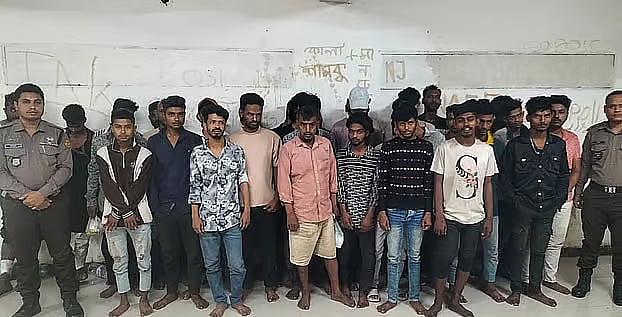
On 25 February, ahead of Eid, a special coordinated raid led to the arrest of 95 individuals from different areas under the two stations.
The following day, 26 February, an additional 38 people were arrested from Geneva Camp in Mohammadpur. Furthermore, the Rapid Action Battalion (RAB) arrested 10 more individuals in connection with extortion, mugging, and assault cases.
Speaking on the difficulty of curbing crime despite arrests, Rakibuzzaman Talukdar, Inspector (Investigation) of Mohammadpur Police Station, told Prothom Alo that many individuals are repeatedly arrested and, after obtaining bail, resume the same criminal activities.
If this cycle continues, crime in the area cannot be effectively controlled, he warned.
Additional Deputy Commissioner Jewel Rana emphasised that special initiatives are required to manage crime in this area.
He noted that a significant proportion of the local population survives through illegal activities, and thus merely making arrests or filing cases will not suffice.
Comprehensive and targeted measures beyond the jurisdiction of just two police stations are necessary, he stated.