Governments change, buses don’t
Enayetullahs exit, new controllers take over Dhaka’s old buses
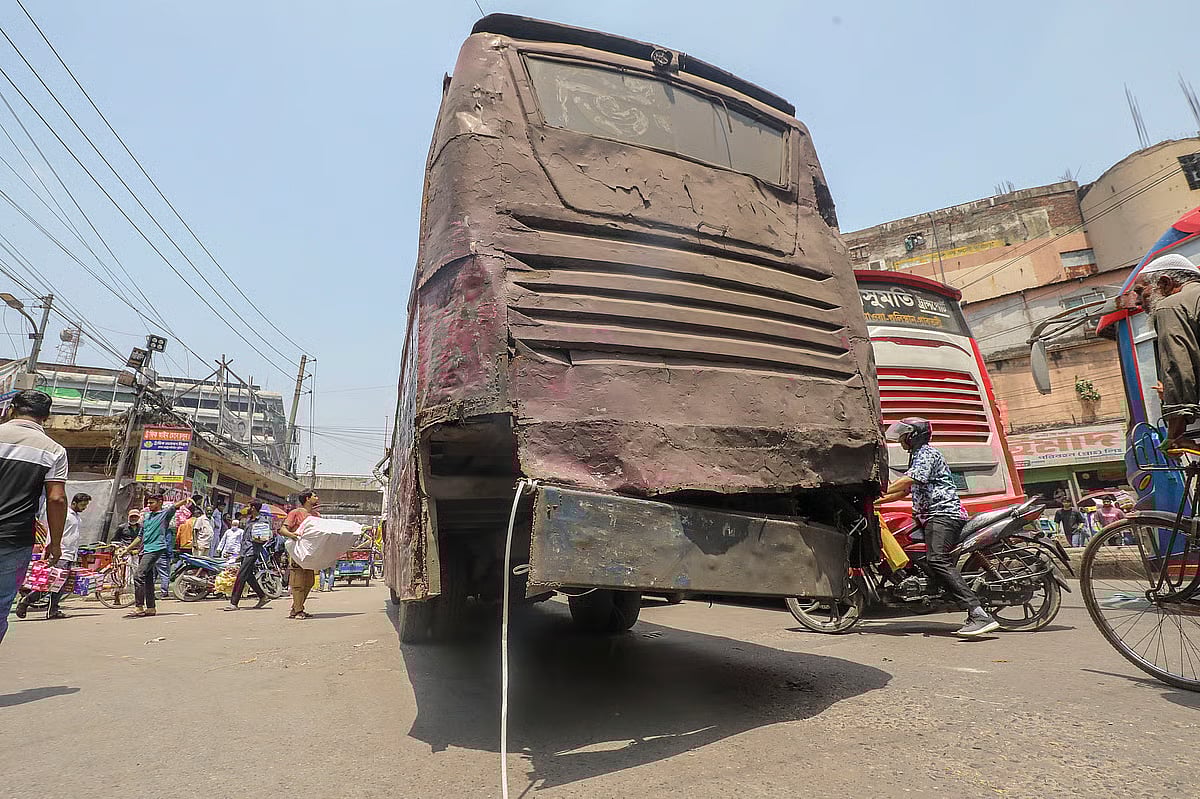
The bus was passing through Karwan Bazar in Dhaka. At a glance, it was clearly very old—dilapidated, paint peeled off, rust all over.
I boarded the bus (15 March, 2026). After getting on, I saw the seats were greasy. Instead of 41 seats, 46 had been installed. Even then, none were empty. I had to stand.
The driver’s assistant on the bus is named Saddam Hossain. He said they pay Tk 4,500 daily to rent the bus. After fuel and route expenses, whatever remains is shared among him, the driver, and the fare collector. It was clear that no matter how old the bus is, the owner’s income is not small—and it never decreases.
The bus’s registration number is Dhaka Metro-Ba-11-3335. I checked with the regulatory authority, the Bangladesh Road Transport Authority (BRTA). An official of the relevant department said the bus, belonging to Shikor Paribahan, operates from Mirpur to Jatrabari. Its route permit has expired. Its fitness certificate has also expired. The bus was manufactured in 2006—meaning it is 20 years old. By now, it should have ended up in a scrapyard. But under the “shadow” of politics, it continues to run freely on Dhaka’s roads without any obstruction.
According to BRTA data, 30 per cent of buses and minibuses registered in Dhaka have exceeded their service life. BRTA exists to ensure these buses do not operate on the roads, and there is traffic police as well—but old buses are still operating. There are allegations that they continue operating because of regular bribes, and no one stops them on the road.
A study published in March 2024 by Transparency International Bangladesh (TIB), an anti-corruption organisation, found that Tk 10.59 billion is collected annually in extortion from privately owned buses. Shares of this money go to individuals affiliated with political parties, police, BRTA officials, and others. The study also found that about 92 per cent of the country’s major bus companies are linked to politicians. Of these, 80 per cent were connected to the then-ruling Awami League.
Efforts to remove old buses from Dhaka’s roads began about a decade and a half ago. The Awami League government could not succeed, as its own leaders were the owners and controllers of those buses. They resisted any government initiative. As a result, during the party’s 15 years in power, people had to travel in old buses while paying higher fares.
After the fall of the Awami League government on 5 August, 2024, following the July mass uprising, there was hope for change. But the interim government has not been seen taking strong action. Meanwhile, control of the bus transport system has shifted into the hands of BNP leaders.
New controllers
According to BRTA, there are about 7,000 approved buses in Dhaka, operating under around 300 companies, with at least 4,000 owners. These buses operate in a largely informal manner.
Owners sometimes rent buses directly to workers or companies on daily written or verbal contracts. Regardless of earnings, owners receive a fixed daily amount. Sometimes companies hire workers to operate buses, paying them fixed amounts depending on the route. In other cases, workers rent buses daily, pay a fixed amount to the company, and keep the rest of the earnings.
Sources say that since most buses lack fitness certificates and route permits, owners place them under companies run by influential figures to avoid being caught by police.
Bihanga Paribahan, which operates from Mirpur to Sadarghat, is one such company. During the previous Awami League government, its managing director was Pankaj Debnath, then president of the Jubo League and a former MP. After the government’s fall, he went into hiding. Now the company is controlled by Mezbah Uddin, president of Ward No. 13 of Dhaka North BNP. He has also become the member secretary of the Bihanga Bus Owners Association. Old, dilapidated buses under the name of Bihanga Paribahan are still operating in Dhaka.
Mezbah Uddin told Prothom Alo that the association is being run by a nine-member committee. He claimed that during the Awami League period, he owned one bus in Bihanga Paribahan and was a general owner. Now he has assumed leadership.
Previously, Basumati Paribahan, operating from Gabtoli to Abdullahpur, was controlled by Khandaker Enayet Ullah, former general secretary of the Dhaka Road Transport Owners Association. The company still exists, but leadership has now shifted to another individual named Saidur Rahman.
Changes have occurred not only in bus company control but also in associations. The Bangladesh Road Transport Workers Federation, the top organisation of road sector workers nationwide, was previously led by Awami League presidium member Shajahan Khan, who is now in prison. The organisation is now headed by BNP labor wing vice chairman Abdur Rahim Box, with Humayun Kabir Khan as general secretary.
During the Awami League era, the transport owners’ association was led by party leader Khandaker Enayet Ullah. Now BNP-aligned Saiful Alam is in charge. He told Prothom Alo that after the fall of the Awami League government, chaos emerged as pro-government transport leaders fled. They are now trying to restore order and have not interfered with ownership.
Regarding expired and unfit buses, he said removing all old buses at once would create a vacuum. New buses must be introduced before removing old ones, requiring government loan support. He also emphasised shifting to a franchise-based system—meaning a single company with uniform-colored buses would operate on each route.
Repeated decisions, repeated retreats
According to BRTA, a total of 16,198 buses and minibuses currently operating in Dhaka have exceeded their service life. There are around 54,000 registered buses and minibuses, meaning about 30 per cent are over 20 years old. A large portion operates on long-distance routes but is registered in Dhaka or nearby districts, making the actual proportion in the capital even higher.
Officials say the number of expired vehicles increases daily as more reach the limit. Vehicles without updated fitness certificates are not even included in this count. Nationwide, out of 86,338 buses and minibuses, 41,168 operate without updated fitness certificates—nearly half.
Efforts to remove expired vehicles began in 2010 when buses older than 20 years and freight vehicles older than 25 years were banned in Dhaka. Similar announcements followed, including an executive order in 2015. None were successfully implemented.
On 29 July, 2018, two students—Abdul Karim Rajib and Diya Khanam Mim—were killed by a Jabal-e-Noor bus on Airport Road. Their deaths sparked a nine-day student movement demanding road safety. Among their key demands were banning unfit vehicles and unlicensed drivers. Despite promises by Awami League, little did change.
In May 2023, the economic lifespan of buses was officially set at 20 years nationwide, but enforcement failed due to resistance from transport owners and workers.
BRTA sources said the government at the time refrained from action ahead of the national election to avoid unrest.
“I will make it happen”— but he couldn’t
Former Dhaka North mayor Anisul Huq initiated a plan in 2015 to introduce 4,000 new buses under a route-based company system. He died in 2017 before implementation. His successor Mohammad Sayeed Khokon made little progress.
In 2020, Sheikh Fazle Noor Taposh and Atiqul Islam took charge of Dhaka South and North respectively. Taposh led the route rationalisation committee and once declared,
“This anarchy will not continue holding the Dhaka residents hostages. I will make it happen.” In December 2021, Dhaka city service bus was started on Keraniganj-Ghatarchar route, but the initiative did not last.
What did the interim government do?
After taking office, the interim government reinstated earlier rules and gave six months for removing old vehicles, promising support for purchasing new ones. No action followed.
When the deadline expired in May 2025, BRTA announced enforcement from 1 July, but it was delayed under pressure. A one-week operation began on 20 July but stopped after transport groups called a strike.
Eventually, expired vehicles were effectively allowed to continue operating.
As the bus owners and workers called a strike, the government sat with them on 10 August. The strike was called off, but the transport groups continue operation of old buses. The BRTA’s drive effectively came into a halt.
Adviser Muhammad Fouzul Kabir Khan said they tried but faced time constraints and pressure from protests and strike threats. Some measures, like seizing expired buses and installing traffic signals on select routes, were implemented.
What damage do old buses cause?
According to the 2016 Revised Strategic Transport Plan (RSTP) for Dhaka, 72 per cent of daily trips in the capital are made by bus and minibus. No updated survey has been conducted since.
Experts say the problems of old buses and the lack of order in the system can be broadly divided into three categories.
First, citizens are deprived of comfortable and safe bus travel. Fare disputes are common and sometimes turn into physical altercations.
Women are regularly harassed. As a result, many are forced to switch to auto-rickshaws or ride-sharing services, increasing their transport costs.
A female employee of a private organisation, speaking anonymously to Prothom Alo, said boarding buses in Dhaka is difficult in itself. She said bus assistants often touch passengers inappropriately while boarding, and it is unsafe for women to travel by bus after evening. Because of this, she has stopped using buses and now travels by auto-rickshaw even if it costs Tk 150 instead of Tk 20.
Second, environmental pollution. According to the Swiss-based IQAir “World Air Quality Report 2025,” Dhaka ranks second among the world’s most polluted capital cities. A 2019 study titled “Sources of Air Pollution in Bangladesh: Brick Kilns and Vehicles,” under the Clean Air and Sustainable Environment (CASE) project, found that vehicles are responsible for 10.4 per cent of Dhaka’s air pollution. About 84 per cent of buses and minibuses in Dhaka emit black smoke beyond permissible limits.
Third, accidents. Unfit buses frequently cause accidents. Competition among drivers to pick up passengers and reckless driving are major causes.
The father of Diya Khanam Mim, a student who died in 2018, Mohammad Jahangir Fakir, is himself a long-distance bus driver. He told Prothom Alo that after student protests, there was some improvement on the roads, but things have returned to the previous state. He said road disorder has increased and so has the death toll. Many buses become so poorly maintained that their condition deteriorates despite repeated repairs, with braking systems failing. Drivers are forced to operate them through sheer force, leading to accidents.
Fare calculation ignores reality
The BRTA determines bus fares based on 12 factors, including vehicle purchase cost, lifespan, maintenance, and repair expenses.
A new city bus is assumed to cost Tk 3.5 million, with a lifespan of 10 years. It is also assumed that each bus will undergo renovation every five years at a cost of Tk 650,000. Fares are calculated based on these assumptions.
However, such new buses are rarely seen in Dhaka. Most buses are dilapidated, faded, and damaged with torn seats. Legally, buses in Dhaka can operate for up to 20 years, yet fares are set based on a 10-year model—meaning buses aged 11–20 years still charge the same “new” fare.
It is also assumed that buses undergo maintenance every 25 days and every three months, costing around Tk 40,000. In reality, this maintenance is rarely done, which is why bus conditions are so poor.
For example, on 12 April, a Meghla Transport bus was seen on the Science Laboratory road in Dhaka with a broken rear body panel. BRTA sources said the bus was manufactured in 2018—only eight years old—yet it had already become dilapidated. If it had been renovated after five years, this condition would not have occurred. Still, it collects high fares by showing maintenance costs on paper.
When asked via phone on 25 April how such buses operate, BRTA Chairman (additional charge) Mir Ahmed Tarikul Omar said mobile courts seize such vehicles when found and instructions have been given to cancel registrations of such old buses. He added that removing all old buses would require political decisions, as replacement buses must be introduced to avoid public suffering.
Chaos enables extortion
In Dhaka, bus passengers are mostly low-income people. Ministers and MPs have official vehicles, government officials also have transport facilities, and many others use project vehicles or subsidised loans (a facility recently stopped). Wealthier residents use ride-sharing services like Uber or auto-rickshaws. Meanwhile, several flyovers have been built and more are under construction.
Transport expert and BUET civil engineering professor Md Hadiuzzaman told Prothom Alo that Dhaka’s buses cannot be considered proper public transport. Their condition and structure are both poor. He said buses remain the backbone of Dhaka’s transport system and will continue to be so even with metro rail and flyovers. However, past governments invested heavily in large infrastructure without fixing the bus system first, which he called a fundamental mistake.
He added that bus route rationalisation or franchise systems remain the solution, but past city mayors held repeated meetings instead of implementation. Pilot projects were launched, but according to him, their purpose was effectively to ensure failure, because disorder in the bus sector enables large-scale extortion. Once order is established, such income disappears.
BNP’s election manifesto promises discipline and safety in public transport, along with integrated smart management and bus route rationalisation.
On 10 April, while standing in a Shikor Paribahan bus from Shewrapara (when metro service was closed), a passenger named Rafiqul Islam said regarding political promises, “Governments come and go; nothing really changes. Let’s see what the new government does.”