Sylhet: ‘Consensus’ on sand plundering
Despite not being designated balumahal, sand is being illegally extracted using dredgers from Bawn Haor in Jaintapur, which is linked to the Piyain River. Furthermore, extensive sand looting continues from the Khashi River flowing through Jaintiapur and Gowainghat, as well as the Noljuri River in Gowainghat Upazila.
Following the fall of the Awami League government on 5 August 2024, local leaders of the BNP and its affiliated organisations took control of all balumahals in Sylhet, just as they had with the stone quarry. Names of leaders from the banned Awami League and Jamaat-e-Islami also appear on the list of accused parties.
Unregulated sand extraction continues relentlessly from Sripur, Rangpani, Jaflong, the protected Bunker area and several other rivers and tourist sites across Sylhet. Just like the indiscriminate looting of stones, sand plundering has now left these beautiful areas disfigured.
Locals state that politically backed syndicates are carrying out the sand looting openly. Although the administration occasionally launches drives, no effective measures are being implemented. Consequently, the region’s natural balance and the very existence of tourist destinations are now under threat.
Tourists once rushed to Sripur and Rangpani daily to admire the beauty of the areas. However, in 1992, Sripur was classified as a stone quarry and placed under lease by the Bureau of Mineral Development (BMD) and in 2013 it was officially gazetted as such. Over time, Sripur began to lose its charm, with a spillover effect on Rangpani as well.
The leasing was suspended in 2020.
Although leasing was suspended, illegal stone and sand extraction continued in Sripur and Rangpani. Following the fall of the Awami League government on 5 August 2024, the situation has worsened. Whereas previously the looting occurred secretly, it is now taking place in full public view.
Comparing present-day Sripur and Rangpani with how they appeared on film four decades ago is almost beyond imagination.
Most of the large stones have already been taken and what remains is being looted vigorously. The once hill-like mounds of sand have vanished. Sand from rivers and nearby char areas is being dug out with spades and shovels, leaving the areas barren and stripped of their natural splendour.
Sripur is situated about five kilometres from Jaintiapur upazila. At the source of Sripur near Mokampunji village, a hilly road runs down to the river.
On Monday afternoon, the water level was visibly low, with heaps of sand piled up around. A few individuals were loading sand from the mounds onto boats. Locals reported that due to an ongoing anti-looting drive in Sylhet for about a week, transport of sand has temporarily slowed down.
Some 15 and 20 people were seen extracting sand in between Rangpani River's Bannon Ghat, Adarsha village and Ward No. 4 of Banglabazar areas. The same scenario was evident in Sripur, where sand was being looted alongside stones.
Environmentalists warn that, apart from Sripur and Rangpani, sand is also being extracted illegally from non-leased sites. There are allegations against some leaseholders themselves, of extracting sand from areas beyond their authorised boundaries. Having already depleted large portions of Sylhet’s tourist sites and protected areas though indiscriminate stone looting, the plunders have now turned to sand.
According to the district administration, Sylhet has 40 designated balumahals, of which 20 are leaseable. Out of these, 15 have been leased for Tk 27.15 million (27 crore 15 lacs), while five have not been leased.
Indiscriminate sand plundering
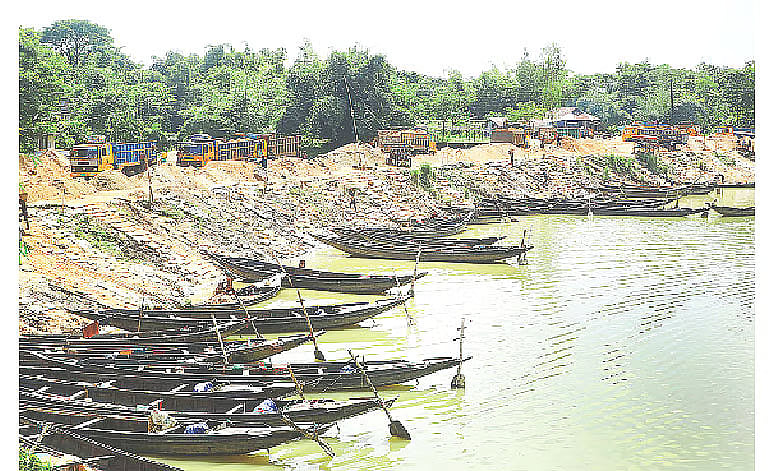
The Jaflong Bridge over the Piyain River in Gowainghat Upazila is approximately 65 kilometres from Sylhet city. Rows of wooden boats and bulkhead vessels are anchored for several kilometres on either side of the bridge.
Some of these vessels were observed stockpiling sand onshore, while others were being loaded from the banks. Labourers were busy transferring the sand onto rows of trucks parked along the riverbank for transportation to different destinations.
On Monday evening in Jaflong, no one was seen extracting sand. However, beside the Jaflong tea estate, more than 50 individuals were observed engaged in sand extraction.
A local resident said that due to fear of the ongoing drives, no one was currently extracting sand or stones, although indiscriminate looting had taken place even just a week and a half ago. Since 5 August last year, sand worth Tk 100 to 150 million has been looted from the Jaflong area alone.
When contacted, Gowainghat Upazila Nirbahi Officer (UNO) Ratan Kumar Adhikari stated that previously thousands of boats were involved in large-scale sand and stone plundering. However, due to the continuation of expedition, the situation had almost been brought under control.
He affirmed that no unauthorised sand extraction would be permitted.
While travelling by motorcycle from the ferry ghat area to the Lalakhal tourist spot, several hundred sand-laden boats were found heading in the direction of the Borgang River between 2:15 pm and 2:45 pm on Monday.
This correspondent boarded a boat from Lalakhal and travelled to the source of the Borgang River. This site is a leased sandbank, with Lalakhal marking the point of origin.
Just prior to the official boundary of the leased area, a bulkhead was anchored, where several labourers were seen extracting sand from the river. Evidence of sand being dug out from the riverbank was also visible.
Upon entering the leased section of the Borgang River, approximately 30 to 35 individuals were observed seated on tarpaulin sheets laid beneath a canopy erected on the riverbank.
One of them, Abdul Mannan, stated that although the balumahal had been leased under a single person’s name, there were in fact 20 to 30 partners including himself involved.
Abdul Mannan claimed that labourers of one boat had mistakenly extracted sand from outside the leased area.
He added that they had been instructed not to return to that location and were being immediately recalled.
He further asserted that, aside from this incident, they were not permitting sand to extraction from any unauthorised site.
Local residents, however, suggested otherwise, stating that due to the ongoing drives and the current high water level, extraction from unauthorised sites had temporarily decreased. Once the water recedes, there is concern that sand extraction may resume as far as Lalakhal.
From September to February last year, following the fall of the Awami League government on 5 August, large-scale looting had taken place, during which sand worth Tk 20 to 30 million (2 to 3 crore) was plundered.
Commenting on the matter, Jaintiapur UNO George Mitra Chakma stated, “Sand extraction from unauthorised areas will not be permitted. We are conducting regular taskforce operations and taking necessary action. Several balumahals are currently under litigation in court. In these sites, sand extraction is prohibited. However, whenever we receive reports of unauthorised extraction, we immediately conduct drives.”
Discussions with locals revealed that despite not being designated balumahals, dredgers were being illegally used to extract sand from Bawn Haor in Jaintiapur, connected to the Piyain River.
Additionally, widespread sand looting continues from the Khasi River flowing through Jaintiapur and Gowainghat, as well as the Noljuri River in Gowainghat Upazila. After being looted from various sites, sand is transported by boat and often anchored at the river terminal in Gowainghat Upazila town.
Much like the stone trade, a syndicate has now formed around sand looting in Sylhet. Following the fall of the AL government on 5 August 2024, local leaders of the BNP and its affiliated organisations assumed control of all balumahals, just as they had taken control of the stone quarry.
Names of leaders from the banned AL and Jamaat-e-Islami also appear among the accused. Prior to the government’s fall, the AL leaders had exercised sole control over these sites. At present, sand looting is being conducted through a form of political consensus.
Reports suggest that Jaintiapur Upazila BNP Vice-President Abdul Ahad, Vice-President Alamgir Hossain, Jaintiapur Union Jamaat Amir Nurul Islam and Jaintapur Union Jubo Dal General Secretary Dildar Hossain are leading groups involved in sand extraction from Shreepur and Rangpani rivers.
Before 5 August last year, the plundering of sand and stone from Shreepur and Rangpani rivers was allegedly facilitated solely by Jaintapur upazila Awami League Organising Secretary Abdur Razzak (alias Raja). BNP leader Ahad, one of the accused in the looting, is reported to be Razzak’s brother-in-law. Following the change of government, Razzak reportedly went into hiding.
When contacted, several leaders of the political parties named in connection with the looting denied any involvement. BNP leader Abdul Ahad said, “I left the stone business in 2018. Whoever has made these allegations against me, they are not correct. I have no involvement whatsoever.”
BNP leader Alamgir Hossain also denied allegations of involvement in sand extraction.
Similarly, Jamaat leader Nurul Islam rejected the accusations stating, “I have not been involved in the stone trade since 2016. With leasing suspended, the question of participating in any illegal business does not arise. A certain vested quarter is deliberately spreading false propaganda against me. In the past I contested the chairman election and I intend to do so again in future. That is likely the reason behind this campaign against me.”
Locals, however, expressed a different view. They alleged that leaders from nearly every political party were involved in indiscriminate sand looting from suspended stone quarry, tourist sites, sandbanks and various rivers.
Furthermore, since 5 August 2024, large-scale sand plundering has occurred in Jaflong, Ballaghat, Jaflong Tea Estate, Lalakhal, Shreepur, Rangpani, Bholaganj stone quarry in Companiganj, the protected Bholaganj area and more recently the Sada pathor tourist site. They further alleged that the local administration had taken no meaningful action to prevent it.
Sources indicated that Sreepur and Rangpani had long flourished in their natural splendour as scenic landscapes.
Responding to sand extraction matter, Sylhet Deputy Commissioner Mohammad Sher Mahbub Murad (who was transferred last Monday as Officer on Special Duty) stated that the administration had regularly taken action against illegal sand and stone extractors.
He added that joint security forces had now launched operations, which had significantly curbed the looting.
However, neither the district administration nor any government or non-governmental organisation could provide information on the exact quantity of sand looted in Sylhet.
Multiple local sources estimated that sand worth Tk 600 to 700 million (60 to 70 crore) had been looted over the past year. At present, the wholesale price of sand stands at Tk 50 per cubic foot.
Abdul Karim Chowdhury, Member-Secretary of Dhoritri Rokhhay Amra (DHORA) Sylhet, expressed grave concern over the indiscriminate looting of sand from rivers, balumahals and tourist sites.
He told Prothom Alo, “Following the fall of the Awami League government, sand looting began alongside stone looting. We even organised programmes demanding an end to such destructive practices, but the local administration took no meaningful steps to prevent them.”
He further stated, “The so-called drives have been nominal and have not stopped the extraction. Due to the absence of strict legal measures, looters have been emboldened and sand extraction has increased manifold. Consequently, as with stones, sand too has been plundered on a massive scale. Stronger legal actions are now essential to protect what remains.”