Crime
Extortion in silence: Shahbagh traders face clandestine attacks, abductions if payments refused
“I have been doing politics for so many years. Should I now starve? Brother, I have now become like a rabid dog in the month of Srabon. Just assume I have gone mad. When someone goes mad, he spares nobody.”
These remarks were made by Taskin Gazi, who has been accused of dominating the pharmaceutical business in Shahbagh in the capital. Although he holds no official position, he introduces himself either as a leader of Jatiyatabadi Chhatra Dal (JCD), or the Bangladesh Nationalist Party (BNP).
After the recent political change, several similar figures centred around Shahbagh have emerged. Allegations suggest they have formed multiple groups to control pharmacies and other businesses in the area while carrying out what traders describe as “silent extortion.”
Victims allege that these groups collect money from business owners both as one-time payments and on a monthly basis at fixed rates. If the extortion money is not paid, shop employees are threatened, abducted and forced to pay money. In some cases, attacks and robberies have also taken place.
Separate extortion groups are also active around ambulances, the ICU of Bangladesh Medical University, various stall on pavement and the flower market.
Most recently, on 27 February, a pharmaceutical employee at Paribagh Supermarket was secretly attacked after failing to pay extortion money. The attackers beat him indiscriminately with iron rods, injuring him and snatching Tk 52,000 in cash and a mobile phone worth about Tk 25,000.
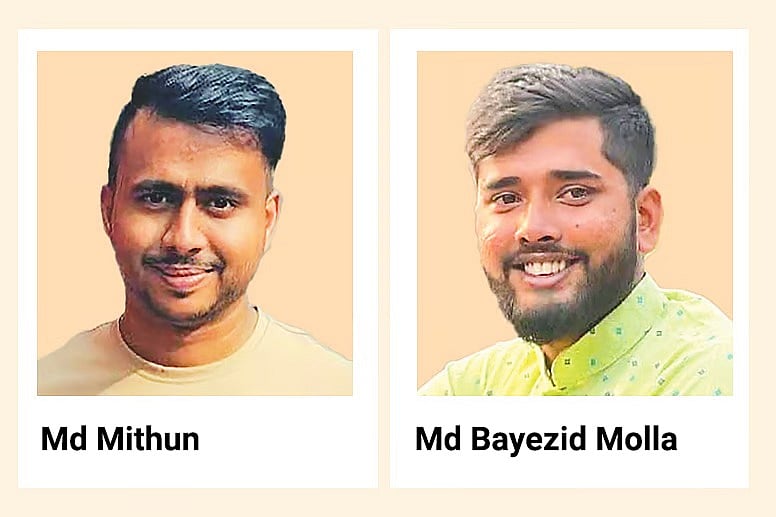
Traders allege that two men identifying themselves as JCD leaders, Md Mithun and Md Bayezid Molla, had earlier demanded Tk 100,000 from that shop. A case has been filed with Shahbagh police station over the incident.
Following this incident, Prothom Alo spoke with 10 traders from Aziz Super Market, Shahbagh medicine Market, Biponibitan Medicine Market, Paribagh Chand Mosque Market and Paribagh Supermarket.
They said that after the fall of the Sheikh Hasina government during the mass uprising on 5 August 2024, some local individuals began creating trouble in the area. Many businesses were locked, and owners could only reopen after reaching understandings with various parties.
One such victim is the owner of Shahbagh Medicine Corner in Paribagh Supermarket. The establishment’s manager, Md Mohiuddin, told Prothom Alo that around 10:00 am on 6 August 2024, a man named Md Mithun—who identified himself as a JCD leader—came and locked the shop. He was only able to reopen it on 8 August after contacting local leaders.
Allegations of extortion, attacks and control over the medicine trade in this important healthcare-related area of the capital have raised concern. Victimised traders say effective monitoring by the authorities is needed to break this network.
Traders say no one speaks openly about these issues out of fear that their businesses might face trouble. They quietly pay the fixed monthly amounts. Some have also paid lump-sum amounts.
Monthly collections at fixed ‘rates’
Wihsing not to be named, several traders in Shahbagh said each shop has to pay a fixed monthly amount, which they refer to as a “rate.” Most shops pay around Tk 10,000 per month in extortion. In some cases, traders previously associated with the Awami League are asked to pay higher amounts.
Speaking with victims, the names of Md Mithun, 28, and Md Bayezid Molla, 28, emerged as those who collect such payments. Traders say both introduce themselves as followers of Md Akhtar Hossain, vice-president of the Dhaka city east unit of Jatiyatabadi Chhatra Dal.
Mithun and Bayezid have repeatedly threatened us demanding extortion money. When they did not get it, they beat up shop employees. We just want to do business and avoid trouble. That is why we endured everything silently. But now it has reached a point where doing business is becoming difficult.Al-Amin (Ripon), a pharmaceutical trader at Paribagh Chand Mosque Market
Al-Amin (Ripon), a pharmaceutical trader at Paribagh Chand Mosque Market, told Prothom Alo, “Mithun and Bayezid have repeatedly threatened us demanding extortion money. When they did not get it, they beat up shop employees. We just want to do business and avoid trouble. That is why we endured everything silently. But now it has reached a point where doing business is becoming difficult.”
He added that after 5 August 2024, “everyone in this area claims BNP affiliation; no one listens to anyone.”
Four traders said the local group also extorts money in the name of electricity bills. Instead of giving the original electricity bill, they are often made to pay according to handwritten bills, forcing them to pay extra money. However, fearing problems in business, traders do not want to speak openly about the matter.
Some traders claim that a portion of the extortion money also goes to Khwaja Habibullah Habib, a member of the BNP’s Dhaka south city unit. However, they said there is some distance between Habib’s group and the Mithun–Bayezid group.
Khwaja Habib told Prothom Alo, “I come from a Nawab family. Someone may be collecting money in my name, but I do not receive any money. I only say that if anyone takes anything, they should not torture people. Patients or shopkeepers should not be harassed.”
He added, “I have also heard allegations about money being taken. One group controls ambulances and ICU matters, another collects from the pavements, and another from the flower market. Everyone knows money is collected there. The boys divide it among themselves.”
Covert attacks and abductions
According to traders, one tactic used to collect extortion money in Shahbagh is covert attacks. If a trader refuses to pay, either the owner or an employee may be targeted when found alone or called somewhere on a pretext. In some cases, victims have been abducted and released in exchange for money.
I have also heard allegations about money being taken. One group controls ambulances and ICU matters, another collects from the pavements, and another from the flower market. Everyone knows money is collected there. The boys divide it among themselves.Khwaja Habibullah Habib, a member of the BNP’s Dhaka south city unit
On 27 February, Shahbagh Medicine Corner employee Md Riaz Hossain was attacked in the same way after refusing to pay extortion money. A lawsuit was filed with Shahbagh police station over the attack near Bangladesh Medical University (formerly PG Hospital).
The investigating officer of the case, Shahbagh police sub-inspector Md Toufiq Hasan, told Prothom Alo that Bayezid, along with Md Sohan Molla and Mominul Munshi—who were with him during the attack—were arrested from Sakura Lane in Shahbagh on Monday morning. Drives are continuing to arrest the others.
According to the case statement, around 9:45 pm that night an unidentified caller informed the shop that a patient admitted to Bangladesh Medical University needed medicine. When Riaz took the medicines and was heading towards the hospital, seven to eight men including Mithun and Bayezid attacked him under the metro rail station and seriously injured him. At one point, a man named Sohan Molla attempted to strangle him.
Riaz Hossain told Prothom Alo that the attackers had earlier demanded Tk 100,000 in extortion from the shop. When the money was not paid, they carried out the clandestine attack and snatched cash and his mobile phone.
Shahbagh police station officer-in-charge Md Moniruzzaman told Prothom Alo on Friday that the assault incident is being investigated. However, he said he had not heard anything about extortion and that traders had not reported such allegations.
Such covert attacks are not new in Shahbagh. Earlier, on 4 October 2024, Fazle Rabbi, an employee of Brothers Medicine Corner at Paribagh Chand Mosque Market, was abducted from in front of Bangladesh Medical University.
Rabbi said he was taken to Ramna Park where Tk 200,000 was demanded from him; the matter was later settled for Tk 40,000. Traders said Mithun and Bayezid were also involved in that incident.
Brothers Medicine Corner manager Md Jonaed declined to comment on the matter. “These are old incidents. We cannot talk about them now,” he said.
Regarding the allegations, Bayezid Molla told Prothom Alo last Friday that he knew nothing about the 27 February attack. However, he said that after hearing the victim crying on the phone during the earlier Ramna Park incident, he had gone there and the victim was released after paying some money. He said he did not receive any share of that money.
Bayezid claimed he was not involved in extortion. He said he is associated with Chhatra Dal along with Akhtar Hossain but holds no official position.
Repeated attempts to contact Mithun over three days on his phone number were unsuccessful.
Md Akhtar Hossain, vice-president of the Dhaka city east unit of JCD, told Prothom Alo, “Mithun and Bayezid hold no position. They sometimes join our programmes with Chhatra Dal. I have not heard any allegations of extortion against them. We do not support any extortionists. If specific evidence is found, action will certainly be taken against them.”
Syndicate around ICU medicines
There are a total of 39 beds in the intensive care units (ICU) of the new and old buildings of Bangladesh Medical University. Each patient may require medicines costing from Tk 2,000 to Tk 25,000–30,000 per day. ICU beds rarely remain vacant, and many patients often wait for a bed.
A large medicine business revolves around these ICUs. Previously, several shops supplied medicines to the ICU, and relatives of patients could also purchase medicines from outside if they wished.
However, the situation changed after the mass uprising. Some local political activists now decide which shops will supply medicines to the ICU.
Traders allege that Shahidul Islam (Khokon), president of the Jubo Dal’s Ward-21 unit under Shahbagh police station, largely decides which traders can supply medicines to ICU patients. The number of such shops varies—sometimes six, sometimes nine. Each shop owner has to pay Tk 10,000 to Khokon.
Traders also claim that several employees of Bangladesh Medical University and a leader of Shahbagh Thana Chhatra Dal are involved in this supply syndicate.
Khokon’s name also surfaced in a recorded phone conversation with Taskin Gazi, who identifies himself as a BNP leader. In that recording, Taskin is heard advising someone to speak with Khokon to gain control over ICU beds.
When contacted, Jubo Dal leader Shahidul Islam Khokon told Prothom Alo, “There used to be disputes over supplying medicines to the ICU. Later we sat down with everyone and divided the beds. Now about six shops supply medicines there. Everyone, including Khwaja Habib bhai, knows about it.”
Asked about allegations of collecting extortion from these shops, he said, “That is completely false. We only fixed the beds to avoid disorder.”
‘There will be trouble if we talk too much’
There have also been attacks related to control of ICU medicine supplies. Owners and employees of Sundarban Pharmacy at Biponibitan Medicine Market have been attacked three times.
The shop’s owner Mizan Uddin and employee Zahirul Islam (Robin) were first attacked on 19 October 2024. Victims said eight to ten people, including Bayezid and Mithun, were involved.
On 12 January this year, the shop owner Mizan and his younger brother Mohiuddin were attacked again. Later, on 26 February, the shop’s employee Shafiqul Islam was attacked by Taskin Gazi and four to five others, according to the victims.
When contacted, Mizan Uddin told Prothom Alo, “They attacked us three times. After the first incident, I considered filing a case. But later I dropped the idea fearing further trouble. We have to earn our livelihood through business. If we speak too much about these matters, there will be trouble.”
However, Taskin Gazi denied involvement in such attacks or in controlling the medicine trade. He claimed he is associated with Shahbagh Thana Chhatra Dal politics and studies at a college in Barishal. He said he started supplying medicines to the ICU on 15 January with investment from another person.
Asked why he had told medicine traders that he had become “like a rabid dog in the month of Srabon,” Taskin said, “I said that in anger during an argument.”
Allegations of extortion, attacks and control over the medicine trade in this important healthcare-related area of the capital have raised concern. Victimised traders say effective monitoring by the authorities is needed to break this network.