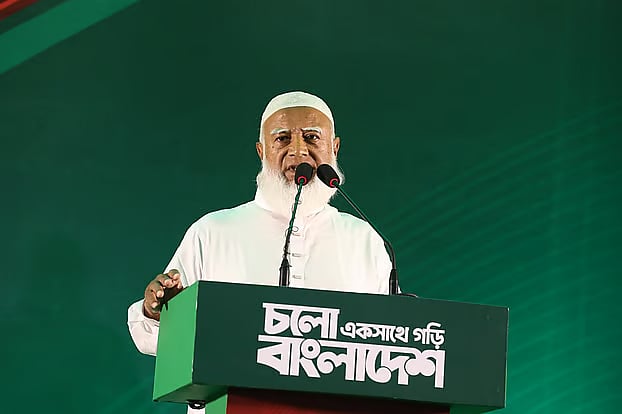
Leader of the Opposition seeks his adviser be appointed to foreign ministry
The Leader of the Opposition in the Jatiya Sangsad (national parliament) and Jamaat-e-Islami ameer Md Shafiqur Rahman, wants his foreign affairs adviser, professor Mohammad Mahmudul Hasan, to be appointed to the Ministry of Foreign Affairs.
He has requested Foreign Minister Khalilur Rahman to place him in the ministry with the status of a minister.
The opposition leader believes that such an appointment would enable the opposition’s foreign policy positions to be presented to and reviewed by the government, while helping maintain “balance” in international relations.
Several policymakers at the Ministry of Foreign Affairs confirmed to Prothom Alo that the foreign minister had received the request from the opposition leader.
Speaking on condition of anonymity, a reliable official said that a letter regarding the matter was sent to the ministry from the opposition leader’s office on 22 February.
However, several former foreign secretaries and professional diplomats say such an appointment has never occurred in Bangladesh. Nor, they note, is there any known example of such a practice in countries in the region.
According to them, in many Western countries, including the United Kingdom, opposition parties play a role through shadow cabinets. In neighbouring India and Pakistan, there have been instances where all political parties have worked together during major crises or special circumstances.
The opposition leader described the proposal to appoint his foreign affairs adviser to the ministry as both “new” and “innovative”.
According to both former and serving diplomats, work within an important ministry such as the Ministry of Foreign Affairs involves a high degree of sensitivity and coordination. In dealing with different countries and international organisations, the ministry operates by balancing three considerations: national interests, the government’s priorities and the interests of the ruling party. In that context, bringing someone from the opposition into the ministry could create complications and disorder.
Request made to the foreign minister
In a letter dated 22 February, sent from the office of opposition leader Shafiqur Rahman to the Ministry of Foreign Affairs, he wrote that professor Mohammad Mahmudul Hasan had been performing diplomatic responsibilities efficiently as his adviser on foreign affairs. He noted that Mahmudul Hasan possesses professional networks and expertise in strengthening relations with other states.
According to the letter, through these networks Mohammad Mahmudul Hasan has been able to enhance bilateral relations on behalf of Jamaat-e-Islami—and for Bangladesh as a state—with organisations and regions including the United Nations, the Commonwealth, the ASEAN, the European Union, as well as countries across Asia, Africa, Oceania, the Americas and Europe.
Appointing someone from the opposition within the government structure could create disorder or additional complications in the ministry’s functioning.M. Humayun Kabir, Former diplomat and president of the BEI
The opposition leader described the proposal to appoint his foreign affairs adviser to the ministry as both “new” and “innovative”. In his view, the appointment of professor Mohammad Mahmudul Hasan would allow the foreign policy positions of the opposition in parliament to be presented to and reviewed by the government, while helping to maintain international balance.
In his letter to Khalilur Rahman, Shafiqur Rahman wrote, “In order to address geopolitical dynamics and manage the country’s foreign policy in a coordinated manner, I recommend this appointment for the government’s consideration.”
Former diplomat and president of the Bangladesh Enterprise Institute (BEI), M Humayun Kabir, told Prothom Alo that governing the state is the responsibility of the government. If the opposition wishes to play a role in foreign policy, it may do so through discussions with the government.
He added that it should also be remembered that the responsibility for running the Ministry of Foreign Affairs rests with the foreign minister.
According to him, appointing someone from the opposition within the government structure could create disorder or additional complications in the ministry’s functioning. Moreover, there is no known precedent for appointing someone from outside the government in this manner.