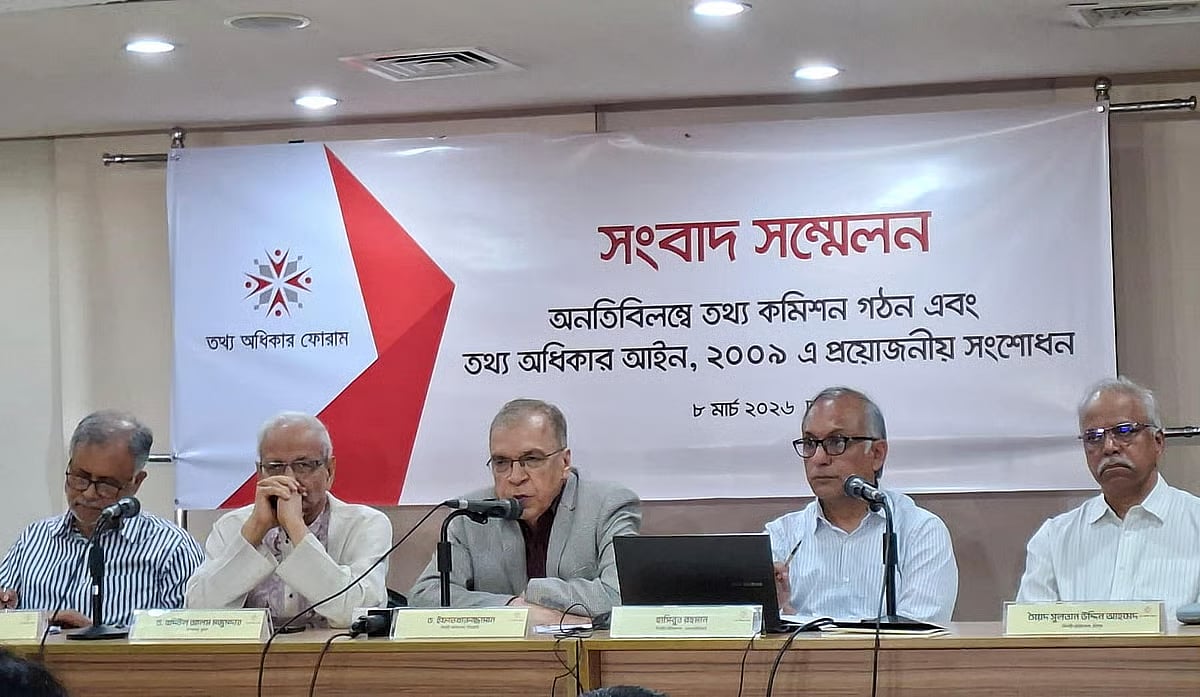
We have seen government decisions made in secrecy: Iftekharuzzaman
The information commission was rendered ineffective during the rule of the Awami League government, and the interim government also failed to set an example in this regard despite having the opportunity, said Iftekharuzzaman, executive director of Transparency International Bangladesh (TIB).
He said, “Perhaps the interim government had something to hide. That is why the entire process remained in darkness. We have seen government decisions being made in secrecy.”
Iftekharuzzaman made the remarks at a press conference at 12:00 pm today, Sunday, in Dhanmondi in the capital.
The Right to Information Forum organised the press conference demanding the immediate formation of the Information Commission and necessary amendments to the Right to Information Act.
Speaking at the press conference, Iftekharuzzaman said that during the tenure of the interim government, decisions in several important sectors of the state were taken without regard for transparency. Therefore, it was not surprising that the government did not allow the Information Commission to be established for one and a half years. However, it is embarrassing that the commission has not been formed despite a legal obligation.
The TIB chief said that for countries with colonial experience, it is not easy to move from a culture of secrecy to a culture of openness.
He said that during the Awami League’s 16-year rule under what he described as a “kleptocratic” system of governance, the Information Commission had been rendered ineffective like many other commissions. However, the governing process of the interim government also lacked transparency, and the formation of the Information Commission had been deliberately delayed until the very last moment.
At the press conference, the Right to Information Forum presented several demands. These include the swift formation of the Information Commission with qualified individuals free from partisan influence.
The forum also demanded that the amendments it proposed to the Right to Information Ordinance issued during the interim government be considered before placing it in parliament, and that the draft be publicised again to gather public opinion.
Shaheen Anam, convener of the Right to Information Forum, delivered the welcome speech at the press conference.
Others who spoke included Badiul Alam Majumdar, secretary of SHUJAN; Syed Sultan Uddin Ahmed, former head of the Labour Reform Commission; Hasibur Rahman, executive director of Media Resources Development Initiative (MRDI); and Zakir Hossain, executive director of Nagorik Uddyog.