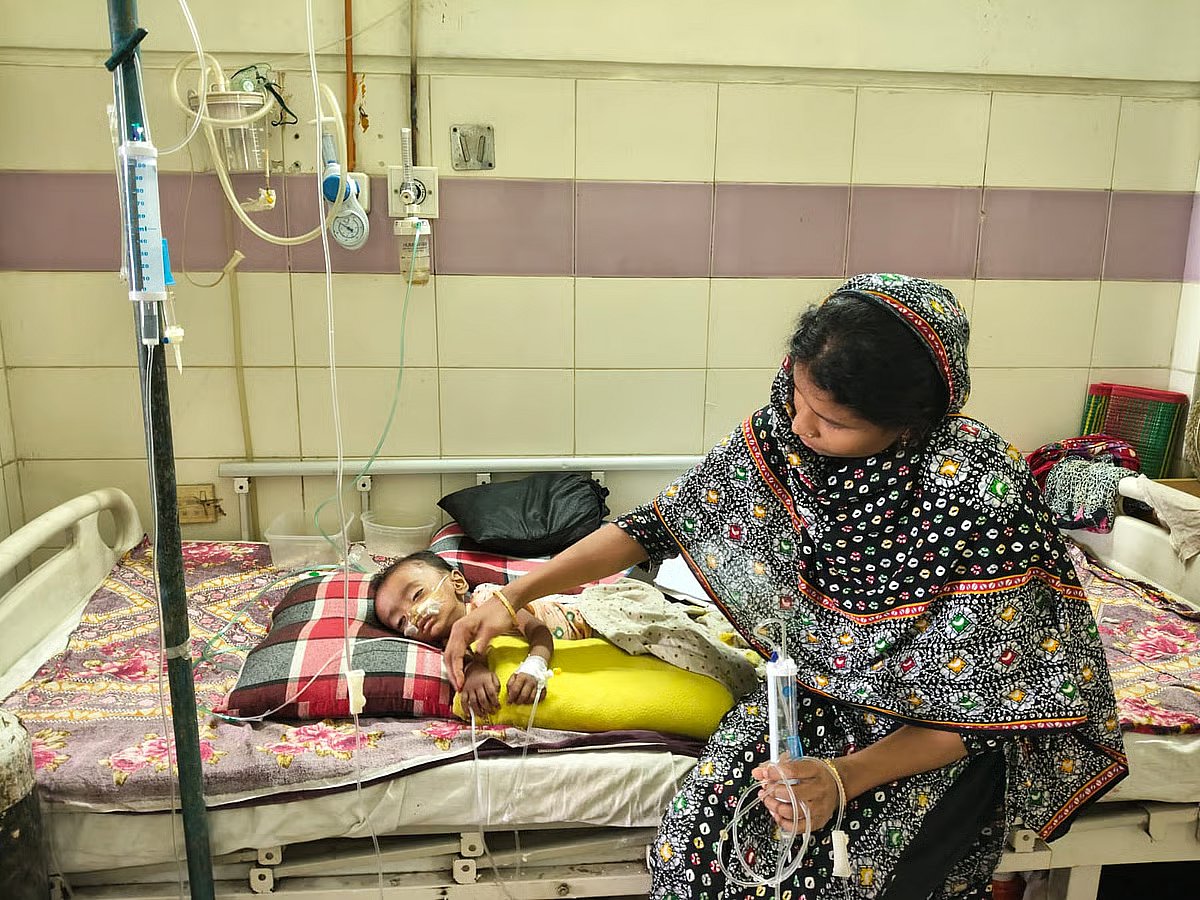
Measles outbreak may persist for another month
Measles has spread to 61 districts across the country, according to data from the Expanded Programme on Immunization (EPI), with 83 per cent of infected children being under the age of five.
The Directorate General of Health Services (DGHS) estimated that the measles outbreak may continue for another one to one and a half months. It said vaccination is already underway in high-transmission areas (hotspots). A nationwide vaccination campaign will begin in three days, on 20 April. In addition, infected children are being treated in isolation.
In this situation, public health experts believe that vaccination, isolation, and public awareness may help reduce the spread of measles.
The current measles situation was presented by the EPI at a workshop titled “Nationwide Measles–Rubella Vaccination Campaign 2026: Role of the Media,” held yesterday, Thursday at the National Institute of Mass Communication in the capital.
It was stated that Bangladeshi children are currently at very high risk of contracting measles. In 2023, 86 per cent of children received the first dose of the vaccine, and 81 per cent received the second dose. Over the past four to five years, the number of unvaccinated or unprotected children has reached or exceeded the number of children born in a single year. Under such circumstances, the outbreak has emerged.
Experts working on newborn health said that around 3.4 million children are born in the country each year. According to EPI data, the number of children who have not received the measles–rubella vaccine is 3.4 million or more.
Speaking to Prothom Alo yesterday, DGHS Additional Director General (Administration) Professor Md Zahid Raihan said, “We have started vaccination in the hotspots. We have arranged for isolation of measles-infected children. Measles is no longer spreading widely. Public health experts have informed us that the outbreak will begin to decline within the next one to one and a half months.”
Public health experts believe vaccination plays a crucial role in preventing measles. Renowned epidemiologist and former director of the Institute of Epidemiology, Disease Control and Research (IEDCR), Professor Mahmudur Rahman, told Prothom Alo, “The nationwide campaign will begin on 20 April. Usually, outbreaks begin to decline within two to three weeks of starting a campaign. If the vaccination programme is properly implemented, it is expected that the outbreak will subside.”
EPI says measles can affect people of any age, but its prevalence, complications, and mortality are higher among children. Complications of measles include pneumonia, diarrhoea, malnutrition, encephalitis, visual impairment, and hearing impairment.
Measles situation and vaccination programme
In a press release yesterday afternoon, the DGHS Integrated Control Room reported that in the last 24 hours (from 8:00 am on 15 April to 8:00 am on 16 April ), 92 new measles cases were identified nationwide. During the same period, two people died from measles, and six others died with measles-like symptoms.
The first measles case this year was detected in the Rohingya camps in Cox’s Bazar. According to the Integrated Control Room, a total of 3,065 measles cases have been identified nationwide so far. Meanwhile, 172 people have died with measles symptoms, and 34 have died from measles. The highest number of infections and deaths has been recorded in Dhaka Division.
Following the outbreak, measles–rubella vaccination began on 5 April in 30 upazilas and 13 municipalities across 18 high-risk districts. From 12 April, vaccination started in four city corporation areas and will continue for four weeks. From 20 April, vaccination will begin in all upazilas, districts, municipalities, and city corporations across the country and will continue for four weeks.
EPI has stated that all children aged 6 months to 59 months (under five years) will receive one dose of the measles–rubella vaccine. Even if a child has previously received the vaccine or has already been infected with measles or rubella, all children within this age group will receive one dose.
Vaccination will be provided at nurseries, kindergartens, Ebtedayee madrasahs, maktabs, orphanages, and child care centres. Students under five years of age in these institutions will be vaccinated. Additionally, children who do not attend school or who miss vaccination at school will receive vaccines at their local routine immunisation centres.
During the campaign, one permanent vaccination centre will be operated at each upazila hospital, municipality, city corporation hospital, and in each ward of city corporations. These centres will remain open every day except Fridays and public holidays. Routine immunisation services will also continue from these centres during the campaign.
EPI has said additional centres will be set up for vulnerable children and those in remote areas. These include children accompanying mothers at shops or markets, factories, rice mills, children from nomadic communities, street children, children staying with mothers in hospitals, children in prisons with their mothers, children in brothels, and children in slums. Vaccination at these additional centres will be provided at convenient times (afternoon or evening), while all other centres will operate from 8:00 am to 3:00 pm.
Bangladesh falls behind
Officials from UNICEF, the World Health Organization (WHO), and DGHS attended the workshop held at the National Institute of Mass Communication. It was stated that Bangladesh had set a target to eliminate measles by December 2026.
Elimination means that there would be no transmission of measles from one person to another within a year. If such a situation continued for two consecutive years, Bangladesh could have been recognised as measles-free by the WHO. However, due to the ongoing outbreak, this target has not been achieved.
At the workshop, a journalist asked how long it would take Bangladesh to reach elimination status again. No response was provided by WHO or UNICEF representatives. Binod Kumar, Regional IVD (Immunization and Vaccine Development) Coordinator for WHO South-East Asia, said that alongside the measles–rubella campaign, Bangladesh must continue its routine immunisation programme properly. If vaccination is carried out effectively, children will remain protected.
EPI also noted that due to Bangladesh’s high population density, the measles virus spreads rapidly. The high birth rate and relatively low vaccination coverage have prevented the development of sufficient immunity against measles and rubella.
The 2020 measles–rubella vaccination campaign significantly reduced the outbreak. However, surveillance data show that measles cases have been increasing since 2021, with a sharp rise in 2026. Age analysis shows that between 2023 and 2026, 80 per cent of infected individuals were under five years old.
Chief guest at the event, DGHS Additional Director General (Planning and Development) Professor Fowara Tasmin, said, “Child deaths from measles were not expected. We have taken the matter seriously. We have taken necessary measures to control the infection.”