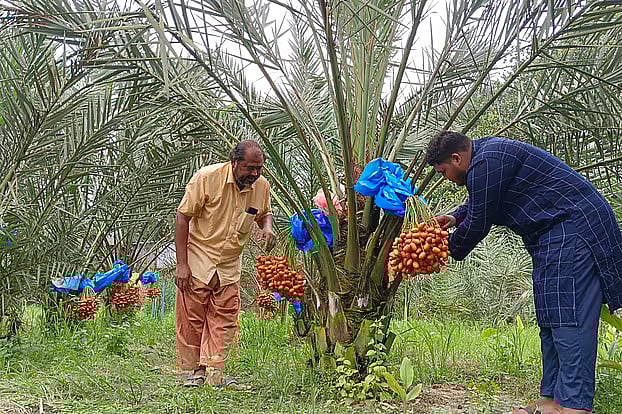
Mymensingh farmer Motaleb
Date palm grove: Generations can live on it
While working in a date palm grove in Saudi Arabia, Abdul Motaleb brought back some seeds to Bangladesh. Inspired by his experience, he began cultivating his own date palm orchard. After overcoming initial setbacks, he eventually found success a few years later. According to Motaleb, his grove now earns him over Tk 5 million (50 lakh taka) annually. His success has also inspired several locals to take up date farming.
Abdul Motaleb is a resident of Paragaon village in Habirbari Union, Bhaluka upazila of Mymensingh. In search of a better livelihood, he went to Saudi Arabia, where he worked in a date grove from 1998 to 2001. Toward the end of 2001, he returned home with a plan to start date cultivation himself. He brought back around 35 kilograms of high-quality date seeds, which he planted on 70 decimals of land in his yard, growing 275 saplings.
Currently, Motaleb owns a 7-bigha date palm grove with over 3,000 trees. His orchard includes premium varieties such as Ajwa, Sukkari, Amber, Lipjell, and Maryam, all originally from Saudi Arabia.
Last Wednesday, during a visit to Abdul Motaleb’s date palm grove, it was observed that various types of dates were hanging from the trees throughout the orchard.
Motaleb shared that he sells: Ajwa dates at Tk 3,000 per kg, Sukkari at Tk 1,000 per kg, Amber at Tk 2,500 per kg, Lipjell at Tk 4,500 per kg, and Maryam dates at Tk 600 per kg
In addition, he also sells date palm saplings. Each cutting-grown sapling sells for between Tk 15,000 and Tk 200,000 while saplings grown from seeds sell for between Tk 500 and Tk 10,000.
Abdul Motaleb said: “I never had formal education. I worked in agriculture here in Bangladesh and continued doing so when I went to Saudi Arabia. While working in a date grove there and tasting the dates, I thought—if I could grow these in my own country, my life would be meaningful, and I wouldn’t need to go abroad again.
In 2001, when I returned home, I brought back 35 kilograms of seeds, from which only 275 trees could be grown. After 18 years of experimentation, I was able to identify 7 female (fruit-bearing) mother trees—the rest were all male.
I cut down the male trees and began propagating new saplings from the female trees through cuttings.
Now, the state of my grove is such that fourteen generations after me could live off it. My children won’t have to struggle anymore.
The orchard now only contains female trees, and the dates produced here perfectly match the taste and aroma of those grown in Saudi Arabia.”
Alongside his father, Motaleb's son, Mizanur Rahman, is also involved in managing the date palm grove while continuing his studies. Together, the father and son have established a new orchard on 8 bighas of land with around 8,000 trees, crossing local and foreign varieties of date palms to cultivate trees specifically for sap extraction. They plan to use this sap to produce date molasses (gur).
Mizanur Rahman, a first-year honors student, said: "I started working with my father in the grove in 2023. I’ve learned how to propagate new saplings through cuttings. Additionally, I’ve developed a new variety by crossing local and Saudi date palm trees, which is capable of producing a large amount of sap."
Inspired by Motaleb's success, many locals have also started date palm cultivation. Entrepreneurs from various regions visit his orchard almost daily to gather information and buy saplings.
Right next to Motaleb’s grove, Afaz Pathan began his own orchard in 2008. He said: "I learned cultivation techniques from Motaleb and now manage 10 acres of orchards in four locations. The yield has been very good, and I earn Tk 2 to 3 million (20–30 lakh) annually. Educated but unemployed youth could transform their lives by starting their own date palm orchards."
Shafiullah Ansari, a visitor to the orchard, said: “The dates produced here are comparatively larger and tastier. Currently, Saudi dates have to be imported to meet domestic demand. But if this type of cultivation expands within the country, import dependency will decrease, and farmers will benefit.”
Mizanur Rahman, additional agriculture officer of Bhaluka upazila, said he provides advice on cultivating Saudi date varieties.
“Date palms are relatively disease-resistant. We regularly provide guidance to such entrepreneurs. However, we currently can't offer direct support to date orchards under any specific government project.
If the government brings farmers under incentive-based projects, it would benefit them and encourage more to take up date cultivation," he added.
This past Wednesday afternoon, Mokhter Ahmed, the divisional commissioner of Mymensingh, visited the date orchard. He remarked: “Motaleb worked in Saudi Arabia and brought back technical knowledge, which he applied to farming on home soil. The idea of expanding Saudi date cultivation and supporting entrepreneurs through incentives will be proposed in a cabinet meeting.”