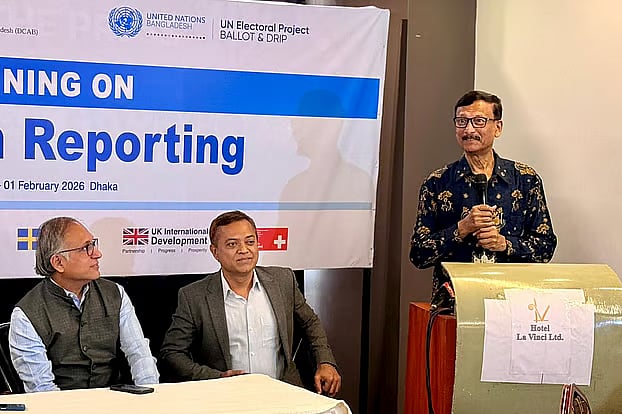
More than 55pc of voters will turn out in the election, hopes Touhid Hossain
Foreign advisor Md Touhid Hossain believes that more than 55 per cent of voters will turn out in the 13th National Parliamentary Election on 12 February.
He made this remark on Sunday in response to journalists’ questions at the closing session of an election-focused training workshop held at a hotel in Dhaka.
The two-day workshop was organised for members of the Diplomatic Correspondents Association Bangladesh (DCAB) with support from MRDI.
When asked whether the government would be able to conduct the election smoothly amid reports that Awami League leaders in India were campaigning for a ‘No’ vote in the referendum, the advisor said that many were campaigning for ‘No’ without fully understanding the issue.
He added that the government clearly wants the ‘Yes’ vote to succeed.
He noted that the government has spent over a year preparing reform proposals through various commissions and intends to implement them. Regarding the ‘Yes’ and ‘No’ votes, parties such as Jamaat, NCP, and a few others campaigned in favour of ‘Yes’. There was some ambiguity regarding the BNP: a few local leaders spoke in favour of ‘No’, while a few central leaders supported ‘Yes’, although their voices were not very strong.
“I am saying this as an individual, not as a minister or as an advisor. But I believe that confusion has now been cleared, because yesterday the BNP Chairman spoke strongly and firmly in favour of the ‘Yes’ vote,” said Advisor Touhid Hossain.
The Foreign Advisor believes that people will not vote after carefully considering four different conditions. On this, he said, “There isn’t enough time, nor the opportunity. In reality, they will vote along party lines. If my party supports ‘No’, then I will vote ‘No’. If my party supports, I will vote. The three or four main parties are all in favour of ‘Yes’. So I don’t think this will be a major problem.”
Acknowledging that some people may abstain from voting this time, Touhid Hossain said, “That always happens. In every election, some people do not vote. I cannot say whether more people will abstain this time. In the 1991 national election, voter turnout was 55 percent. But I believe that this time, more than 55 percent of voters will turn out.”
When asked whether the election environment was fragile, the advisor said, “I have already told you that no election is completely peaceful. I looked at the 1991 election this morning… I had thought the 1991 election was peaceful. In reality, there was some unrest, and there will be some unrest. Different people will perceive it differently. We cannot let that influence our approach. We are moving forward toward the election as we see fit. The election will take place.”
Regarding the handover of diplomatic passports for himself and his wife, Touhid Hossain said, “Neither my wife nor I have handed over our diplomatic passports. They remain valid. It is very unusual for a Foreign Affairs Advisor or a minister to hand over their passport during their term. Some ministers have done so because they need it for travel. They handed over their passports to make it easier to get visas.”
On the question of foreign interference in the election, the advisor said, “Every country has some traditions, intentional or unintentional. In India, for example, a certain tradition has developed. Here, there is something similar. It has become part of the culture that members of the diplomatic community talk about such matters. A large part of society here wants them (the diplomats) to speak. So I cannot blame them; it is part of the culture.”
When asked about addressing foreign concerns ahead of the election, Touhid Hossain said, “…we are trying to find solutions. We will continue to do our best to address these concerns.”
At the event, Stefan Liller, Resident Representative of the United Nations Development Programme (UNDP), emphasised that journalist safety is crucial for a secure election. He particularly highlighted the importance of ensuring the safety of women candidates and journalists in the digital space.
Other speakers at the closing session included Hasibur Rahman, Executive Director of MRDI, AKM Moinuddin, President of DCAB; and Abu Hena Imrul Kayes, General Secretary of DCAB.