Twenty ordinances issued during the interim government— including the Anti-Corruption Commission Ordinance, National Human Rights Commission Ordinance, Police Commission Ordinance, Prevention and Remedy of Enforced Disappearance Ordinance, and Referendum Ordinance—are not being approved in the current parliamentary session.
Among these, a special committee of the Jatiya Sangsad (National Parliament) has recommended repealing four ordinances, including those on the appointment of Supreme Court judges and the Supreme Court Secretariat.
For the remaining 16 ordinances, it has been recommended that they not be immediately presented in Parliament as bills; instead, they should be reviewed later, strengthened, and then reintroduced as new bills.
On the other hand, 98 ordinances—including the July Mass Uprising (Protection and Liability) Ordinance, which grants indemnity to those involved in the July uprising—have been recommended to be presented in Parliament unchanged as bills.
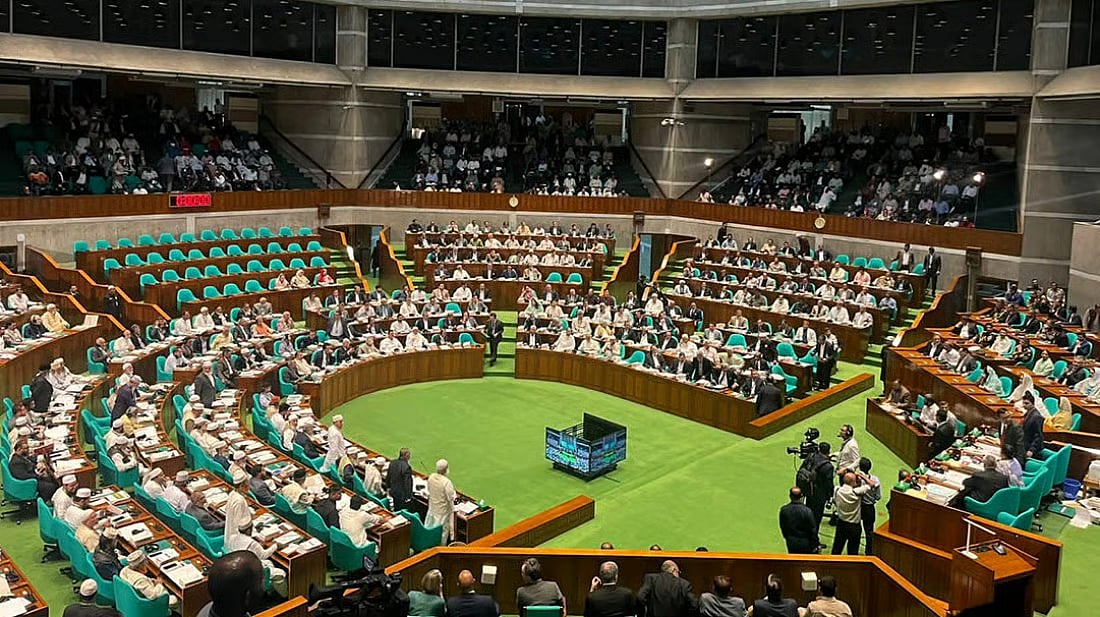
The report of the special committee was presented in Parliament today, Thursday, by its chairman Zainul Abedin.
As per rules, the 133 ordinances issued during the interim government were placed at the first sitting (12 March) of the 13th Parliament. A special committee comprising members from both the ruling and opposition parties was later formed to review them and submit a report.
According to the report, out of the 133 ordinances, 98 are recommended to be placed in Parliament unchanged as bills, and 15 are recommended to be presented in amended form through the relevant ministries. The committee recommended 16 out of remaining 20 not to be immediately presented as bills but reviewed and strengthened before reintroduction, while four should be brought to Parliament for repeal and preservation.
In effect, 20 ordinances issued during the interim government will not be approved by Parliament. As a result, they will lapse after a specified period. The Constitution states that any ordinance must be approved within 30 days of being placed in Parliament, otherwise it ceases to have effect.
Three members of the opposition party Jamaat-e-Islami submitted “notes of dissent” regarding these 20 ordinances.
Four ordinances recommended for repeal
The four ordinances that have been recommended to repeal and preserve are : Jatiya Sangsad Secretariat (Interim Special Provisions) Ordinance, Supreme Court Judges Appointment Ordinance, Supreme Court Secretariat Ordinance, 2025, and Supreme Court Secretariat (Amendment) Ordinance, 2026.
Although the Constitution provides for a law on judicial appointments, none had been enacted until the interim government introduced the Supreme Court Judges Appointment Ordinance in 2025. It proposed forming an independent “Supreme Judicial Appointment Council,” led by the Chief Justice, to select suitable candidates for the Appellate and High Court divisions and recommend them to the President.
Separately, the Supreme Court Secretariat Ordinance aimed to establish an independent secretariat to oversee lower courts, ensure discipline, and strengthen judicial independence. Under this ordinance, the secretariat would handle administrative and secretarial responsibilities for subordinate courts and administrative tribunals.
It would also control decisions related to judicial postings, promotions, transfers, discipline, and leave. Overall authority would rest with the Chief Justice, while a secretary would serve as the administrative head.
Jamaat-e-Islami submitted dissenting opinions regarding these two ordinances.
16 ordinances to be reviewed later
Sixteen ordinances are recommended for further review and strengthening before being reintroduced as new bills. These include: National Human Rights Commission (Amendment) Ordinance, 2024; Revenue Policy and Revenue Management Ordinance, 2025; Revenue Policy and Revenue Management (Amendment) Ordinance; National Human Rights Commission Ordinance; Referendum Ordinance; Prevention and Remedy of Enforced Disappearance Ordinance; Anti-Corruption Commission (Amendment) Ordinance; Prevention and Remedy of Enforced Disappearance (Amendment) Ordinance, 2026; Microfinance Bank Ordinance; and Right to Information (Amendment) Ordinance.
Jamaat-e-Islami members have expressed dissent on these as well.
Other ordinances recommended for later reintroduction include: Value Added Tax and Supplementary Duty (Second Amendment) Ordinance; Customs (Amendment) Ordinance; Income Tax (Amendment) Ordinance; Civil Aviation (Amendment) Ordinance; and Bangladesh Travel Agency (Registration and Control) Amendment Ordinance.
No dissent was raised by Jamaat on these.
Among these, the Referendum Ordinance was issued to enable a referendum for implementing the July National Charter. The Anti Corruption Commission (Amendment) Ordinance, 2025 expanded the commission’s investigative and covert inquiry powers, allowed direct filing of cases, brought serious financial crimes (including those committed abroad) under its jurisdiction, and increased the number of commission members.
The Revenue Policy and Revenue Management Ordinance restructured the system by separating revenue policy formulation and revenue collection, creating two divisions under the Ministry of Finance—Revenue Policy Division and Revenue Management Division. This sparked protests among officials.
The Microfinance Bank Ordinance, issued on 28 January, 2026, aimed to establish microfinance banks, though it has not yet come into effect.
98 ordinances recommended to be passed unchanged
Among the ordinances recommended to be passed unchanged are: Welfare and Rehabilitation of Martyrs’ Families and July Fighters Ordinance; July Mass Uprising Memorial Museum Ordinance; and July Mass Uprising (Protection and Liability) Ordinance.
There are also several ordinances related to local government institutions, including provisions for appointing administrators under special circumstances and in the public interest—something opposed by Jamaat.
Other ordinances in this list include: Bangladesh Bank Amendment Ordinance, 2024; Bangladesh Energy Regulatory Commission (Amendment) Ordinance; Special Security Force (Amendment) Ordinance; Repeal of Security for the Father of the Nation’s Family Members Ordinance; Amendments to various university laws (changing names such as Bangabandhu, Bangamata, Sheikh Hasina, etc.); Grameen Bank (Amendment) Ordinance; International Crimes (Tribunal) (Second Amendment) Ordinance; Delimitation of Parliamentary Constituencies (Amendment) Ordinance; Cyber Security Ordinance; and Government Service (Amendment) Ordinance. Several others relate to name changes.
15 ordinances to be presented in amended form
Fifteen ordinances are recommended to be presented in amended form, though the report does not specify the changes. These include: Women and Children Repression Prevention (Amendment) Ordinance, 2025; Public Procurement (Amendment) Ordinance; Bank Resolution Ordinance; Anti-Terrorism Ordinance; Code of Criminal Procedure (Second Amendment); National Data Management Ordinance; Bangladesh Labour (Amendment) Ordinance; Human Organ Transplant Ordinance; Police Commission Ordinance; Smoking and Tobacco Products Usage (Control) (Amendment) Ordinance; Prevention and Suppression of Human Trafficking and Migrant Smuggling Ordinance, 2026; Land Use Control and Agricultural Land Protection Ordinance; Bangladesh Telecommunication Regulation (Amendment) Ordinance; Non-Government Educational Institution Teachers and Employees Retirement Benefits (Amendment) Ordinance; and Welfare Trust for Non-Government Educational Institution Teachers and Employees (Amendment) Ordinance.
Among these, the Anti-Terrorism Ordinance had been amended to ban the political activities of the Awami League by allowing prohibition of specific entities and their activities, including rallies, meetings, and publications. It has been recommended for passage in amended form, though specific changes were not detailed.
The interim government had also issued the Police Commission Ordinance to establish a commission that would recommend appointments of the Inspector General of Police and handle public complaints and internal grievances within the police. This too is recommended for passage in amended form, with dissent from Jamaat-e-Islami.