Mosquito control
More than 48,000 committees to fight mosquitoes exist only on paper
More than 48,000 committees across the country are supposed to work on mosquito control. These committees are supposed to exist at every ward of every union, as well as at various levels up to the national level. On paper, they exist; in reality, they do not.
Experts say dengue cannot be prevented in the country unless the Ministry of Local Government takes the issue seriously and acts proactively.
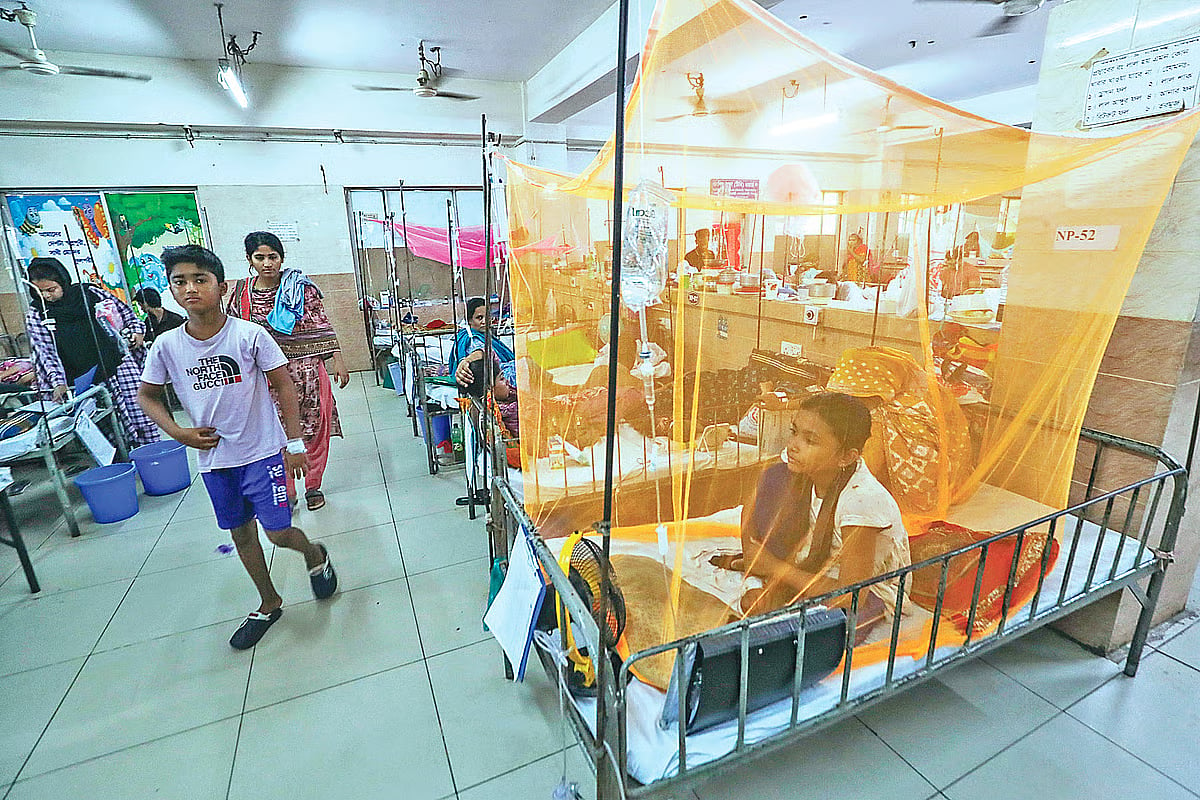
The dengue outbreak is worsening. The Directorate General of Health Services (DGHS) is reporting deaths every day. Another 10 people died yesterday, Tuesday. Nine people died the previous day. This brings the number of dengue deaths this year to 281. More deaths are feared.
Dengue has now spread to every district of the country. The disease is transmitted by Aedes mosquitoes. The main responsibility for controlling Aedes mosquitoes lies with the Local Government Division under the Ministry of Local Government, Rural Development and Cooperatives. But the division has failed to properly carry out this responsibility year after year.
The National Guideline for Prevention of Dengue and Other Mosquito-Borne Diseases, published by the Local Government Division in 2019, calls for committees to be formed at the union, upazila, district, pourashava, city corporation and national levels.
The guideline details the number of members, when and how each committee should be formed, who should serve on them and their terms of reference. But apart from the national committee and committees in city corporations, almost all the other committees are effectively inactive. There has been little discussion about committees at the district, upazila or union levels.
Mohammad Rabiul Islam, joint secretary of the Local Government Division, told Prothom Alo on Monday that the national committee and the committees of the 13 city corporations are working on mosquito control.
He said the committees of 330 pourashavas are also working. Asked about the other committees, he said, “Surely the committees are active. They are working.”
So many committees
The lowest-level committee is the Committee for Prevention of Dengue and Other Mosquito-Borne Diseases at the union ward level. It has 11 members, with the ward member concerned serving as its chair.
The National Guideline for Prevention of Dengue and Other Mosquito-Borne Diseases, published by the Local Government Division in 2019, calls for committees to be formed at the union, upazila, district, pourashava, city corporation and national levels.
There are 4,599 unions in the country. Based on nine wards per union, there are 41,391 union wards. There is no known instance of such a committee being formed in any ward of any union in the country to prevent dengue or control mosquitoes.
The next level is the Committee for Prevention of Dengue and Other Mosquito-Borne Diseases at the union level, chaired by the union parishad chairman.
Above the union level, there are two types of committees: pourashava and upazila committees. The country has 330 pourashavas and 503 upazilas. The mayor chairs the pourashava committee, while the upazila chairman chairs the upazila committee.
We are not aware of any requirement to form committees at the union or ward level. This has not even come up in major policymaking meetings.A researcher advising the incumbent government on dengue
Above these are district committees. There are supposed to be 64 such committees, one in each district. There is also one committee in each city corporation. The country currently has 13 city corporations.
In addition, every ward of every city corporation and municipality is supposed to have a committee. There are 668 wards in the city corporations and at least 990 wards in the municipalities.
At the top of the structure is the National Committee for Prevention of Dengue and Other Mosquito-Borne Diseases. The committee has 24 members, including the mayors of Dhaka’s two city corporations, the cabinet secretary, a representative of the Prime Minister’s Office (PMO), secretaries of 14 ministries and representatives of five other important organisations or institutions.
In total, there are supposed to be 48,559 committees from the union ward level to the national level. Many people are not even aware that so many committees are supposed to be formed under the Local Government Division.
A researcher advising the incumbent government on dengue, speaking to Prothom Alo on condition of anonymity, said committees exist or are supposed to exist in every pourashava.
“But we are not aware of any requirement to form committees at the union or ward level,” the researcher said. “This has not even come up in major policymaking meetings.”
What are these committees supposed to do?
The national guideline prepared in 2019 provides detailed instructions on the responsibilities of committees at every level, including the Local Government Division.
It says the Local Government Division will determine the responsibilities of all stakeholders involved in dengue prevention—including relevant ministries, divisions, departments and agencies, private organisations and institutions, local government bodies, mass media and NGOs—and coordinate their activities.
We have not received any instructions regarding the formation of a committee to prevent dengue. So no such committee has been formed in the upazila. However, work to prevent dengue is underway.Runalt Chakma, UNO, Bera in Pabna, and administrator of Bera pourashava
The division will provide local government institutions with directions and support to undertake and implement year-round dengue prevention activities and supervise the work undertaken. It is also supposed to take necessary measures based on opinions and recommendations received from city corporations, districts, upazilas and unions.
Among 16 key responsibilities, the guideline says the Local Government Division will primarily advise on all necessary measures for mosquito control across the country.
According to the terms of reference of the national committee, it will review, evaluate, supervise and coordinate activities undertaken and implemented; conduct necessary research; formulate policies and strategies; and update them. The national committee is supposed to hold at least four meetings a year.
The guideline also details the responsibilities of city corporations and their committees for preventing mosquito-borne diseases. It lists 33 instructions or measures relating to mosquito control, dengue prevention and cleanliness.
Similarly, the Local Government Division has listed the responsibilities of district, municipal and upazila committees. Each committee is supposed to hold a meeting once a month. Among the responsibilities assigned to pourashavas is taking measures to regularly conduct mobile courts as a legal step to destroy mosquito breeding sites.
Even the committees at the most basic level—the union ward committees—are supposed to hold a monthly meeting to review the situation.
What is happening on the ground?
On 11 March this year, Prime Minister Tarique Rahman urged people across the country to participate in cleanliness drives to prevent dengue and chikungunya. Even then, no major initiative was seen from the Local Government Division.
The prime minister later inaugurated a nationwide cleanliness programme on 12 September. The programme is being held every Saturday and will continue until 12 December.
Dengue spread across the country for the first time in 2019. It is now a problem in rural areas as well. But there are no major mosquito-control operations in rural areas.
The prime minister’s initiative has reportedly prompted some activity at the city corporation, pourashava and upazila levels.
The Cumilla district administration told a Prothom Alo correspondent yesterday that committees had been formed at the district, upazila and union levels to prevent dengue. Committees have also been formed in all 27 wards of Cumilla City Corporation.
However, Runalt Chakma, upazila nirbahi officer of Bera in Pabna and administrator of Bera pourashava, told Prothom Alo, “We have not received any instructions regarding the formation of a committee to prevent dengue. So no such committee has been formed in the upazila. However, work to prevent dengue is underway.”
Abdul Hamid, chairman of Haturia-Nakalia Union Parishad in Bera upazila, told Prothom Alo, “At the monthly meeting organised by the upazila parishad, the chairmen were asked to take initiatives to prevent dengue. Since then, we have undertaken cleanliness drives and awareness and publicity activities with union parishad members, village police and local residents.”
Nurul Amin, executive officer of Netrokona pourashava, told Prothom Alo that mosquito-control operations using fogging machines are being conducted every Saturday in line with the prime minister’s announcement. However, he said none of the pourashava’s nine wards has a dengue prevention committee.
It has become essential to activate and form these committees. If all the committees, from the grassroots to the national level, can be made active, ordinary people will become involved and a major movement to prevent dengue can be built across the country.Public health specialist Abu Jamil Faisal
Mymensingh City Corporation said it had formed a task force committee to prevent dengue. Previously, ward-level committees comprising councillors existed, but they are no longer functioning.
Anwar Hossain, UNO of Keshabpur in Jashore, told Prothom Alo that no meeting of any dengue prevention committee had been held, although one would be held. For now, one area is being selected each day for cleaning.
On the other hand, Humayun Kabir, chairman of Majidpur Union Parishad in the same upazila, said a meeting of the union dengue prevention committee had been held and cleanliness activities were also underway.
Mohammad Alauddin, chairman of Keshabpur Union Parishad, said no meeting of the union parishad committee formed to prevent dengue had been held. However, garbage along roadsides was being cleared sporadically.
Afzalul Haque, chairman of Kursha Union Parishad in Taraganj upazila of Rangpur, told Prothom Alo that mosquito-control chemicals and a fogging machine had been purchased under an annual development assistance fund project on the instructions of the UNO. Village police member Abdur Rahman had been trained to operate the machine. However, no committee for mosquito control has yet been formed.
Sylhet City Corporation said there was no ward-level dengue prevention committee there.
There are no dengue prevention committees of any kind in Sandwip upazila, pourashava or any union in Chattogram.
Dengue spreads from cities to villages
Dengue was primarily a Dhaka city-centric problem. To some extent, it was also concentrated in major cities such as Chattogram and Khulna. As a result, government mosquito-control efforts were also focused on urban areas.
Dengue spread across the country for the first time in 2019. It is now a problem in rural areas as well. But there are no major mosquito-control operations in rural areas.
People in every district of the country are now being affected by dengue. In the latest 24-hour period—from 8:00 am Monday to 8:00 am Tuesday—1,996 patients were admitted to hospitals across the country. The number of dengue patients hospitalised this year has reached 90,356. Yesterday, 5,776 dengue patients were undergoing treatment at government and private hospitals across the country.
Public health specialist Abu Jamil Faisal told Prothom Alo that many people are unaware of the existence of so many committees.
“It has become essential to activate and form these committees,” he said. “If all the committees, from the grassroots to the national level, can be made active, ordinary people will become involved and a major movement to prevent dengue can be built across the country.”
(Prothom Alo correspondents in Mymensingh, Cumilla, Sylhet and Netrokona; Taraganj, Rangpur; Bera, Pabna; Keshabpur, Jashore; and Sandwip, Chattogram, contributed to this report.)