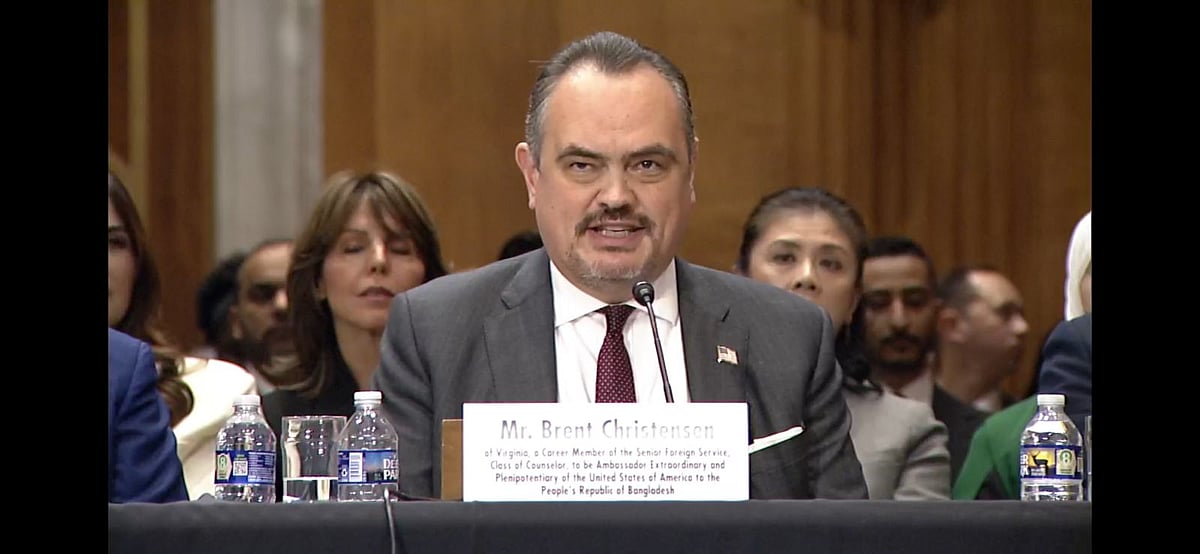
US senate nomination hearing
I’d engage with Dhaka to clearly articulate risks from Chinese activities: Brent Christensen
Nominee for the post of US ambassador to Bangladesh Brent Christensen has said if his nomination is confirmed, he would engage with the Bangladeshi government and the military to clearly articulate the risks from Chinese activity.
“If confirmed, I would engage with the Bangladeshi government and the military to clearly articulate the risks from Chinese activity, involvement with their military, activities in their maritime domain, and in their critical infrastructure,” he told the US senate nomination hearing in the question and answer session on Thursday.
Four US ambassador nominees presented their written statements before the US senate committee on foreign relations. Later, the ambassador nominees answered the questions of the senate committee members.
US president Donald Trump nominated on 2 September Brent Christensen as the next US ambassador to Bangladesh. His nomination has been sent to the senate committee. The nomination will be finalised if the senate committee approves it after this hearing.
John Peter Ricketts, US Republican Party’s senator from Nebraska, asked Brent Christensen questions about gradually increasing relation between Bangladesh and China.
He said, another threat that we’re facing is Communist China. Mr. Christensen, Bangladesh’s military to military cooperation with Communist China is growing. Communist China recently refurbished a strategic Bangladeshi submarine base to accommodate both warships and submarines. And just this month, Bangladesh’s interim government has reportedly approved a plan to acquire up to 20 Chinese-made J-10 fighter jets. They will also acquire new surface to air missiles and long-range radars. It finalised the sale with the Chinese defense industry.
If you’re confirmed, how would you engage with Bangladesh’s military political leadership to discourage further reliance on Chinese platforms, promote greater transparency in their defense and procurement process?
In response, Brent Christensen said, “I share your concern about Chinese influence across South Asia, and if confirmed, I would engage with the Bangladeshi government and the military to clearly articulate the risks from Chinese activity, involvement with their military, activities in their maritime domain, and in their critical infrastructure, as well as highlight the opportunities and benefits that come with a closer partnership with the United States, especially a closer partnership between our militaries.
Senator Pete Ricketts then asked, “This hearing here comes as the Senate Foreign Relations Committee has just advanced the Think Twice Act yesterday by voice vote. This bipartisan legislation requires a comprehensive strategy to sway countries like Bangladesh from purchasing Chinese weapons. It is critical that we get this bill across the finish line so we can combat Beijing’s growing influence through arms sales and so Mr. Christensen, I hope that we can provide you that as one of the tools when you’re working with the Bangladeshi government. What are other things that we can do? What are all terms we have to the Chinese defence sales in South Asia that you would employ as ambassador?”
To this, Brent Christensen said, “One of the things that we can do through our US military groups is also highlight some of the allied systems that might be more affordable for a country like Bangladesh that may not be able to afford the premier US military systems as well as encourage their interoperability with other platforms as we conducted additional exercises with them.”
“Allied systems” means a network of companies that work together to provide a service or product.
Before the question and answer session, the US ambassador nominee Brent Christensen in his written statement, presented before the senate committee, said, “Bangladesh is also at a pivotal point. Student-led protests in August 2024 brought down a government that had been in power for 15 years. The people of Bangladesh will go to the polls early next year – the country’s most consequential election in decades – to choose a new government and a new path forward. The United States supports Bangladesh in its journey toward a bright and democratic future.”
He also said, “Bangladesh, the eighth most populous country in the world, often does not receive the attention it deserves, as it is overshadowed by its even larger neighbours. With my over twenty years of experience working on US policy toward Bangladesh across my Foreign Service career, including a prior tour in Dhaka, I understand well its importance and the significant US interests there. Bangladesh’s strategic location makes it an important participant in an open, secure, and prosperous Indo-Pacific region.”