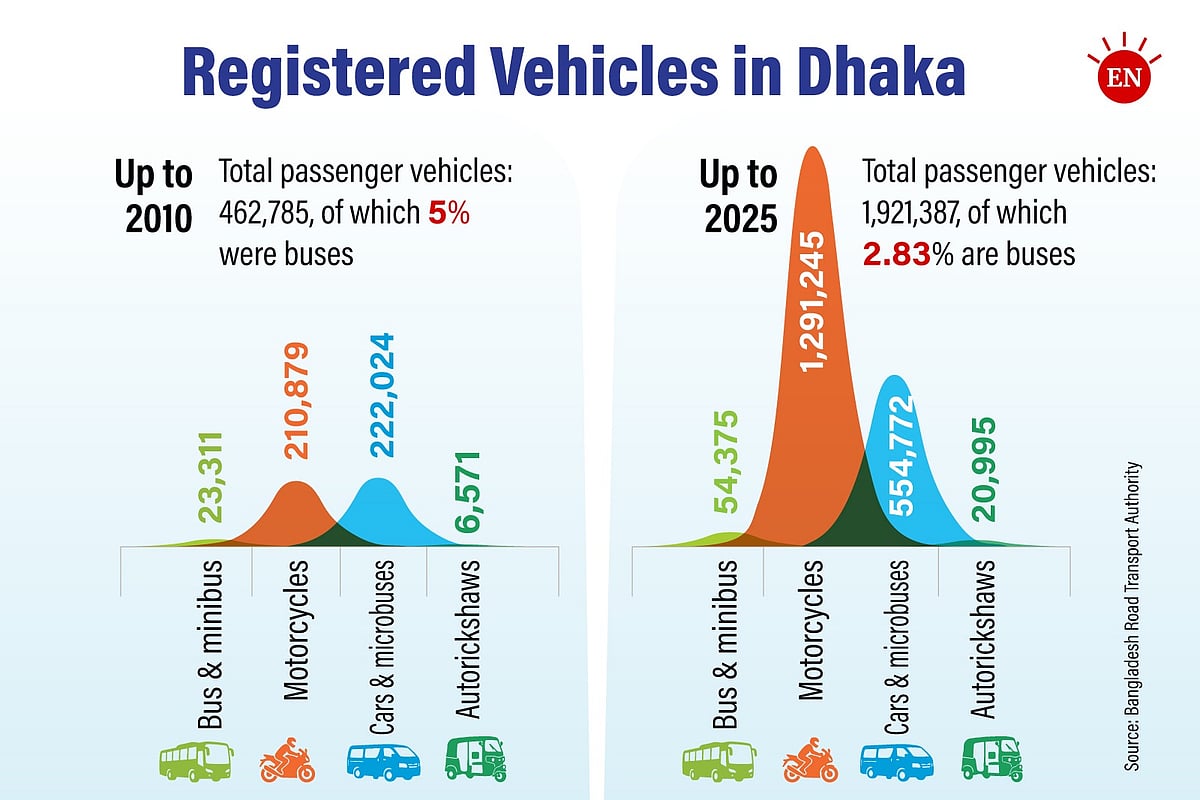
Over the past one and a half decades, there has been a slow growth in the number of buses in Dhaka, while the number of cars (sedans), SUVs, microbuses, and motorcycles have surged dramatically. Autorickshaws have also increased, but still fall short of demand.
Government policies have encouraged private car ownership, contributing to worsening traffic congestion. In the name of easing congestion, the now-ousted Awami League government undertook mega infrastructure projects worth billions. However, many of these flyovers are now plagued by traffic jams.
According to data from the Bangladesh Road Transport Authority (BRTA), the number of registered buses, minibuses, cars (sedans), SUVs, microbuses, autorickshaws, and motorcycles in Dhaka stood at 462,785 in 2010.
Of these, only 5 per cent were buses and minibuses. By 2025, the total number of these seven types of vehicles rose to 1,921,387—but buses and minibuses made up just 2.83 per cent.
A significant portion of registered buses and minibuses operate on intercity and suburban routes. Within the city, shorter routes are mainly served by minibuses. Compared to 2010, the number of minibuses in 2025 increased by 25 per cent to 10,341. In contrast, cars and SUVs rose by 152 per cent over the same period.
In recent years, battery-powered rickshaws have also surged. Estimates from passenger rights groups, police, and other stakeholders suggest there are around 1.5 million illegal battery-operated and engine-driven three-wheelers. The rise of these smaller vehicles has also contributed to a rise in road accidents.
Saidur Rahman, Executive Director of the Road Safety Foundation, told Prothom Alo that successive governments have encouraged private car ownership while placing various barriers on bus registration. “Most passengers in the city rely on buses, which use only about 15 per cent of road space. Meanwhile, only 9 per cent of people use private cars, yet they occupy nearly 70 per cent of road space,” he said.
Focus on mega projects instead of buses
In 2005, the government approved a 20-year Strategic Transport Plan (STP) for Dhaka, with an implementation timeline up to 2025. The plan emphasised that most city residents depend on buses, and therefore bus-based solutions should be prioritised in both short- and long-term planning. It proposed route rationalisation, bringing buses under single company management based on routes, and replacing smaller buses with larger, more comfortable ones.
In 2015, Japan International Cooperation Agency (JICA) revised the STP. It stated that 80 per cent of Dhaka’s population relies on public transport, while the remaining 20 per cent use private vehicles or other means. Among public transport users, about 64 per cent rely on buses and minibuses.
According to the revised plan, by 2035 Dhaka would have six metro rail lines, several flyovers, and dedicated bus rapid transit (BRT) corridors. Even then, 57 per cent of travel was projected to remain bus-dependent.
However, governments have given less priority to buses. During the Awami League’s more than 15 years in power, multiple flyovers were constructed. Metro rail has also been built and is delivering benefits, though limited to a single route so far.
Analysis shows that around 500 billion taka has been spent on projects such as pedestrian overpasses, flyovers, and BRT systems to reduce congestion, while metro rail projects cost about 334.72 billion taka. Yet there has been little improvement in the bus system, which remains the primary mode of transport for most residents.
Why are there fewer buses?
Route permits for passenger buses in Dhaka are issued by the Metropolitan Regional Transport Committee (Metro RTC), headed ex officio by the Police Commissioner, with BRTA officials serving as member secretaries.
The committee also includes representatives from transport owners’ and workers’ associations.
In 2018, the board of the Dhaka Transport Coordination Authority decided to halt new route permits as part of efforts to introduce discipline and implement a company-based bus system (route rationalisation).
From 2019, then Dhaka South City Corporation mayor Fazle Noor Taposh instructed Metro RTC not to issue new route permits.
Under the rationalisation initiative, buses were introduced on a few routes, but the system is no longer effectively in operation. After the interim government took office, Metro RTC became active again and issued more than 2,500 route permits.
However, according to BRTA sources, most of these permits were renewals of old buses rather than new additions, as permits must be renewed annually. Due to years of inactivity, nearly all existing permits had expired—meaning that in practical terms, very few new buses have entered Dhaka’s roads since 2019.
Stakeholders say another reason for the lack of new buses is the long-standing directive to phase out old buses since 2015, along with promises of low-interest loans for owners—promises that were never fulfilled.
Additionally, dominance by existing operators discouraged new investment. Many low-quality buses imported from China and India over the past decade, especially CNG-run buses, became unusable within a few years and are no longer in operation.
Analysts say the government can ensure affordable and comfortable mobility by focusing on bus system reform. This requires political will and resistance to pressure from vested interest groups.
Saidur Rahman added, “Dhaka’s public transport system is not people-friendly. The new government must take steps to change that, but so far, no visible initiative has emerged.”