Rangpur residents suffer severe mosquito infestation, ‘crash programme’ yields no relief
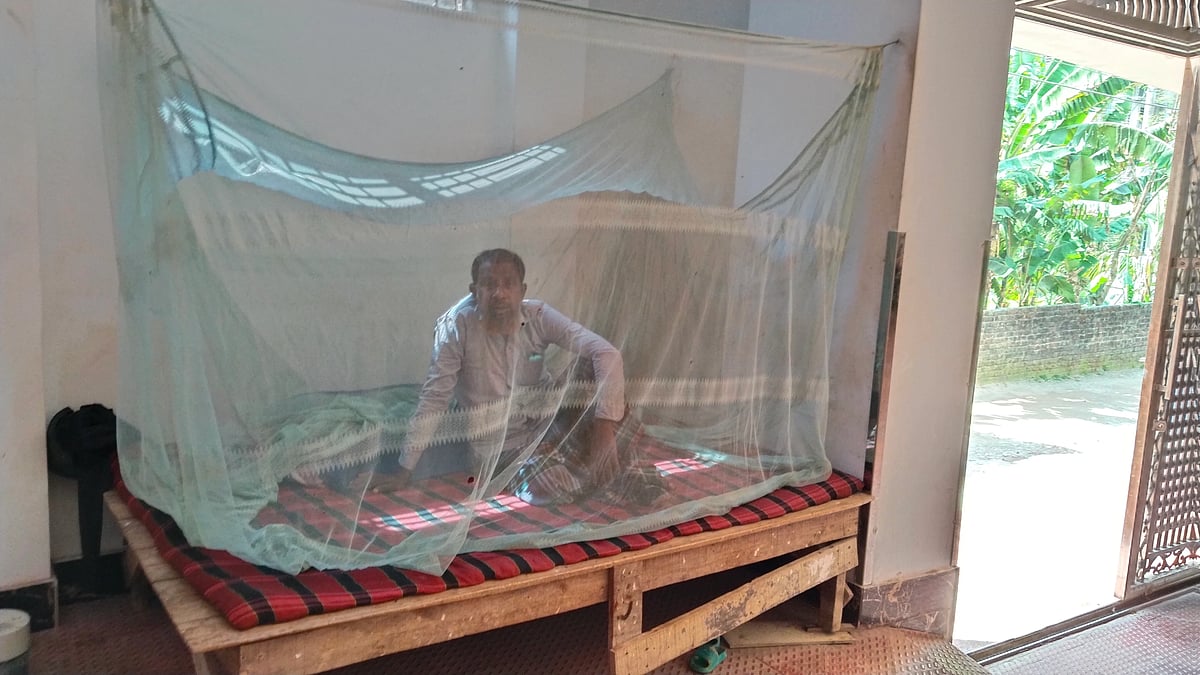
Tajul Islam works as a night guard at a house in Satgara Mistripara area of ward no. 18 under Rangpur City Corporation.
Even during the daytime, he sits on his bed under a mosquito net. Explaining why, Tajul said the mosquito infestation is so severe that he cannot stay without a net.
This suffering extends beyond Tajul Islam to residents across all 33 wards of Rangpur city. According to official figures, the city has a population of approximately 800,000, while unofficial estimates exceed one million.
Most residents endure significant mosquito nuisance. They complain that the failure to clean canals, drains, and sewers, along with irregular insecticide spraying across the 205-square kilometre city, has allowed the infestation to reach an alarming level.
Tajul Islam told Prothom Alo, “There are stagnant pools and dirty water all around. That means mosquitoes everywhere. They bite day and night without pause. The bites keep causing fever, and my body never feels well. I have worked here for a year, but not once has anyone come to kill mosquitoes.”
However, the city corporation claims it launched a ‘crash programme’ to eliminate mosquitoes from 17 March. Sources indicate that after the new administrator, Mahfuz-un-Nabi Chowdhury, joined on 15 March, he began holding meetings with relevant officials to identify the problem.
These efforts have improved the pace of urban cleaning activities. Authorities have sprayed adulticide in bushes and open drains, and larvicide in waterlogged areas to destroy mosquito larvae.
At the same time, they have initiated measures to test the effectiveness of these chemicals with the support of entomological technicians from the civil surgeon’s office.
Kamruzzaman Ibne Taj, chief health officer of Rangpur City Corporation, told Prothom Alo that the insecticides they use have already been tested in the two city corporations in Dhaka. Nevertheless, they have initiated local testing to verify their effectiveness.
With assistance from entomological technicians, they will complete the tests within a week, he added.
According to official figures, the city has a population of approximately 800,000, while unofficial estimates exceed one million. Most residents endure significant mosquito nuisance. They complain that the failure to clean canals, drains, and sewers, along with irregular insecticide spraying across the 205-square kilometre city, has allowed the infestation to reach alarming levels.
Culex mosquitoes predominate
In Bangladesh, three main types of mosquitoes commonly spread: Culex, Aedes, and Anopheles.
Among them, Culex is the most prevalent. Culex bites can transmit filariasis and Japanese encephalitis, while Aedes transmits dengue and chikungunya and Anopheles spreads malaria.
The city corporation has not conducted any survey or research to identify which areas suffer the most infestation.
However, the civil surgeon’s office usually conducts field surveys, collects samples, analyses insects in laboratories, and monitors the effectiveness of insecticides for controlling mosquito- and vector-borne diseases. Entomological technicians Mahabuba Ferdousi and Md Alauddin carry out this work.
Mahabuba Ferdousi told Prothom Alo that they conduct mosquito surveys three times a year. This year, pre-monsoon rains began earlier than usual.
In March, they collected mosquito samples from densely populated areas such as Keranipara, Radhaballav, Senpara, Munshipara, Guptapara, Kotkotipara, and the bus terminal area.
Of these, approximately 60 per cent were Culex mosquitoes. Around 30 per cent were Armigeres (another species related to Culex), which are larger in size.
In addition, Aedes accounted for 2 per cent, while the remaining 8 per cent consisted of other species.
Chief Health Officer Kamruzzaman Ibne Taj noted that the abundance of bushes and paddy fields within the city corporation area contributes to the high prevalence of Culex mosquitoes.
Entomological technician Md Alauddin added that Rangpur is a filariasis-prone region, and Culex mosquitoes act as vectors for the disease.
These mosquitoes breed in environments where human waste, livestock waste, and stagnant water accumulate.
He warned that the situation in Rangpur remains risky, as three phases of programmes conducted between 1999 and 2019 failed to eliminate filariasis in the region.
Furthermore, pre-monsoon rains this year have raised concerns about the emergence of Aedes larvae.
Sources from the civil surgeon’s office indicate that dengue cases transmitted by Aedes mosquitoes have been increasing in Rangpur City Corporation since 2019.
Mosquito infestation makes residential life unbearable
Residents of Keranipara, Munshipara, Radhaballav, Guptapara, and Senpara areas in the city report that mosquitoes have made life extremely difficult, even during the daytime.
In particular, the approximately 16-kilometre-long Shyamasundari canal (or river), which runs through the city, has accumulated stagnant water and turned into a major breeding ground for mosquitoes. The approximately 3-kilometre KD canal faces a similar situation.
City corporation officials also acknowledge that water hyacinths have accumulated in both the Shyamasundari and KD canals.
Various institutions and households continue to dump waste into these water bodies. Moreover, the city’s weak drainage system and open drains have created favourable conditions for mosquito breeding.
Even light rainfall causes waterlogging, which further contributes to the rise in mosquito populations.
Md Asaduzzaman, a resident of Pasharipara adjacent to the Shyamasundari canal, told Prothom Alo, “The foul smell from dirty water and waste, along with the mosquito infestation, makes it unbearable to live in our homes. Our children are falling ill. I cannot explain how severe the mosquito problem is. They use fogging machines, but do those really kill mosquitoes!”
What is happening under the ‘crash programme’?
According to city corporation sources, between 30 and 36 workers carry out mosquito control operations daily across different wards, supervised by 12 overseers.
Each day, they use seven spraying machines to apply larvicides in waterlogged areas to destroy mosquito larvae.
Residents of Keranipara, Munshipara, Radhaballav, Guptapara, and Senpara areas in the city report that mosquitoes have made life extremely difficult, even during the daytime. In particular, the approximately 16-kilometre-long Shyamasundari canal (or river), which runs through the city, has accumulated stagnant water and turned into a major breeding ground for mosquitoes.
In addition, from the afternoon onwards, they operate 30 fogging machines to apply adulticides. Authorities have also taken initiatives to remove water hyacinths and waste from the Shyamasundari and KD canals.
Executive Magistrate Shahriar Rahman oversees the mosquito control operations.
He told Prothom Alo, “We are receiving a large number of complaints. The mosquito infestation is severe. For this reason, we have increased both manpower and activities. Although operations are currently underway in 15 wards, we are gradually expanding them.”
However, residents of the 18 newly extended wards have expressed frustration over the absence of mosquito control activities in their areas.
Faruk Hossain, a resident of Telipara in ward no. 9, said they remain consistently deprived of services.
He added that mosquitoes have made life unbearable, and even keeping doors and windows shut or using aerosol sprays has not provided relief.
Mokhlesur Rahman, head of the department of medicine at Rangpur Medical College Hospital, told Prothom Alo that considering the geographical location, climate and pattern of urbanisation in Rangpur, authorities should introduce an integrated mosquito management system.
He emphasised that destroying mosquito breeding grounds offers a more cost-effective and sustainable solution than merely killing adult mosquitoes.
He added that the city corporation must continue this work regularly.