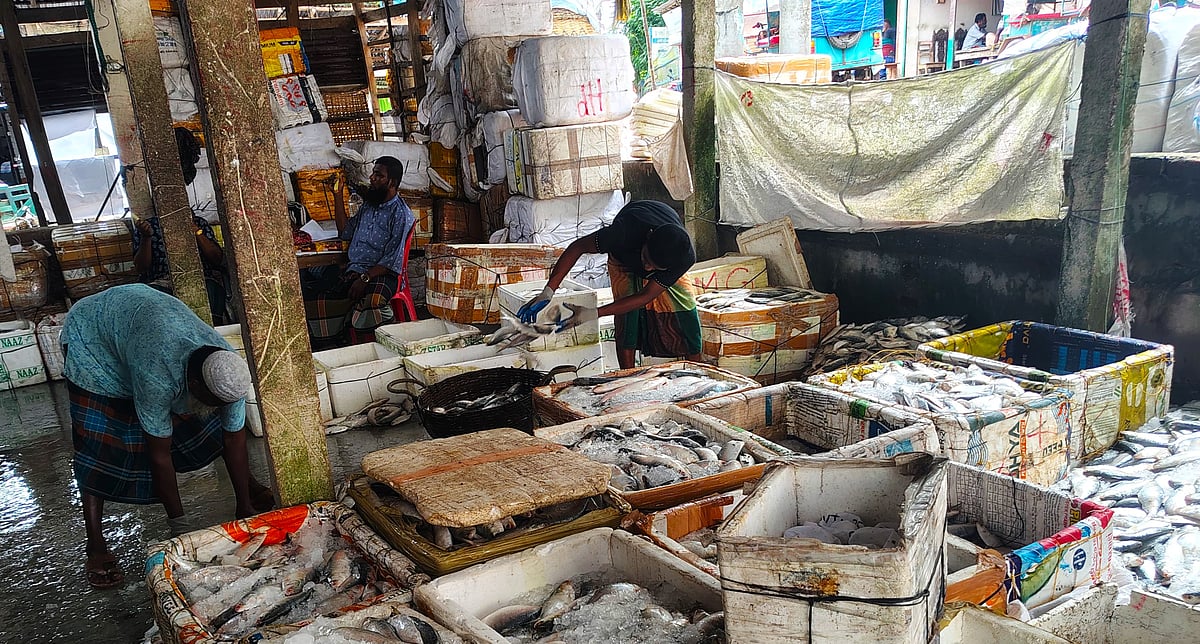
Hilsa season nearing its end, yet prices remain out of reach
Day labourer Abul Kalam had been waiting in hope that prices would drop toward the end of the season when supply typically increases. He planned to buy hilsa fish — not a large one, but maybe a couple of small to medium-sized ones — to share with his wife and children. But that hope was not fulfilled, and now he doubts it ever will be.
Last Sunday night at Choumatha Bazar in Barishal city, Kalam kept glancing at the hilsa baskets — sometimes at the buyers, sometimes at the sellers — and then walked on, casting helpless eyes at the fish.
When approached, he let out a deep sigh and said, "How can I afford it? Even jatka (young hilsa) costs Tk 1,200. The big ones—I can't even touch them. I know I can’t buy, so I just came to look at them one last time."
It’s not just the poor; even the lower-middle class can barely afford hilsa. While listening to Kalam’s lament at the market, a private sector employee nearby purchased two hilsa weighing around 800 grams for Tk 3,200.
He said, "After waiting two months, this is the first time I’ve bought hilsa. The season is almost over, and I still hadn’t fulfilled my wife and kids' wishes. So, even though it hurts financially, I bought them anyway."
The hilsa season is drawing to a close. Starting from the second week of October, a 22-day government ban will be in place to protect mother hilsa during the peak spawning period. Climate change has also disrupted seasonal patterns — this year, heavy rainfall came during autumn instead of the traditional monsoon months, and the hilsa season has shifted accordingly.
Just days ago, the coastal areas saw stormy winds and heavy rains, coupled with the full moon of Madhupurnima — a time when, local fishermen believe that this type of weather causes shoals of hilsa to emerge from the deep sea and fill their nets.
This full moon in the Bengali month of Bhadra is typically a special time for fishers. However, in recent years, the once-famous hilsa abundance during this period has significantly declined.
Despite hilsa appearing in the markets during the season, prices remain sky-high. Consumers are asking: Why is hilsa still so expensive, even in peak season?
Hilsa has been available in Barishal’s retail markets since June, and supply increased in August and September (the Bengali months of Shraban and Bhadra), but prices did not drop. In June, hilsa weighing over 1 kg was sold at Tk 3,000, and 1-kg fish were priced at Tk 2,500. Now, even with higher supply, the prices remain the same.
Why the high prices?
Buyers and retail sellers blame the soaring prices of hilsa mainly on syndicates in the wholesale market. From fishermen to wholesalers, then to warehouse agents, market brokers, and finally to retail vendors — a profit margin or commission is added at every stage, ultimately increasing the burden on the consumer.
However, wholesale traders argue that the supply of hilsa is no longer what it used to be, and at the same time, the cost of catching fish has doubled, leaving little room for price reductions.
Zahir Sikder, a wholesale trader at Port Road Market in Barishal, said, "There’s no such thing as a syndicate. The truth is, fewer fish are being caught. Big hilsa are especially rare. And costs have gone up significantly compared to before."
Today, Tuesday at Port Road Market, wholesale prices were as follows: 1 kg hilsa sold at Tk 86,000 per maund (approx. 37.3 kg), 900g hilsa at Tk 76,000 per maund, 500g hilsa at Tk 60,000 per maund, hilsa over 1 kg sold for up to Tk 103,000 per maund.
Catching costs have doubled
People involved in the fisheries sector say the rise in fuel prices has put the marine fishing industry under pressure. Expenses for operating trawlers, fishermen’s food, ice, and wages have increased by about 70 per cent, making it difficult to recover costs through fish sales.
In September 2022, diesel was priced at Tk 114 per liter. Although the official rate is now Tk 102, it is being sold at Tk 105 in local markets. Just a few years ago, the price was Tk 65 — meaning the cost has nearly doubled.
Jahangir Khan, owner of the FB Mayer Doa trawler from Padma village, Patharghata, shared that his trawler employs 19 fishermen to fish in deep sea. The trawler requires 12 barrels of fuel, costing over Tk 200,000.
Additional expenses include: Engine oil: Tk 12,500, Ice: Tk 65,000, 10 days' worth of food: Tk 150,000, spare parts: Tk 20,000, medicine: Tk 5,000, drinking water: Tk 2,000 and miscellaneous: Tk 7,500.
Total cost per trip stands at nearly Tk 500,000.
Jahangir Khan said, “To cover these expenses, I need to sell at least Tk 1.5 million worth of fish. But these days, I often sell only Tk 200,000 to Tk 1 million worth of fish. It’s getting harder.”
Even trawlers that fish in shallow waters are facing rising costs. Another trawler owner from Patharghata, Mohammad Selim, said that a shallow-sea trawler now needs: 2 barrels of fuel: Tk 40,000, engine oil: Tk 5,000, ice: Tk 15,000, food: Tk 70,000, spare parts: Tk 5,000, medicine and water: Tk 2,000 and other expenses: Tk 5,000. Total cost stands at around Tk 140,000, compared to Tk 75,000–85,000 previously.
He added, “Recovering costs and making a profit has become very difficult. That’s why hilsa prices are so high in the market.”