Bengal Delta Conference 2025
Branding July Uprising a conspiracy serves India’s interests: Siddharth Varadarajan
Portraying Bangladesh’s July Uprising as a “conspiracy” was advantageous for the Indian government, as it helped deflect attention from its own foreign policy failures and controversies, Siddharth Varadarajan, founding editor of the Indian media outlet The Wire, said on Friday.
He pointed out that in the first week of the uprising, the Indian government deliberately remained silent, allowing rumours to spread unchecked.
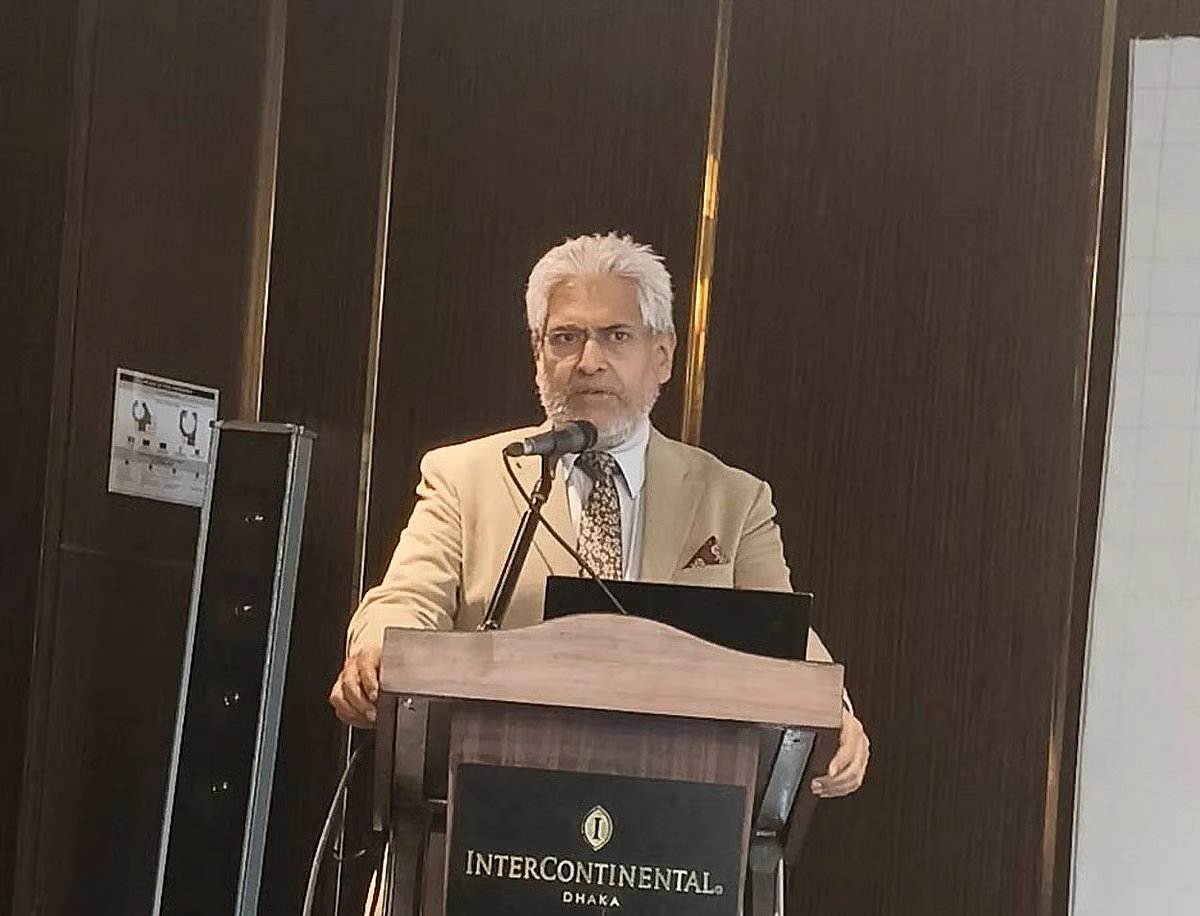
Siddharth Varadarajan delivered his remarks at the inaugural session of the two-day international conference, Bengal Delta Conference 2025, held at a Dhaka hotel yesterday.
Research institute, Dhaka Institute of Research and Analytics (DIRA) organised the conference.
Its central theme was “Bangladesh at Crossroads: Rethinking Politics, Economics, Geopolitical Strategy.”
Speaking at a special panel titled “Media, Rumour and Narrative: Post-July Bangladesh in the South Asian Frame”, Varadarajan commented on Bangladesh–India relations before and after the uprising, the rumours circulated across Indian social media, the positioning of Indian mainstream media, and incidents of violence against Hindus.
He was joined in discussion by Bangladeshi documentary filmmaker Dipak Kumar Goswami.
Siddharth Varadarajan observed that successive Indian governments had nurtured the assumption that it would be best for India if Sheikh Hasina remains the Prime Minister of Bangladesh. From the tenure of Manmohan Singh through to that of Narendra Modi, Indian policymakers felt comfortable with Sheikh Hasina in power and sought to ensure her continued survival in office.
According to him, the Modi government regarded Sheikh Hasina as India’s most reliable partner. In return, she extended economic benefits to industrialists close to Narendra Modi, such as the Adani Group. Simultaneously, Modi turned a blind eye to the instrumentalisation of Bangladesh in India’s domestic politics.
Reflecting on the fall of the Sheikh Hasina government, Siddharth Varadarajan noted that during the first 24 hours, the scenes emerging from Bangladesh were dominated by the celebratory mood surrounding Sheikh Hasina’s downfall, alongside reports of child killings and student killings. Yet, after the first 24 hours, Indian media began reporting that large-scale communal riots were under way, that Hindus were under attack, temples were being vandalised, and even that genocide was occurring. To this end, fake footage was disseminated, and artificial intelligence was deployed.
He stated that the Indian government intentionally permitted such rumours to proliferate.
According to Siddharth Varadarajan, the rumours spread to such an extent that they entered the mainstream media. Casting the July Uprising as an “anti-Hindu conspiracy” carried an overtly political message. Some claimed it was orchestrated by Pakistan, others attributed it to the United States “deep state”, while yet others blamed Jamaat-e-Islami. Thus, not only did this narrative obscure the failures of the Modi government’s foreign policy, it also deepened divisions within Indian society itself.
Varadarajan concluded that, overall, the Indian government was content with this framing, for it shifted public attention away from the failures of Modi’s foreign policy.