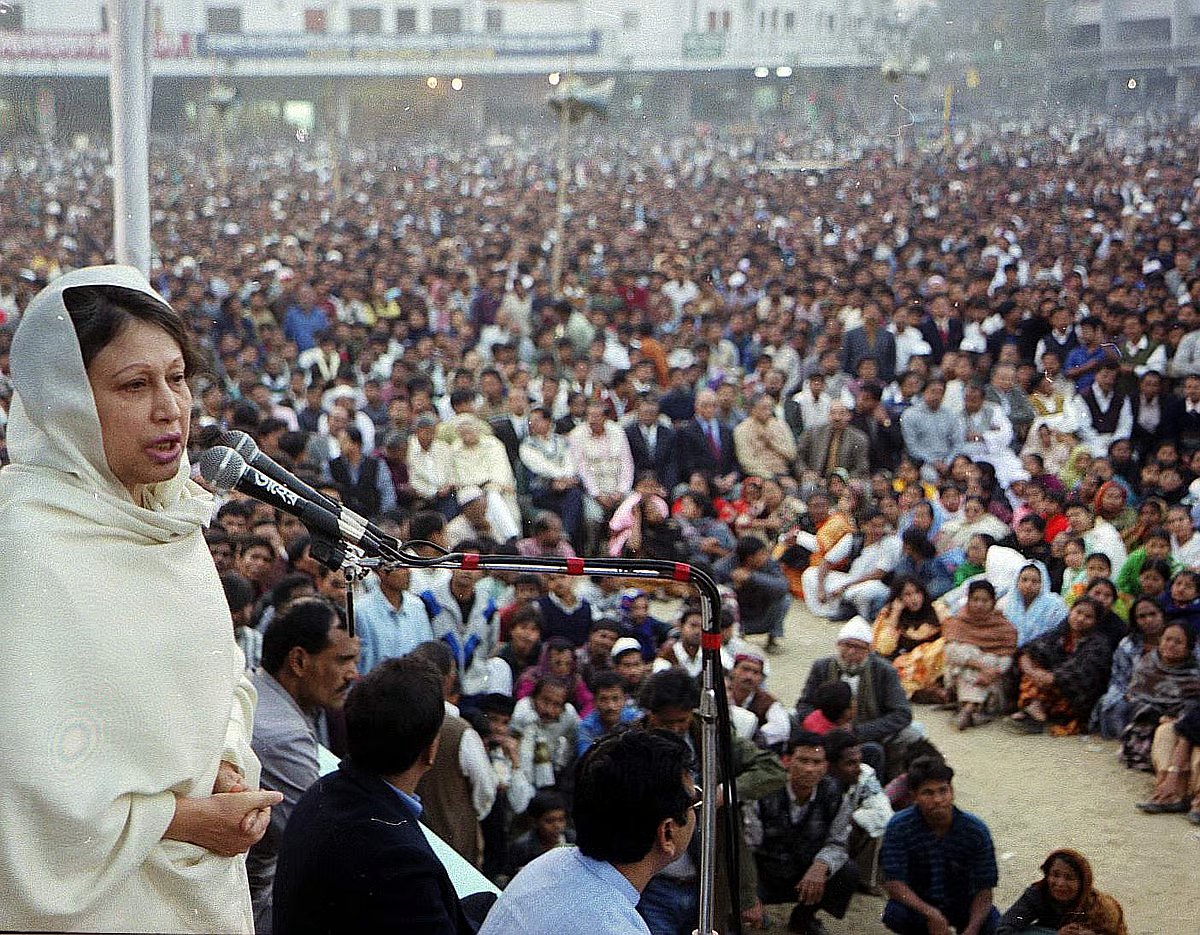
Khaleda Zia: From homemaker to resolute leader
Khaleda Zia was a homemaker. Seven months after the death of Ziaur Rahman, she joined the Bangladesh Nationalist Party (BNP) under exceptional circumstances.
In less than 10 years after entering politics, Khaleda Zia became prime minister. Her political career spanned nearly 43 years.
After entering politics from a domestic life, Khaleda Zia gradually emerged as a resolute and courageous leader.
She kept the BNP united through crises and adversities. In the later years of her life, she came to be regarded as a ‘symbol of national unity’.
The founder of the BNP and the then president, Ziaur Rahman, was assassinated on 30 May, 1981 by a group of renegade members of the armed forces.
As a result of conspiracies over leadership, the BNP was plunged into deep uncertainty.
In such circumstances, Khaleda Zia joined the BNP on 3 January, 1982. She initially became senior vice-chairperson of the party, later acting chairperson and eventually chairperson.
At that time, she was under 40 years of age. Thus began the BNP’s journey under new leadership.
Political observers state that it was primarily the movement against the autocratic ruler Ershad that provided Khaleda Zia with a strong political foundation and helped shape her leadership persona.
In subsequent years, she gradually succeeded in firmly establishing her position in politics.
Analysing Khaleda Zia’s long political life encompassing movements, struggles, and governance, political observers note that in the final phase of her life she earned respect across party lines and emerged as a symbol of unity for all.
Following the fall of the autocratic Sheikh Hasina government after the mass uprising on 5 August last year, Khaleda Zia was released. On 7 August, she delivered a brief video address at a BNP rally in Naya Paltan, Dhaka.
Observers who closely followed Khaleda Zia’s political career for many years note that one of her defining characteristics was her tolerance for differing opinions.
Referring to the dreams of the youth during the mass uprising, she said: “Let us build a society based not on destruction, not on revenge, not on vengeance, but on love, peace and knowledge.”
An uncompromising leader
After joining politics in 1982, Khaleda Zia became actively involved in the anti-Ershad movement in 1983. Under her leadership, the seven-party alliance was formed. Political researchers argue that her leadership played a decisive role in the fall of Ershad.
Through nine long years of struggle, she earned recognition as an ‘uncompromising leader’. Following the mass movement of 1990, the BNP came to power with overwhelming public support in the 1991 parliamentary elections.
Khaleda Zia became the first woman prime minister in the history of the country. She later served as prime minister for two more times.
On this subject, writer and political analyst Mohiuddin Ahmed wrote in his book Khaleda, “In the true sense, she was the first prime minister of independent Bangladesh to be elected under a neutral government. No one can take this achievement away from her.”
Late journalist Mahfuz Ullah evaluated from a different perspective the significance of a woman becoming prime minister in a Muslim-majority country after entering politics from domestic life.
Although Khaleda Zia was seen as uncompromising in movements and struggles, she never completely rejected the idea of dialogue and compromise in politics.
In the preface to the book ‘Begum Khaleda Zia: Her Life and Her Story’, Mahfuz Ullah wrote: “She (Khaleda Zia) established her own distinct political position at a time when male-dominated society exercised absolute dominance.”
Unity and compromise
Observers who closely followed Khaleda Zia’s political career for many years note that one of her defining characteristics was her tolerance for differing opinions.
She spoke little and listened more. Another notable aspect of her character was her effort to reach consensus with other political parties and viewpoints in the interest of the greater good.
It has been observed that, in exercising state power, she at times entered into ‘alliances’ with certain individuals even at the expense of party ideology. Through compromise, she worked together with others, whether from within or outside the structures of state power.
Although Khaleda Zia was seen as uncompromising in movements and struggles, she never completely rejected the idea of dialogue and compromise in politics.
When necessary, she was prepared to step back from her own position. This was evident, for example, in the incorporation of the non-party, neutral caretaker government system into the Constitution.
Initially, the BNP did not agree with this proposal. Later, accepting public demand, she incorporated the caretaker government system into the Constitution.
Analysing Khaleda Zia’s overall political life, political analysts and researchers state that her ascent to state power after prolonged struggles, subsequent imprisonment and persecution and the unprecedented state honours she received in her final years together transformed her into a powerful political figure in Bangladesh, one who came to symbolise unity.
Her role in rebuilding democracy, meeting public expectations, providing effective administrative leadership, managing crises and disasters and strengthening foreign relations was unparalleled.
According to analysts, Khaleda Zia was a leader with a keen understanding of circumstances. When necessary, she was prepared even to limit her own power.
In the preface to ‘Begum Khaleda Zia: Her Life and Her Story’, BNP secretary general Mirza Fakhrul Islam Alamgir wrote, “Begum Khaleda Zia was not merely an individual; through her own qualities and achievements, she transformed herself into an institution. She became a living history. However, due to an adverse political environment, there has been relatively little research-based discussion on Begum Khaleda Zia.”
Alliance-based politics
The practice of alliance-based mass movement politics in Bangladesh reached a successful culmination in the anti-Ershad movement of 1990.
At that time, the eight-party alliance led by the Awami League, the seven-party alliance led by the BNP, and a five-party alliance comprising left-leaning parties played a coordinated role on the streets.
As the leader of the seven-party unity alliance during the anti-Ershad movement, Khaleda Zia played an exemplary role. Following the fall of Ershad, the BNP came to power in 1991.
In the 1996 election, the BNP was defeated and the Awami League assumed office.
In 1999, Khaleda Zia formed a four-party alliance comprising the then chairman of the Jatiya Party, HM Ershad, the then ameer of Jamaat-e-Islami, Ghulam Azam, and the chairman of Islami Oikya Jote, Shaikhul Hadith Azizul Haque. At one stage, Ershad’s Jatiya Party withdrew from the alliance.
However, a faction of the Jatiya Party under the leadership of Naziur Rahman Manzu remained within the alliance. This alliance won the 2001 election. However, the exit of this alliance government was not a smooth one.
Amid various developments, a military-backed caretaker government was formed on 11 January 2007.
Subsequently, elections were held in 2008, in which the Awami League came to power and the BNP took its place in opposition. Under the leadership of Khaleda Zia, the BNP once again began alliance-based movements.
Over time, the four-party alliance expanded into an 18-party alliance, which later evolved into a 20-party alliance. Khaleda Zia led this alliance until her imprisonment on 8 February 2018.
Khaleda Zia was not hesitant to pursue political compromise with like-minded or ideologically opposing forces in the interest of the country.
Over her long political career, she led the seven-party, four-party and later the 20-party alliances. These developments will remain significant milestones in the country’s political history.
On this matter, writer and political analyst Mohiuddin Ahmed wrote in his book ‘Khaleda’ that, She (Khaleda Zia) evolved from a homemaker into a full-fledged politician.
In exercising state power, she at times entered into alliances with certain individuals even at the expense of ideological considerations.
During the electoral crisis of 1994–95, Khaleda Zia engaged in dialogue with the Awami League. In 2006, meetings were held between the two major parties regarding reform of the election commission.
In 2013, during a national crisis, the BNP participated in dialogue between the two parties under the mediation of the United Nations.
Although these efforts did not produce the desired outcomes, political observers consider them evidence of Khaleda Zia’s inclination towards compromise and dialogue.
Steadfast even in extreme crisis
A major storm fall upon Khaleda Zia and her family after the events of 1/11 in 2007. At that time, the military-backed caretaker government declared a state of emergency.
Khaleda Zia, her elder son Tarique Rahman and her younger son Arafat Rahman Koko were arrested. Various attempts were made to split the BNP and to send Khaleda Zia abroad.
Against this backdrop, rumours circulated in the first week of April 2007 that Khaleda Zia would leave the country for Saudi Arabia. Earlier, following the arrest of Tarique Rahman on 8 March, she had been deeply shaken.
In the prevailing circumstances, many senior party leaders went into hiding.
On the night of 22 April, then central BNP leader and former minister Brigadier (Retd) ASM Hannan Shah informed journalists that Khaleda Zia would not go to Saudi Arabia.
He stated that she was prepared to face any situation, but would not leave the country.
Later, Khaleda Zia herself stated, “I have no place outside this country; this (Bangladesh) is my address. This country, its soil and its people are everything to me. Therefore, I will not go abroad.”
During the tenure of the military-backed caretaker government following the events of 1/11, Tarique Rahman was arrested in a corruption case on 7 March 2007. Arafat Rahman Koko was arrested on 3 September.
On the same day, Khaleda Zia was also arrested. Subsequently, Tarique Rahman was sent to London and Arafat Rahman Koko was sent to Thailand for medical treatment.
Although attempts were made to send Khaleda Zia abroad while she was in prison, she refused.
After the Awami League came to power, Khaleda Zia was evicted from her residence in the Cantonment on 13 November 2010. She had lived in that house for 28 years.
She then moved to a rented house in Gulshan known as ‘Feroza’. In 2013, when intense political movements gained momentum, she was confined there by barricades placed on the road in front of the residence.
Following the one-sided election of 5 January 2014, when protests again escalated in 2015, Khaleda Zia was blocked in at her Gulshan office, with the road in front sealed by 14 trucks and vans.
These incidents constitute some of the most harrowing experiences of Khaleda Zia’s life. During this period, in January 2015, her younger son, Arafat Rahman, passed away while undergoing medical treatment in Malaysia. At that time, Khaleda Zia herself was confined at her Gulshan office.
Even in moments of extreme crisis, Khaleda Zia placed her trust in the people of the country. Referring to these events, she delivered an emotional address at a formal press conference.
She said: “I lost my husband (Ziaur Rahman) at a young age. While in prison, I lost my mother [Tayeba (Majumder) Begum]. While confined in my office, I lost a child (Arafat Rahman). My other child (Tarique Rahman) has been left disabled by torture and is undergoing treatment in abroad. Even in this life of personal loss, the people of this country are my family.”
In his book, writer Mohiuddin Ahmed wrote, “During the tenure of the Hasina government, Khaleda Zia was on many occasions forced into isolation and subjected to inhumane treatment. Yet she did not lose patience. She had confidence in herself. This will remain an example.”
Political activists state that one of the most notable characteristics of Khaleda Zia was her uncompromising image. She was never seen to yield to compromise. In politics, she established a standard of her own.
In his book ‘Khaleda’, writer Mohiuddin Ahmed wrote about Khaleda Zia, “The success of a politician largely depends on whether that person has been able to reach the pinnacle of power. She reached the top of the power structure as prime minister. This may be considered her strength. Such a rare combination of grace and merit is seldom found in the world. It exists more often in legend… She was undoubtedly a successful politician.”