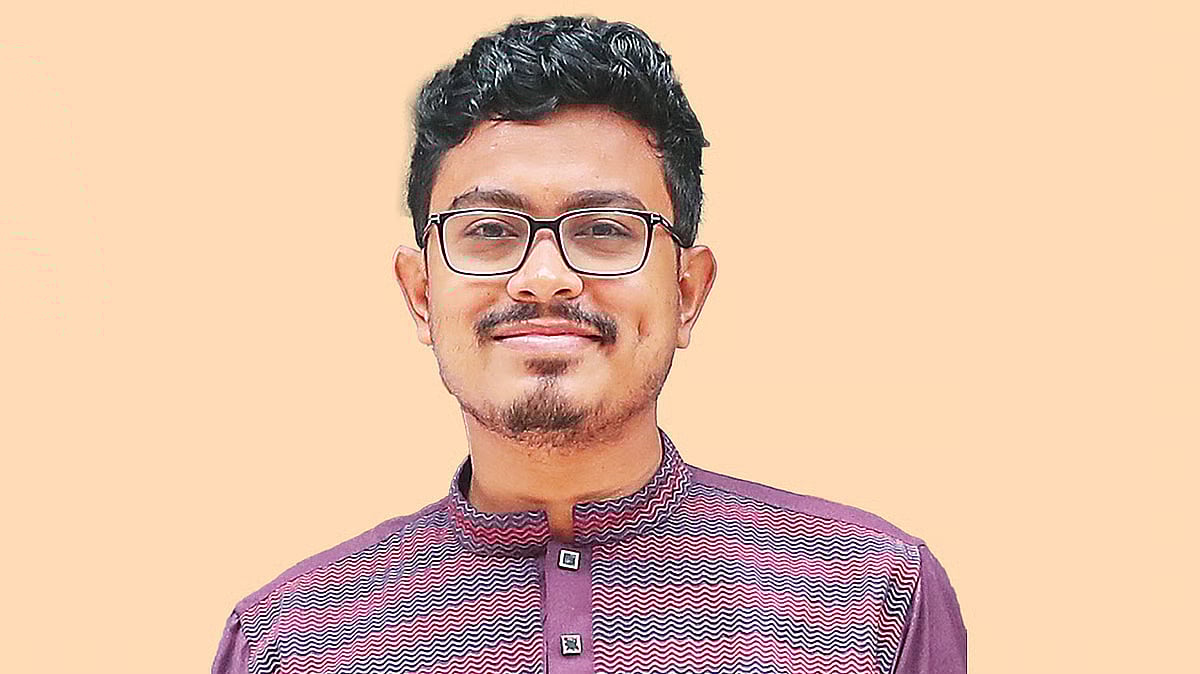
Interview: Shadik Kayem
We’re confident about female students’ votes
Shadik Kayem is the VP candidate from Islami Chhatra Shibir-backed Oikyoboddho Shikkharti Jote (United Students’ Alliance) panel in the upcoming DUCSU election. He was the president of the Dhaka University unit of the Jamaat-e-Islami’s student wing during the July Uprising. Now he is included in the central committee of Islami Chhatra Shibir. Prothom Alo’s Asif Howlader took his interview.
After a long time, your organisation has returned to open politics and is now contesting the student union election. What kind of response are you getting from students?
Shadik Kayem: We are going directly to the students, listening to their hopes and expectations, and sharing with them our roadmap for solving their problems. We are visiting dormitory rooms, departments, and institutes.
Alongside this, our campaign is running online as well. For the past year, we have been involved in various student-friendly activities—whether addressing financial hardship, safety concerns, or academic crises. So, students already know us, and we are receiving spontaneous and positive responses during our campaign.
You have not fielded panels in the hall union elections. Yet, it is said that some of your members are contesting. What exactly is your strategy here?
Shadik Kayem: During the July Revolution, on 17 July, students clearly said they did not want organisational student politics (committee formation) in the halls. We urged the university administration, through an official email, to seek students’ views on this matter, but they have not done so. Under such circumstances, putting forward hall panels or forming committees would mean going against students’ wishes.
However, with the elections approaching, many students are now reaching out to us. Whoever approaches us, we try to work together with them in a spirit of cooperation.
It is widely believed that your panel is weak in two crucial areas: garnering female students’ votes and the Jagannath Hall votes. How do you respond?
Shadik Kayem: That’s nothing more than propaganda. Our panel will win the highest share of women students’ votes. We are confident about the women’s vote, though admittedly we are a little uncertain about the male students.
As for Jagannath Hall, we are in regular contact with students there, and I have already campaigned on-site. Personally, I grew up in Khagrachhari, with Hindu friends living next door and Chakma friends nearby. We have excellent social relations. I believe we will carry that spirit of working together for the development of Dhaka University as well.
The students of Jagannath Hall, too, will put their trust in leadership that offers competence, honesty, and integrity. From the conversations I have had, many have reassured me of their confidence in us.
What would you say are your strengths and weaknesses?
Shadik Kayem: We are talking about unity in diversity and about inclusion. Our panel is built on those principles. Even our critics are included in it. We have tried to place individuals in positions according to their expertise.
We have representatives from the Chakma community, both hijabi and non-hijabi women, students with disabilities, and many others. We have also included those who may not agree with us ideologically. One of our greatest strengths is this openness and our attempt to forge unity within diversity. We are sending a message through our panel: rightists, leftists, and centrists must all work together for the country.
Since many cannot challenge us on the basis of ideas, ideals, or competence, they resort to vilification. We are constantly being targeted with propaganda and labels. Some are obsessed with finding ways to block us. Our approach is not to retaliate or engage in mudslinging but to present students with solutions to their problems and a vision of a dream campus. Perhaps that can even be seen as our weakness.
How hopeful are you about your panel’s chances of winning?
Shadik Kayem: We are witnessing students’ spontaneous enthusiasm and support. After the July Revolution, much of the leadership became tainted with corruption in various ways. In contrast, we have stood beside students throughout the year and have carried the aspirations of July into every space through our student-friendly initiatives.
We will walk with students on the path to building their dream campus. We want to create a safe campus—and we are particularly committed to ensuring safety for female students. Until that goal is achieved, we will not stop.
Thank you.
Shadik Kayem: Thank you too.