EC primary scrutiny
Prothom Alo investigation: Political parties’ central offices at houses, factories, coaching centres
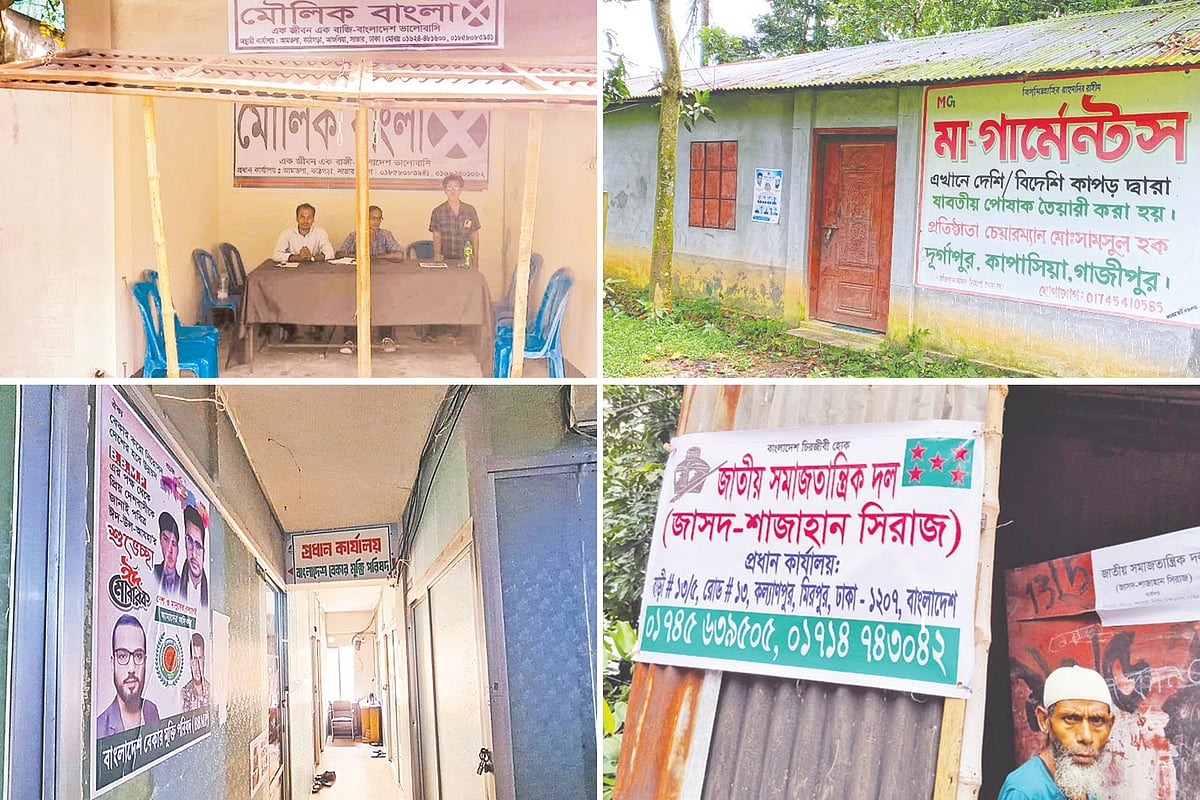
At the end of a narrow alley stand several small, old, rusted tin-shed houses. Each is a single-room unit. These modest dwellings—locally known as chapras—are rented by low-income workers to support their families. However, one of these rooms is different: it now serves as the central office of the Jatiya Samajtantrik Dal (JASAD-Shajahan Siraj), one of the 22 political parties deemed eligible in the election commission's preliminary scrutiny for registration.
This party operates its political activities from that tin shed on Road No. 13 in Kallyanpur, Dhaka. Another party considered eligible for registration, the Bangladesh Solution Party, has listed its central office as a small, now-closed clothing factory in a village in Kapasia, Gazipur. Meanwhile, the Bangladesh Bekar Samaj (BABES) listed an address as their central office which, in reality, is the residence of the party president’s son.
From 23 to 25 August, Prothom Alo conducted on-the-ground verification of the 22 parties that were deemed eligible by the election commission. The newspaper visited each address listed as the central office in their registration applications. Of the 22 parties, 19 have their central offices in Dhaka, while the other three are based in Savar, Keraniganj, and Kapasia (Gazipur). The investigation involved three staff correspondents and two correspondents from Prothom Alo, who inspected the offices, interviewed party leaders, and gathered relevant data.
Many political parties think that if they obtain registration, they can use it to gain their purposes. They can become members of parliament by allying with a major party. In Bangladesh, becoming an MP is still the most profitable business.Abdul Alim, former member of Electoral System Reform Commission
Of the listed addresses, 4 central offices are located in residential buildings or private homes. These belong to the Bangladesh Bekar Samaj (BABES), Bangladesh Justice and Development Party, Jatiya Samajtantrik Dal (JASAD-Shajahan Siraj), and Janatar Dal.
Two parties could not be traced at the addresses they provided. For instance, the Notun Bangladesh Party listed an address in Malibagh Chowdhurypara, but no one in the building was aware of such a party. When Prothom Alo contacted the party’s chairman, retired Major Sikdar Anisur Rahman, he explained that the office had been rented through a party worker without informing the building owner that it would be used for political purposes. When the landlord objected, the office was shifted to a building near the ECB Square. He claimed the election commission was informed of the change via letter.
On the other hand, Bangladesh Jatiya League listed its central office as being located in “Tanpara Ati, Keraniganj.” However, a field visit to various nearby areas of Ati—such as Daripara, Badshar Mor, Panchdona, and Tebargram—found no trace of any place called "Tanpara Ati." Multiple locals stated they had never heard of such a location.
On 23 August, Prothom Alo contacted Mahbubul Alam, chairman of the Bangladesh Jatiya League, by phone regarding the issue. At the time, he stated that the party office was located somewhere around the Ghatarchar area of Keraniganj, but he could not provide a specific address. He then disconnected the call.
Later, on the night of 28 August, Prothom Alo again reached Mahbubul Alam by phone. This time, he said the party’s central office had been relocated to Mazar Road in Mirpur, Dhaka, and claimed that the election commission (EC) had already visited and inspected the office.
Among the 22 parties deemed initially eligible for registration, 12 have their central offices in commercial buildings. These parties are: Forward Party, Amjonotar Dal, Bangladesh Sangskarbadi Party (BRP), Bangladesh Nezami Islam Party, Bangladesh Samajtantrik Dal (Marxist), Janata Party Bangladesh, Bangladesh Aam Janagon Party, National Citizen Party (NCP), Bhasani Janashakti Party, Bangladesh Bekar Mukti Parishad, Bangladesh Communist Party (Marxist) – CPB(M), Jamiat Ulema-e-Islam and Nezami Islam Party
Among the remaining 4 parties, the Moulik Bangla Dal provided an address in Savar. Upon visiting the location, it was found to be a semi-concrete single room from which the party is operating. Nearby is a house, a rickshaw garage, and a grocery shop.
The other 2 parties are: Bangladesh Ganatantric Party (BDP) and Jatiya Janata Party (JJP)
Leaders of the Jatiya Janata Party claim that the building housing their office in Wari, Dhaka, is owned by the party itself.
Conditions for party registration
To participate in the national parliamentary elections with a party symbol, a political party must be registered with the election commission (EC). This time, 147 parties applied for registration. Of these, 22 passed the preliminary scrutiny, and the EC aims to complete field-level verification of these parties by 31 August. Currently, 50 parties are registered with the EC. In addition, the EC has suspended the registration of the Awami League, which is currently banned from political activity.
Currently, 50 parties are registered with the EC. In addition, the EC has suspended the registration of the Awami League, which is currently banned from political activity.
To qualify for registration, a party must meet several key requirements set by the EC, including:
A functioning central committee and an active central office
Active district offices in at least one-third of administrative districts
Offices in at least 100 upazilas, with each having a minimum of 200 registered voters as party members
Alternatively, if a party has had at least one elected MP in the past or secured at least 5 per cent of the vote in a previous national election, it may also qualify for registration.
Ahead of the 2024 national election, 93 parties applied for registration. However, only two were granted registration: Bangladesh Jatiyatabadi Andolon (BNM) and Bangladesh Supreme Party (BSP).
These decisions by the EC sparked significant controversy and criticism. Ten parties that were denied registration held a press conference and alleged that the EC had approved two "ghost" parties under government pressure and based on recommendations from various agencies.
Before the 2018 national election, 76 political parties applied for registration, but none were approved.
Party office inside a village factory
In its registration application, the Bangladesh Solution Party listed its central office address in Kapasia, Gazipur. However, the election commission’s (EC) list did not mention any specific address for the party.
To investigate, a Prothom Alo correspondent visited the College Mor area of Kapasia Upazila on 23 August. Local residents could not provide any information about the party. During conversations, one person mentioned that a businessman from Durgapur village in Durgapur Union of Kapasia had revealed a party called Solution Party. This businessman used to sell masks during the COVID-19 pandemic.
The EC’s list included the phone number of the party's president, Shamsul Haque. When contacted over the phone and asked about the party’s office location, he replied, “We’re currently tied up with election office matters. I won’t be able to meet for a couple of days... we’re organising things and running around.”
Later, when visiting Durgapur village, Prothom Alo spoke with Shamsul Haque’s father, Abdul Motaleb. He said his son was busy with party activities. When asked where the party office was, he replied that his son has a semi-pucca four-room garment factory beside their house, and that is being used as the party office.
Party operates from leader’s son’s apartment
The Bangladesh Bekar Samaj (BABES) uses the drawing room of a flat on the third floor of house 131/1A on Crescent Road in Dhaka as its central office. The flat is occupied by the son of the party’s founding president, Md Hasan.
Speaking to Prothom Alo over the phone, Md Hasan said, “The central office of the party is in my own house. Party activities have been going on here for 10 to 12 years. We’re a small party and face many limitations. Since we can’t leave the office empty, my son and his family live there.”
Inside a coaching centre
The Forward Party listed its central office address as the second floor of House No. 1 on Road No. 2 in Dhanmondi. When visited around noon on 24 August, it was found that a poster of the party was stuck on the entrance wall of the building. On the second floor is the Scholars Coaching Centre, and access to the Forward Party’s office is through the coaching centre.
An official of the coaching centre, speaking anonymously, said that the Forward Party uses two rooms, and its members visit occasionally.
When contacted over the phone, the party's general secretary, Md Mahbubul Alam, said, “In compliance with the election commission’s requirements, we have party committees in 22 districts and 100 upazilas across the country.”
A one-room central office
The central office of the Bangladesh Communist Party (Marxist) – CPB (M) is located in a single room on the sixth floor of the Bangladesh Shishu Kalyan Parishad building on Topkhana Road. When Prothom Alo visited on 23 August, the room had a small table, about a dozen plastic chairs, a hand microphone, and a few register books. However, there was no computer or printer in the office.
A man named Monir was present at the time. He said he moves around with the party’s convener, Abdus Samad, though he does not hold any official position in the party. He provided the phone number of Taleb Islam, saying he was the right person to speak with about the party’s affairs.
Prothom Alo tried calling and messaging that number multiple times but received no response.
The central office of the Bhasani Janashakti Party is also a single room, located on the third floor of Building 11 in Purana Paltan. Inside, there are several portraits of Maulana Abdul Hamid Khan Bhasani, as well as one of Zafrullah Chowdhury. However, the top leaders of the party do not sit in this room. They use another room on the same floor, designated as the metropolitan office, which is noticeably cleaner than the central office.
Party general secretary Abu Yusuf told Prothom Alo that their previous registration application was rejected in 2022. That’s why they have reapplied under the new name “Bhasani Janashakti Party” instead of “Bhasani Onushari Parishad.” They have requested "Palm-fiber Cap" as their electoral symbol.
In the case of Jatiya Samajtantrik Dal (JASAD–Shajahan Siraj), which operates from a tin-roofed one-room office, general secretary Abdul Jalil said to Prothom Alo that former MP Shajahan Siraj had once been elected from their party. Based on that, they have applied for registration and requested the symbol “Doat Kolom.”
On the other hand, party president Moazzem Hossain Khan Mojlish told Prothom Alo, “The election commission requires parties to have an office. We have fulfilled that requirement. If we receive registration, we’ll get a bigger office.”
Office on the rooftop
The Jamiat Ulema-e-Islam and Nizami Islam Party is operating its central office from a rooftop room at House 50/3 on Northbrook Hall Road in Old Dhaka. From the outside, there is no indication that the building houses a political party office.
When Prothom Alo visited the office on 24 August, the room contained some chairs and tables but no computers or printers.
Rabiul Islam, the party’s assistant general secretary, said their registration applications had been rejected four times before. When asked about the party’s activities, he advised speaking to the party's general secretary.
Later that day, Prothom Alo contacted the general secretary, Mufti Mohammad Abdul Qayyum, by phone. He said he was busy with registration work and would speak later.
Prothom Alo tried several more times to reach him. On one occasion, he sent a photo of a handwritten paper via WhatsApp, which stated that the central committee consists of 51 members and was restructured on 26 August 2023. When asked for the party constitution and details of district and upazila-level committees, he did not respond.
Party position unknown to leader himself
Among the places outside Dhaka where Janatar Dal has formed committees is Daulatpur upazila in Manikganj district. According to a list collected from the party, the name of the general secretary of the Daulatpur upazila committee is listed as Mozzafar Dewan. Yet Mozzafar Dewan himself has no idea that he has been given a party post.
Speaking to Prothom Alo over the phone on 24 August, Mozzafar Dewan said, “I do not belong to any political party. I am just a helpless man. I work as a day labourer in agriculture. Sometimes I write songs and poems. A man named Mokhshed took my voter ID (national identity card) on the pretext of providing financial assistance. Perhaps that same person inserted my name into the party committee.”
Two parties seek ‘Dhenki’ symbol
The central office of the Bangladesh Reformist Party (BRP) is on the third floor of building number 40/1 in Segunbagicha. The staircase leading up to the office is so narrow that two people cannot walk side by side.
Inside, the three-room office is however tidy. On 23 August, party vice chairmen Mazharul Islam and Mehedi Hasan spoke at the office. They said the party has a 570-member central committee and has applied to the Election Commission (EC) for the ‘Dhenki’ (traditional rice husking pedal) as its electoral symbol.
The Bangladesh Democratic Party (BGP) has also applied to the EC for the ‘Dhenki’ symbol. This party’s main office is located at house number 47 in sector 12, Uttara. Visiting the address revealed it to be an under-construction building. On 23 August, BGP chairman SM Shahadat and secretary general Saiful Alam spoke to Prothom Alo at their makeshift office in one corner of the parking area, partitioned with white cloth.
S M Shahadat said the party’s permanent office will be on the second floor of the under-construction building. As the floor is not yet finished, they are temporarily operating from the parking lot. He added that the party aligns with BNP as a like-minded ally and, if granted registration, intends to contest elections with the ‘Dhenki’ symbol.
Graffiti of uprising on office walls
The temporary central office of the National Citizen Party (NCP) is on the 16th floor of Rupayan Tower in Banglamotor. The walls of the office are covered with graffiti depicting mass uprisings.
The front section of the office is equipped with modern facilities for press conferences or meetings. There are separate rooms for the party’s convener and member secretary, as well as several rooms designated for senior leaders. NCP’s central committee has 216 members. The party has committees in most districts outside Dhaka, as well as at city, upazila, and thana levels.
Parties registered despite unmet criteria
The Election Commission (EC) introduced the rule of political party registration ahead of the ninth national parliamentary elections in 2008. Generally, the EC invites applications for party registration before parliamentary elections.
However, some political parties in the past obtained registration despite not fulfilling the required conditions, former member of the Election System Reform Commission Abdul Alim told Prothom Alo.
He said many political parties think that if they obtain registration, they can use it to gain their purposes. They can become members of parliament by allying with a major party. In Bangladesh, becoming an MP is still the most profitable business. From this idea, small political parties are trying to commercialise politics without meeting any conditions. To stop this, the law on political party registration must be reformed.”
Shamsuzzaman, Staff Reporter, Savar; Iqbal Hossain, Correspondent, Keraniganj; and Sadik Mridha, Correspondent, Sripur, Gazipur contributed reporting.