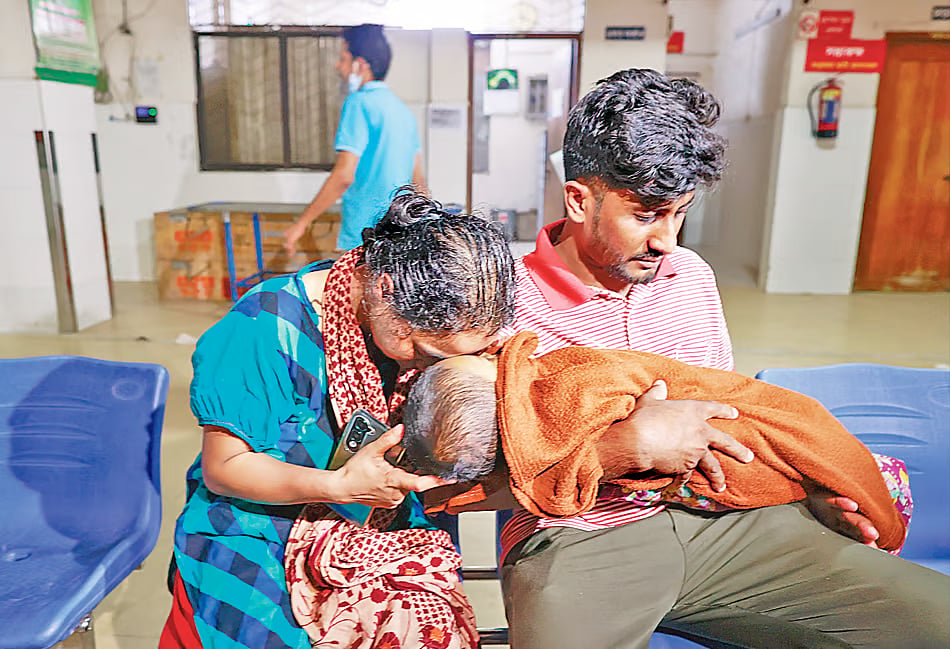
Children received neither vaccines nor vitamin A, measles deaths rising also due to malnutrition
Many children across the country are contracting measles because they did not receive vaccines on time. The death toll is also increasing everyday.
Children have not received Vitamin A supplements on schedule either. The rate of breastfeeding among mothers has declined as well. Experts say malnutrition has made children far more vulnerable.
Meanwhile, yesterday, Friday, the Integrated Control Centre of the Directorate General of Health Services reported the deaths of seven more children from measles.
In a press release, the centre stated that, during the latest 24-hour period (from 8:00 am Thursday to 8:00 am Friday), six children died with measles symptoms and one child died from confirmed measles.
From 15 March to yesterday, Friday, 343 children across the country have died from measles and measles-like symptoms.
Child health and public health specialists believe measles is a preventable disease. They say timely and appropriate measures could have prevented so many child deaths. Alongside vaccination, proper nutrition also protects children.
Public health specialist and former chief scientific officer of the government’s Institute of Epidemiology, Disease Control and Research, Mushtuq Husain told Prothom Alo, "A series of injustices has been committed against children."
"There has been no campaign promoting breastfeeding, no Vitamin A campaign, and children have not received deworming medication properly. All of this has increased malnutrition. On top of that, children became unprotected after failing to receive measles vaccines on time. The result is this outbreak and so many deaths," he added.
Children becoming vulnerable
Under the Expanded Programme on Immunisation (EPI), children in the country routinely receive the first dose of the measles vaccine at nine months of age and the second dose at 15 months.
To make the vaccination programme effective, authorities need to bring 95 per cent of children under vaccine coverage; however, that target has not been achieved in practice.
The 2023 EPI evaluation report showed that only 82 per cent of children received the vaccine. In other words, 18 per cent or more children remain outside vaccination coverage every year.
At a roundtable discussion organised jointly by UNICEF and Prothom Alo on Wednesday, UNICEF Health Manager Riad Mahmud said in his presentation that 85 per cent of children infected with measles are under five years of age.
A series of injustices has been committed against children. There has been no campaign promoting breastfeeding, no Vitamin A campaign, and children have not received deworming medication properly. All of this has increased malnutrition. On top of that, children became unprotected after failing to receive measles vaccines on time. The result is this outbreak and so many deaths.Mushtuq Husain, Public health specialist
Even more alarming, 65 per cent of infected children had received no vaccine at all, while 21 per cent were only partially vaccinated.
Epidemiologists said the number of children excluded from vaccination has increased over several years.
When the number of unvaccinated children becomes equal or close to the number of children born in a single year, outbreaks of diseases such as measles occur.
Authorities usually bring children who miss routine immunisation programmes under vaccination coverage through national campaigns. The most recent campaign began in December 2020 and ended in January 2021.
The next campaign was scheduled for January 2025. Authorities later moved the date to September, but postponed it again because of a typhoid vaccination campaign.
Elections then further delayed the programme. This year’s campaign finally began on 20 April. However, measles had already spread throughout the country before the campaign started.
Children victims of negligence
Not only did children receive measles vaccines on time, they also did not receive Vitamin A supplements on schedule.
Child health specialist and former head of the pediatrics department at Dhaka Medical College, Abid Hossain Mollah, told Prothom Alo, “Vitamin A performs many functions. It helps maintain proper cellular function in the body. Vitamin A also helps produce tears in the eyes. A deficiency of Vitamin A can cause night blindness and may even lead to visual impairment. In addition, Vitamin A strengthens disease resistance.”
Nutritionists said that 7.5 per cent of people of all age groups in the country suffer from Vitamin A deficiency. The rate is higher among children.
Authorities organise Vitamin A campaigns twice a year to address Vitamin A deficiency among children. However, during the tenure of the previous interim government, those campaigns also failed to take place properly.
Malnutrition weakens immunity. If an undernourished child does not receive vaccination, the risk of infection increases many times over. If the child also fails to receive proper treatment, the risk of death rises as well.Abid Hossain Mollah, Child health specialist
Director of the government’s National Nutrition Institute, Md Yunus Ali, told Prothom Alo yesterday, Friday, that the most recent Vitamin A campaign took place in March 2025.
Authorities had planned the next campaign for November–December 2025, but it did not take place.
Like Vitamin A supplementation, children are also being deprived of breast milk. Vaccine specialist and former deputy programme manager of the EPI, Tajul A Bari, told Prothom Alo, “Breast milk strengthens immunity. Infants should receive only breast milk during the first six months after birth (exclusive breastfeeding). However, a huge number of children are not receiving it; rather, the rate is declining.”
Nutritionists said that 7.5 per cent of people of all age groups in the country suffer from Vitamin A deficiency. The rate is higher among children. Authorities organise Vitamin A campaigns twice a year to address Vitamin A deficiency among children. However, during the tenure of the previous interim government, those campaigns also failed to take place properly.
The latest Demographic and Health Survey (2022) showed that only 53 per cent of children receive exclusive breastfeeding up to six months of age.
Four years earlier, the figure stood at 65 per cent. In other words, a vast number of children in the country are not receiving breast milk.
UNICEF health manager Riad Mahmud also highlighted the current breastfeeding situation during the roundtable discussion. In his presentation, he said that the rate stood at 56.6 per cent in 2025.
Another example of neglect towards children is the failure to observe National Deworming Week.
Authorities last observed National Deworming Week in May 2024. The programme usually takes place twice a year.
An official from the Disease Control Branch of the Directorate General of Health Services, speaking to Prothom Alo on condition of anonymity, said that authorities did not conduct the National Deworming Programme in 2025, despite having already purchased deworming tablets.
Child health specialist Abid Hossain Mollah said, “Malnutrition weakens immunity. If an undernourished child does not receive vaccination, the risk of infection increases many times over. If the child also fails to receive proper treatment, the risk of death rises as well.”