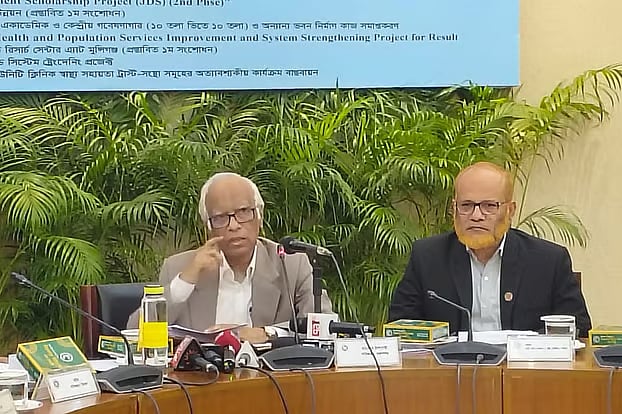
Implementing so many reforms may be difficult for elected govt: Planning adviser
Planning adviser Wahiduddin Mahmud said it may be somewhat difficult for an elected government to fully implement all these reforms.
“We believe the interim government implemented a large number of reforms, many of which were high-end or ambitious. I hope that most of the reforms, or at least their essence, will be adopted," he added.
Wahiduddin Mahmud made these remarks to journalists after today’s meeting of the Executive Committee of the National Economic Council (ECNEC).
Wahiduddin Mahmud further said, “We are leaving behind many ordinances. For example, there is an ordinance to make the judiciary independent. The new government will certainly review whether the judiciary has been given too much independence. In some cases, this may feel uncomfortable.”
The planning adviser explained that making the judiciary fully independent means that the law ministry no longer controls many matters. The judiciary has become autonomous. These are significant reforms.
During this time, Wahiduddin Mahmud highlighted various sectoral reform committees, the Bangladesh Bureau of Statistics (BBS), procurement policies, and other reforms. He expressed hope that the next National Parliament will review these ordinances and turn them into laws.
Wahiduddin Mahmud also noted that problems with project directors remain. The challenge is that now few people want to become project directors, and contractors are also less enthusiastic.
He added, “From what I have heard, corruption has not decreased significantly, and extortion still occurs.”
At today’s ECNEC meeting, a total of 17 projects were approved, with a total cost of Tk 153.83 billion.
Of this, government funding amounts to Tk 94.51 billion, project loans total Tk 56.10 billion, and the implementing agencies’ own funding is Tk 3.79 billion.
The meeting was held at the NEC Conference Hall in Sher-e-Bangla Nagar under the chairmanship of chief adviser and ECNEC Chairperson Professor Muhammad Yunus. Among the approved projects, 13 are new, and 5 are revised.