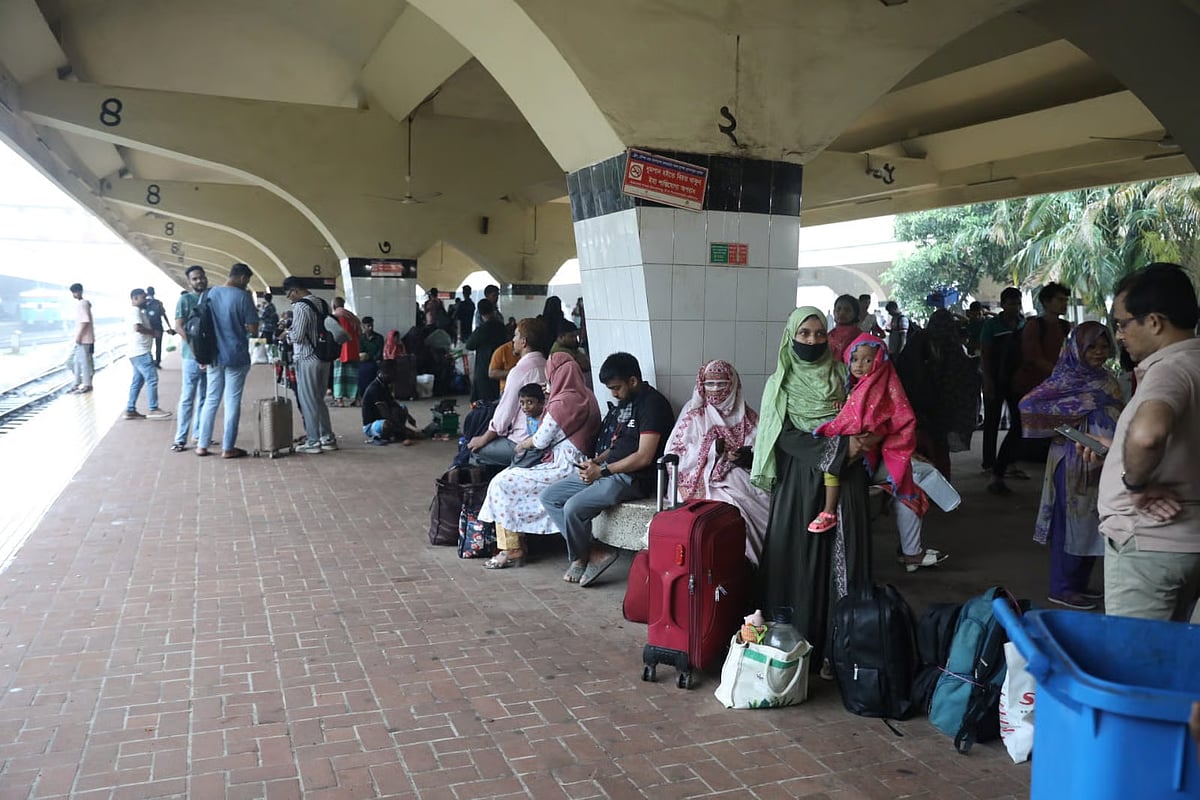
Fear of rising measles cases amid Eid travel
Millions of people are leaving the capital to celebrate a joyful Eid with their relatives. This is a regular occurrence and no exception this year. However, amid a measles outbreak, experts fear that Eid travel could further increase infections. They also expressed disappointment at what they see as a lack of government attention to the issue.
The Eid-ul-Azha holiday began today, Monday. However, people had already started leaving Dhaka before that. This movement will continue until Thursday, the day before Eid. Researchers at the Bangladesh University of Engineering and Technology (BUET) have shown that between 12 million and 15 million people leave Dhaka during the three to four days before Eid.
A measles outbreak emerged in the country at the beginning of this year. Deaths from measles and its complications have already exceeded 500. The number of identified patients has surpassed 60,000.
As the situation worsened, the government launched a special vaccination campaign on 5 April, but infections and deaths are not declining. As a result, public concern and anxiety are also increasing.
Virologist and former vice-chancellor of Bangladesh Medical University (formerly BSMMU), Nazrul Islam, public health expert Be-Nazir Ahmed, and child health specialist Professor Abid Hossain Mollah have warned that increased crowding during Eid travel, mass movement of people, and greater contact among children could lead to wider transmission.
According to these experts, extra caution is essential this Eid despite the festive mood. Even minor carelessness could trigger a major new wave of infections.
‘Infections may rise further after Eid’
Between 18 and 24 May, 64 people died from measles and its complications. During the previous seven days, 40 people had died.
Professor Nazrul Islam told Prothom Alo that given the way measles has spread across the country, there is concern that infections may rise further after the Eid holidays.
Explaining the reason, Nazrul Islam said that measles is an extremely contagious viral disease that mainly spreads through respiration. A child who has not yet been infected may become infected if they travel to an area where measles is already widespread and come into contact with an infected child.
There is also excessive crowding in public transport during Eid travel, which increases the risk, the physician noted. He said that if an infected child is travelling by bus, launch, or train, there is a risk that other children in the same environment could also become infected.
‘Children may become infected in hotspots’
Public health expert Be-Nazir Ahmed said measles may spread in two ways during the Eid holidays.
First, a family may travel to an area that is already a measles “hotspot.” A healthy child may become infected there. Second, if an infected child travels while already showing symptoms, they may spread the infection to others along the journey or at the destination.
Be-Nazir Ahmed told Prothom Alo that measles treatment management outside Dhaka is very weak, and this has already been proven. Therefore, if a child becomes infected after travelling to a remote area, the situation could become critical.
Be-Nazir Ahmed advised that unless absolutely necessary, it would be better to avoid long journeys with children under the age of five this time.
What kind of precautions are needed
Child health specialist Professor Abid Hossain Mollah believes that raising awareness, rather than creating panic, is now the most important task.
According to experts, some basic precautions during Eid travel can reduce the risk of infection. Parents, in particular, should be extra cautious with children.
Professor Nazrul Islam said parents should definitely wear masks. However, using masks for children is not always easy, and that should also be taken into consideration.
Physicians said if a child has symptoms such as fever, red eyes, cough, or rashes on the body, it is better not to travel with them. They also advised avoiding crowded places, unhygienic environments, and contact with infected individuals.
Since the measles virus spreads through the air, Professor Abid Hossain Mollah advised avoiding crowds with children. He told Prothom Alo that if the trip can be avoided or postponed, then it is preferable not to take children aged five or younger this time (during Eid). However, people’s emotions are involved in this matter. Therefore, the most important thing is to remain cautious.
Government ‘lacks attention’
This Eid, private-sector employee Sanaullah was particularly cautious while travelling to his village home with his two children because of measles concerns. One child is seven years old, while the other is over four. Sanaullah travelled by launch with his wife and two children to Borhanuddin upazila in Bhola. They boarded the launch from Sadarghat in Dhaka.
Sanaullah said he had not seen any instructions on how people could travel safely amid the measles outbreak. He said, “I have not noticed any public awareness campaign on this issue. I have been careful, but many others may not be.”
Experts also said they do not see government attention being given to the issue of Eid travel despite rising measles infections.
Professor Abid Hossain Mollah said, “There needs to be extensive government-led public awareness campaigns regarding measles. We are not seeing much of that.”
Professor Nazrul Islam echoed the same concern. In his words, “It feels as though the government has been inattentive. Perhaps there is an attempt to portray the disease as something minor.”
The government has already cancelled leave for doctors and nurses responsible for treating measles patients and instructed them not to leave their workplaces.
However, former Director General of the Directorate General of Health Services, Be-Nazir Ahmed, said this is not the real solution.
Be-Nazir Ahmed said, “Giving instructions to doctors and nurses in this way is the easy route. Issuing a circular is enough. But there seems to be little initiative to prevent the disease from spreading.”
According to Be-Nazir Ahmed, the government should now focus primarily on increasing public awareness, intensifying surveillance in affected areas, and ensuring vaccination for children.
When asked for comments on the matter, Professor Halimur Rashid, Director of the Disease Control Branch of the Directorate General of Health Services, declined to comment.