Roundtable
Measles cases have decreased in 30 upazilas after vaccinations
Amid the measles outbreak, vaccines were administered last month in the first phase across 30 high-risk upazilas. After one month, it was observed that the number of measles cases in these upazilas had dropped to nearly zero.
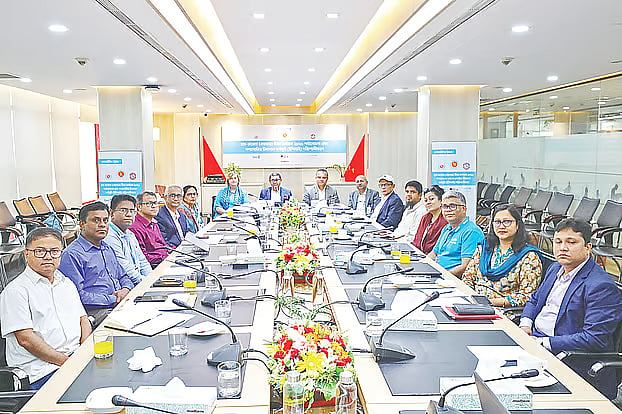
This was stated at a roundtable discussion titled ‘Review of the Measles-Rubella Vaccination Campaign 2026 and Strengthening the Expanded Programme on Immunization (EPI).’ The event was held yesterday, Wednesday, at the Prothom Alo office in Karwan Bazar, of the capital.
The presentation at the meeting stated that the success rate of the ongoing Measles-Rubella (MR) vaccination campaign across the country is 93 per cent. However, to effectively control the infection, it is essential to ensure at least 95 per cent coverage through routine immunisation.
The meeting, jointly organised by UNICEF and Prothom Alo, was attended by government policymakers, health experts, and representatives of international organisations. The roundtable discussion was held at the Prothom Alo office in Karwan Bazar, the capital.
Speaking at the event, the chief guest, Health and Family Welfare Minister Sardar Md. Sakhawat Hossain, said that the danger posed by the measles outbreak was extremely severe. Those who worked in the field could truly realise the extent of its devastation.
Expressing gratitude to private pharmaceutical companies for providing ventilator support on time, he said that without those ventilators, the death toll would have been even higher. Another 10 ventilators are expected to arrive within the next two to three days.
Referring to mismanagement in the health sector by the interim government, the health minister claimed that the former health adviser had not left even ten taka in the fund for expenditures. He added that 1.5 million doses of measles vaccine arrived in the country yesterday. There will be no further vaccine shortages in the future. By 10 May, a total of 108 million doses of vaccines for 10 diseases, including measles, will arrive in the country.
65 per cent of the measles patients were unvaccinated
The keynote presentation at the discussion was delivered by UNICEF Health Manager Riad Mahmud. The presentation stated that due to the rising number of measles infections among children, the Measles-Rubella (MR) vaccination campaign was launched ahead of schedule. The program, implemented in three phases, first targeted high-risk municipalities and upazilas, then major city corporations, and finally expanded nationwide. The campaign currently has a 93 per cent success rate, with a goal of increasing it to 100 per cent. In the 30 upazilas covered in the first phase, the number of cases has nearly dropped to zero.
On 5 April, the government launched a vaccination campaign in 30 upazilas across 18 districts considered at high risk for measles infection. The covered areas include: Barguna Sadar and municipality; Pabna Sadar, municipality, Ishwardi, Atgharia, and Bera; Chandpur Sadar, municipality, and Haimchar; Maheshkhali and Ramu in Cox’s Bazar; Gazipur Sadar; Chapainawabganj Sadar and municipality, Shibganj, and Bholahat; Atpara in Netrokona; Mymensingh Sadar, Trishal, Tarakanda, and Srinagar; Godagari in Rajshahi; Mehendiganj and Bakerganj in Barishal; Porsha in Naogaon; Jashore Sadar and municipality; Natore Sadar; Munshiganj Sadar and municipality, Louhajang; Madaripur Sadar and municipality; Nawabganj in Dhaka; Nalchity in Jhalokathi; and Jazira in Shariatpur.
UNICEF Representative in Bangladesh Rana Flowers said that in the future, rather than relying solely on campaigns, the routine immunisation program must be strengthened further. To achieve this, she emphasised reinforcing integrated primary healthcare and ensuring related services such as nutrition and family planning together
On 12 April, vaccination began in Dhaka North and South City Corporations, as well as in the Mymensingh and Barishal City Corporations. Then, from April 20, the measles vaccination campaign was launched nationwide. However, the presentation also highlighted challenges related to the routine immunisation program (EPI). It stated that at least 95 percent vaccine coverage is necessary to prevent infection effectively. However, the rate of receiving the second vaccine dose remains comparatively low.
According to the data presented on the measles outbreak, 85 per cent of infected children are under five years of age. Even more concerning is that 65 per cent of the infected children had received no vaccination at all, while 21 per cent were only partially vaccinated.
Malnutrition also a factor
At the roundtable discussion, the Prime Minister’s Special Assistant for Health, Ziauddin Haider, said that one-third of children infected with measles were under nine months old. Calling the issue alarming, he said that children are supposed to receive antibodies from their mothers after six months of age. Even if children are breastfed, it is urgently necessary to examine whether the breast milk contains sufficient vitamin A or other antibodies.
Ziauddin Haider believes that nearly all children who died from suspected measles in the country were suffering from malnutrition. In his view, vaccination programs alone are not sufficient to prevent measles. He said that 24 percent of children under five in the country suffer from malnutrition. Therefore, attention must also be given to children’s nutrition.
Emphasis on routine vaccination
UNICEF Representative in Bangladesh Rana Flowers said that in the future, rather than relying solely on campaigns, the routine immunisation program must be strengthened further. To achieve this, she emphasised reinforcing integrated primary healthcare and ensuring related services such as nutrition and family planning together.
The country must develop quality local vaccine production capacity to reduce dependence on importsFirdousi Qadri, Chairperson, National Immunisation Technical Advisory Group
Rana Flowers also said that attention should be paid to school-based vaccination systems. Checking vaccination cards at the time of school admission would make it easier to identify children who were left out. In her opinion, lessons must be learned from recent experiences to ensure that no vaccine shortages occur in the future.
Call for local vaccine production
Firdousi Qadri, chairperson of the National Immunization Technical Advisory Group — the technical committee that provides recommendations on vaccination — said that the country must develop quality local vaccine production capacity to reduce dependence on imports. She stressed upgrading the National Drug Control Laboratory to meet World Health Organization standards.
Hasanul Mahmud, Assistant Director of the Expanded Programme on Immunization (EPI), discussed the evolution of the vaccination program and its current capabilities. He said that EPI is currently providing vaccines against 12 diseases. Capacity has been achieved to store three months’ worth of vaccines at the district level and one month’s supply at the upazila level. In addition, vaccines can now be stored at the central level for six months to one year while maintaining the cold chain.
Chiranjit Das, National Professional Officer (Immunization) of the World Health Organization (WHO) Bangladesh, said that WHO is working to ensure high-quality vaccination campaigns. Data obtained from surveillance activities are regularly shared with the government so that the ongoing measles outbreak can be addressed effectively.
Challenges remain
Professor Prabhat Chandra Biswas, Director General of the Directorate General of Health Services, said that although vaccination is progressing according to targets, some children are still being left out, which remains a major challenge. Efforts are underway to identify those children and bring them under vaccination coverage.
ATM Saiful Islam, Additional Secretary of the Health Services Division, said that vaccines can become ineffective (invalid doses) if the cold chain is not properly maintained during storage. He emphasised strengthening digital monitoring systems to address this issue.
When to go to the hospital
Pediatric specialist Professor Abid Hossain Molla said that not all children infected with measles need to be hospitalised. However, children should be taken to the hospital immediately if they experience breathing difficulties, inability to eat or drink, excessive vomiting or dehydration, seizures, or complications affecting the eyes and mouth. He added that in most cases, measles recovers within 7 to 10 days.
Others present at the meeting included Abu Ahmmad Al Mamun, Director (MIS) of the Directorate General of Health Services, and Prothom Alo Special Correspondent Shishir Morol. Ricky Salmina, Press Specialist at the US Embassy in Dhaka, attended as an observer. The discussion was moderated by Prothom Alo Assistant Editor Firoz Choudhury.