Roundtable
Social change essential to end online harassment against women
Perpetrators are harassing, defrauding and blackmailing women online in various ways, including by creating fake profiles and generating videos using artificial intelligence (AI).
Over the past five years, the ‘police cyber support for women’ unit has received more than 78,000 complaints relating to cyber violence and harassment against women.
Speakers at a roundtable stated that, in order to prevent such abuse, women must learn how to protect themselves online, while the state must also take proactive steps to ensure their security.
They emphasised that meaningful social change is necessary to end online harassment against women.
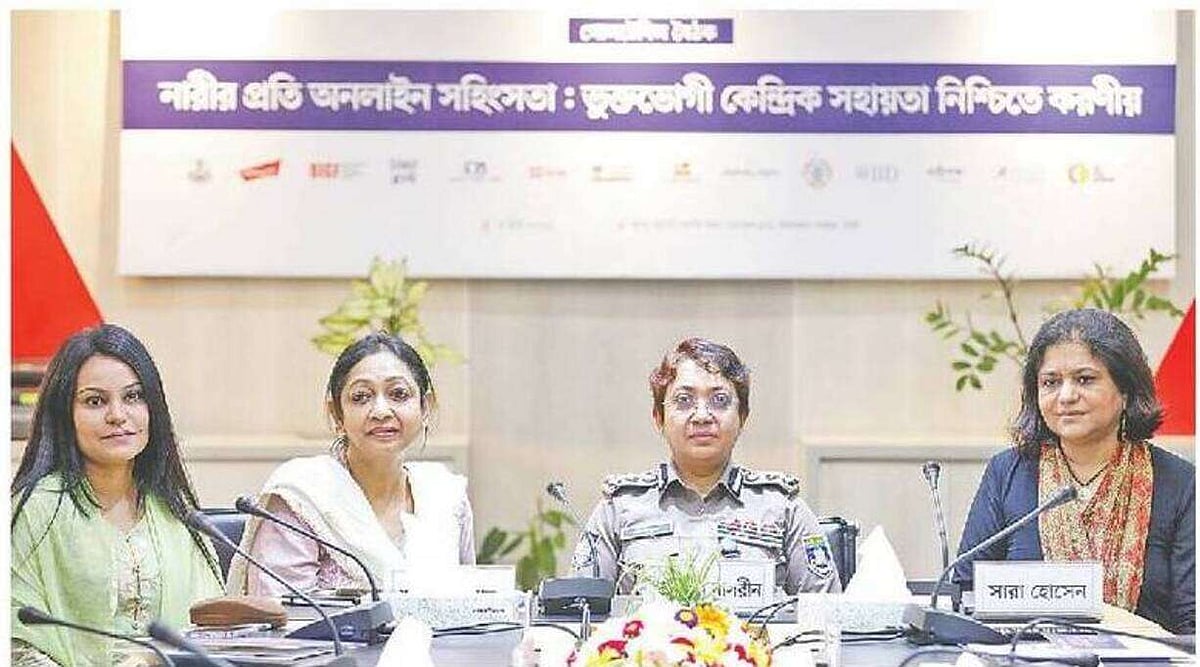
The roundtable, titled ‘Online violence against women: Ensuring victim-centred support’, took place at the Prothom Alo office in Karwan Bazar, Dhaka on Monday. CSWC (Cyber Support for Women and Children) and Prothom Alo jointly organised the event.
Speaking as the chief guest, deputy inspector general (DIG) of police headquarters, Taptun Nasreen said, “We must take measures to ensure that violence against women does not occur online. Many people share a great deal of personal information online in pursuit of ‘views and reach’. By spreading personal information in this way, one exposes oneself to risk.”
“Over the past five years, we have received 87,727 complaints regarding online violence against women. We have taken action in 52,702 of these cases so far. Only 180 cases have proceeded to formal litigation,” she added.
She further remarked, “To prevent cyber violence, we must unite and promote cultural development.”
Sara Hossain, honorary executive director of BLAST (Bangladesh Legal Aid and Services Trust) and senior advocate of the Supreme Court said, “The legal processes to suppress cybercrime do not align with the emergence of new forms of offences. As time progresses, criminals devise new methods. Therefore, we must enact laws more swiftly.”
She added, “A particular group seeks to hold women back. People direct hateful speech against women for various reasons, including misogyny and political retaliation. We need social change to counter this.”
Professor Quazi Mahfujul Hoque of the department of law at the University of Dhaka highlighted weaknesses in collecting and preserving evidence after complaints are filed.
He said, “In cases of online violence, a major problem is that police officers often do not know how to gather and preserve information and evidence for investigation. We must also raise awareness among those responsible for handling these cases.”
Professor Nahreen Islam Khan of the department of geography and environment at Jahangirnagar University noted that she herself faces hateful comments and harassment online on a daily basis.
She said, “The government must take the strongest measures to stop such harassment against women. Political parties also bear responsibility.”
Professor BM Mainul Hossain, director of the Institute of Information Technology at the University of Dhaka, stated, “Doxxing has become one of the most alarming forms of violence against women. Perpetrators publish the victim’s phone number on websites with the intention of harassment. The state and the police will take action, but women must also equip themselves with technological education.”
Sharmin Khan, legal adviser at the International Center for Not-for-Profit Law, said, “Government institutions should appoint officials who possess adequate knowledge of information technology to address issues of cyber violence and digital security.”
Trishia Nashtaran, founder of ‘Meye Network’ said, “In cases of online violence, people tend to focus more on removing the content; however, someone may take a screenshot or store the content. As a result, the digital footprint remains.”
She added, “Social media platforms do not take adequate measures to curb fake accounts and hateful comments because they prioritise revenue. Instead, the State should introduce mechanisms to hold these platforms accountable.”
Afroja Shoma, assistant professor in the Department of Media and Mass Communication at American International University-Bangladesh said, “To ensure women’s safety online, we must strengthen organisational and social power alongside reforming the law.”
Priya Ahsan Chowdhury, adviser to the CSWC platform and advocate of the Supreme Court, said, “If we fail to enforce the law, incidents of violence will continue to rise.”
Kaniz Fatema, former director of Bangladesh Women in Technology (BWIT) said, “We should also conduct research into why individuals commit crimes online.”
Sharmin Akter, programme and coordination officer at Women with Disabilities Development Foundation (WDDF), called for greater attention to the protection of women with disabilities.
She said, “We must include women with disabilities in the process of amending laws and formulating policies against cyber violence.”
Hema Chakma, executive member of the Dhaka University Central Students' Union (DUCSU) said, “Online violence against women has reached an alarming scale. Therefore, the State must assume responsibility for preventing such violence rather than placing the burden solely on individuals.”
Labanya Pragya, a student of the Department of International Relations at the University of Dhaka said, “People are creating harassing content using artificial intelligence (AI). We should therefore begin raising awareness and knowledge about AI from the school level.”
In her welcome remarks, Mahbuba Akter, director (Advocacy and Communications) at BLAST said, “We need victim-centred mechanisms to prevent online violence against women. Most victims do not know where to lodge complaints or where to seek redress.”
Manisha Biswas, legal expert at BLAST and focal person of the CSWC platform, presented the keynote paper titled ‘Women and Technology: Addressing gender-based challenges and necessary measures for legal protection’.
In the paper, she recommended raising public awareness; promoting safe internet use at the school level; strengthening coordination between government and non-government sectors to prevent online violence; safeguarding privacy; handling information collected following complaints with caution; establishing a special wing to remove violence-inciting content; forming cyber cells in every divisional city and police station; centrally monitoring cases and empowering the Bangladesh Telecommunication Regulatory Commission to block harmful links.
Firoz Choudhury, assistant editor of Prothom Alo, moderated the roundtable.