Roundtable
Focus should be on classroom learning
Over the past few decades, Bangladesh has made notable progress in infrastructure and enrolment rates at the primary and secondary levels. However, the quality of learning in classrooms has not reached the desired standard.
The main challenge in education remains the learning deficit. Many children complete primary education without acquiring fundamental skills in mathematics.
As a result, the human resource development framework—“from education to job-oriented skills and from skills to job”—is becoming weak.
Therefore, achieving learning outcomes must now receive the highest priority. Greater attention must be given to classroom teaching. At the same time, emphasis should be placed on inclusive education.
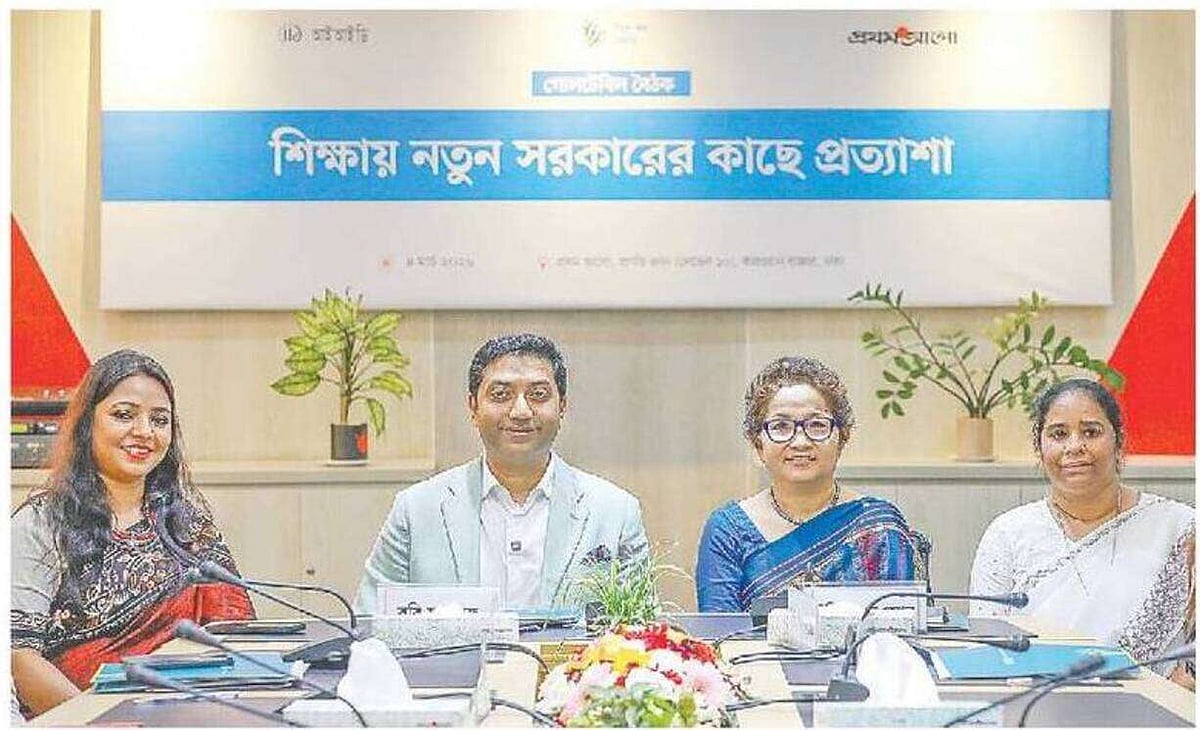
Teachers and stakeholders in the education sector made these observations while participating in the roundtable titled ‘Expectations from the new government in education’, organised jointly by research organisation IID and Prothom Alo.
The discussion took place yesterday, Wednesday, at the Prothom Alo office in Karwan Bazar, Dhaka.
Speaking at the event, State Minister for Primary and Mass Education Bobby Hajjaj said, “Our focus will be on outcome-based and career-oriented education.”
Bobby Hajjaj further said he believes that small changes in education can produce significant long-term improvements. He identified three key areas where such changes are crucial: curriculum, the classroom and continuity.
He said, “If the curriculum is right, if the classroom environment is right and if we maintain continuity, then education will undergo substantial change.”
The state minister added that there are many achievements in primary education that deserve recognition.
The dropout rate has declined considerably. However, at the same time, many students still complete their schooling without proper learning.
He also said the government plans to place strong emphasis on technical education. Alongside this, importance is being given to sports, arts, and culture.
He added that the prime minister has already pledged to allocate a larger share of the national budget to the education sector.
Currently, education spending stands at around 2 per cent of GDP. He said this will be increased to 5 per cent adding, “This is the prime minister’s commitment.”
Highlighting the shortage of teachers and other challenges faced by educational institutions in the Chittagong Hill Tracts, National Human Rights Commission Commissioner Ilira Dewan emphasised the need to address these issues. She said, “We must ensure equity, not merely equality.”
“The curriculum needs more focus”
Principal of Holy Cross College, Sister Shikha Gomez said, “We want a progressive education. For that reason, the curriculum needs greater focus. Teacher recruitment, their training, and the space for research are extremely important. Why are teachers engaging in commercialised education? Why are they providing coaching? These issues also need thorough examination.”
Sister Shikha Gomez pointed out that although higher secondary education is officially two years in duration, students do not even receive 15 months in practice. She said there are too many holidays and regular classes do not take place.
Principal Shikha Gomez said that after receiving the invitation to attend the programme, she asked her students, as well as those who had secured admission to Bangladesh University of Engineering and Technology, what they would say if they had the opportunity to speak before the state minister for education.
The students suggested ensuring regular attendance in classrooms, guaranteeing that teachers across the country conduct classes consistently, and ensuring practical classes alongside theoretical ones.
They also emphasised the need to stop corruption. According to the students, corruption related to the education sector often makes it difficult to implement many good projects and plans.
They urged special attention to this issue. In addition, they suggested introducing counselling arrangements for parents.
Presenting findings from an evaluation report, Syeed Ahamed, chief executive officer of IID, said that more than half of the students who complete primary education lack basic competencies.
Students in rural areas lag further behind those in urban areas. Among 10 year old children, only 32 per cent can read and understand mathematics. In other words, seven out of every 10 children cannot do so.
Referring to findings from a 2023 study on the causes of school dropout, Sayeed Ahamed said that 39 per cent of parents cited financial hardship as the primary reason.
Referring to a survey conducted across 12 countries, he added that Bangladesh spends the most on private tutors.
During the survey, researchers observed that more than half of a household’s education expenditure goes towards coaching fees and payments to tutors.
Commenting that the problem begins at the very foundation of education, Asif Saleh, executive director of BRAC said, “If we attempt to introduce sudden changes without diagnosing the problem, we will again fall into the same challenge of project-based development initiatives.”
Professor Sumera Ahsan of the Institute of Education and Research, University of Dhaka said that education requires sector-based planning. She also advised that positive reforms should not be reversed with a change of government.
Emphasising the importance of music and physical education, Priyanka Gope, chair of the Department of Music at University of Dhaka, also spoke at the event.
Rezwana Karim Snigdha, associate professor of Anthropology at Jahangirnagar University, called for the abolition of multiple-choice questions (MCQ) in university admission tests.
At the same time, she emphasised the need to reduce the number of students in classrooms.
Educational institutions should be free from undue political influence
Ayesha Jahan, a teacher at Monipur High School and College, said that schools face a genuine shortage of teachers. Very few people join the profession out of passion.
She emphasised the need to address this shortage first. She also suggested that teachers should receive at least three months of basic training before entering the classroom.
She further said that the education sector must be freed from the undue influence of partisan politics.
Samir Ranjan Nath, programme head at BRAC Institute of Educational Development, said that the main challenge in education remains the learning deficit, as highlighted by various studies and surveys.
He said the key question is how to overcome this problem and that greater attention must be given to classroom learning.
The roundtable discussion was moderated by Firoz Choudhury, assistant editor of Prothom Alo. Other speakers included Deepa Sankar, chief of Education at UNICEF Bangladesh; Fahmida Shabnam, education programme specialist at UNICEF; Shirin Akter, programme officer (Education) at UNESCO and Samia Huq, dean of the school of general education at BRAC University.