Nipah virus with 3 new threats, 100pc patients died past 2 years
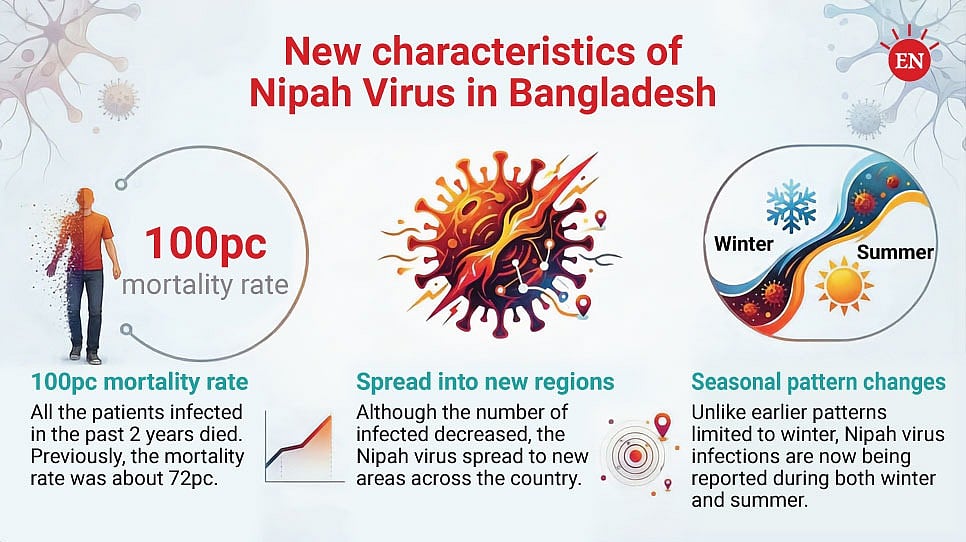
The country has observed three new and alarming characteristics of the Nipah virus.
First, over the past two years, 100 per cent of patients infected with the Nipah virus died. Previously, the fatality rate of the disease exceeded 70 per cent.
Second, although the number of Nipah virus cases has declined, the virus has now spread across a wider geographical area than before.
Third, for the first time in the country, Nipah virus infections have occurred during the summer season.
Despite the emergence of these new dangers, the sale and consumption of raw date palm sap have not stopped. Promotion and sale of date palm sap continue widely, particularly through social media platforms.
Public health experts say that authorities must stop the sale of date palm sap to prevent Nipah virus transmission. They emphasise the need for strict legislation, but no visible initiative has been taken in this regard.
Nipah is a highly dangerous and contagious viral disease. Fruit bats of the Pteropus genus act as the natural reservoir of the virus. Transmission occurs from bats to humans.
Bat saliva, urine, or faeces can contaminate date palm sap, toddy palm sap, partially eaten fruits, and similar items, leading to the spread of the virus.
The main symptoms include fever, headache, seizures, loss of consciousness, changes in mental status (such as confusion or incoherent speech), and, in some cases, respiratory distress.
The disease can also spread through physical contact with infected animals or humans.
Up to 2025, Bangladesh has identified a total of 347 Nipah virus cases, of which 249 patients have died. The overall fatality rate in the country exceeds 72 per cent. However, IEDCR reports that all patients infected in 2024 and 2025 died.
100 per cent death
According to data from the Institute of Epidemiology, Disease Control and Research (IEDCR), Bangladesh first identified the Nipah virus in Meherpur in 2001.
Authorities detected cases in Naogaon in 2003. However, the largest outbreak to date occurred in Faridpur district in 2004, where 35 people were infected and 27 died.
Up to 2025, Bangladesh has identified a total of 347 Nipah virus cases, of which 249 patients have died.
The overall fatality rate in the country was just over 72 per cent. However, IEDCR reports that all patients infected in 2024 and 2025 died.
Sharmin Sultana, senior scientific officer at IEDCR, told Prothom Alo that five patients were infected in 2024 and four in 2025, and all of them died. “No previous year recorded a 100 per cent fatality rate,” she said.
Nipah virus cases have now been identified in 35 districts across the country. The virus is spreading to new areas, which is a clear sign of danger.Sharmin Sultana, senior scientific officer at IEDCR
Deaths during summer
Nipah virus commonly spreads through raw date palm sap, which is mainly available during winter. As a result, infections and deaths traditionally occurred during that season.
However, for the first time in the country, a patient died from Nipah virus infection during the summer in 2025. The patient died in August last year.
Experts believe this development represents a new and dangerous characteristic of the virus.
Public health expert Mushtuq Husain told Prothom Alo that the patient likely became infected after consuming guava partially eaten by bats.
“This shows that Nipah can spread through fruits other than date palm sap. We are also seeing the virus spread during summer, not just winter. This is alarming,” he said.
Expanding geographical spread
If Bangladesh is divided vertically on the map, Nipah virus cases historically concentrated in the northern and western regions.
Districts such as Naogaon in the north, Faridpur in the central region and Meherpur in the west continue to report higher incidence.
However, the virus has gradually spread to new districts. Authorities identified Nipah virus in Bhola district for the first time last year. In 2024, officials also detected cases in Shariatpur.
When bats drink sap, they urinate at the same time. Can a net stop liquid contamination? None of this is possible. Claims that sap can be made safe in this way are completely false.Syed Moinuddin Sattar, chief scientific officer of a Nipah virus surveillance programme
Sharmin Sultana said that Nipah virus cases have now been identified in 35 districts across the country. “The virus is spreading to new areas, which is a clear sign of danger,” she said.
Misleading claims about making date palm sap safe
Experts have dismissed claims that covering sap collection pots with nets can fully prevent bat contamination. IEDCR conducts Nipah virus surveillance jointly with the International Centre for Diarrhoeal Disease Research, Bangladesh (icddr,b).
Syed Moinuddin Sattar, chief scientific officer of the surveillance programme, told Prothom Alo that bats have very small bladders and urinate while feeding.
“When bats drink sap, they urinate at the same time. Can a net stop liquid contamination? None of this is possible. Claims that sap can be made safe in this way are completely false,” he said.
No law in place
Experts believe that authorities must stop the consumption of raw date palm sap to protect the public from Nipah virus. They also stress the need to ban advertising and sales. Such measures require legislation.
Mushtuq Husain said that IEDCR has raised this issue with the government several times and that officials at the Ministry of Health agree. “However, the type of initiative required to enact a law has not taken place,” he added.