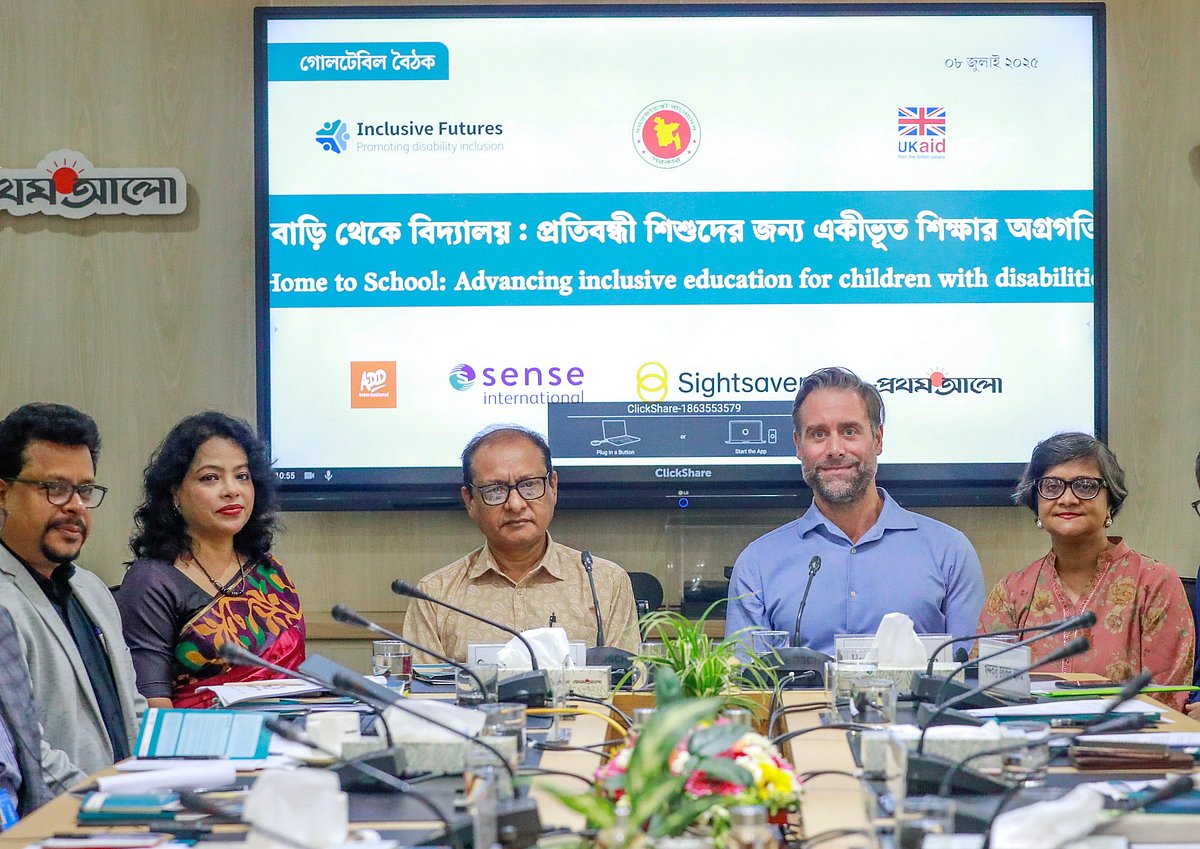
Roundtable
Children with disabilities must be included in mainstream education: Experts
Experts believe that it is essential not only to raise awareness in society but also to bring about structural changes within the education system in order to ensure inclusive education for them.
They emphasised the need for coordinated efforts among the relevant ministries to support this initiative.
Sustainable and integrated measures must be taken by the government, development organisations, and education-related departments to ensure that children with disabilities can learn normally in every school, the experts noted.
They raised these points on Tuesday at a roundtable discussion titled "Home to School: Advancing Inclusive Education for Children with Disabilities", organised by ADD International, Sense International, Sightsavers, and Prothom Alo under UK Aid’s Inclusive Futures initiative.
Under the Disability Inclusive Development (DID) programme and the Inclusive Futures initiative, the "Shikhbo Shobai" (Everyone will learn) project has been jointly implemented since April 2022 in a consortium led by Sightsavers, in partnership with ADD International and Sense International, with funding from the UK’s Foreign, Commonwealth & Development Office (FCDO).
The project has been carried out in collaboration with the Directorate of Primary Education (DPE) across 45 government primary schools in three upazilas (sub-districts) of Sirajganj and Narsingdi districts.
Primary and mass education adviser professor Bidhan Ranjan Roy Podder attended as the chief guest at the roundtable.
He said that it is necessary to develop suitable infrastructure in schools to bring children with disabilities under inclusive education.
Support from the Department of Social Services and the Health Department is also required, the adviser said, adding that there are challenges in this effort.
Bidhan Ranjan Roy Podder also called for launching community-based voluntary organisations to support people with disabilities.
He further said that such initiatives would benefit families, communities, and all other stakeholders involved with children with disabilities.
During the event, the adviser praised the ‘Shikhbo Shobai’ (Everyone will learn) project run by ADD International, Sense International, and Sightsavers.
Director General of the Department of Social Services, Md Saidur Rahman Khan, spoke as a guest of honour at the meeting.
He stated that after NGOs or development agencies complete a project, their activities often come to an end. Therefore, successful projects should be formally adopted by the government and integrated into the mainstream system.
Highlighting the lack of coordination among ministries working on disability issues, Khan suggested that a meeting of the National Coordination Committee, formed under the Disability Rights Protection Act, could be organised.
If all relevant ministries and departments are present, practical and actionable decisions can be made, Saidur Rahman Khan added.
Sightsavers' Country Director Amrita Rejina Rozario shared the positive outcomes of their home-based education initiative for children with severe disabilities under the "Shikhbo Shobai" (Everyone will learn) project.
She noted that many severely disabled children were able to enroll in school and prevent dropout as a result of the initiative.
Rozario emphasised that they had demonstrated at the local level how a child with disabilities can receive appropriate education through coordinated efforts.
She urged that such a model should be incorporated into national policy.
Hamish Higginson, Global Technical Lead at Sightsavers, described "Shikhbo Shobai" (Everyone will learn) as a prototype initiative under the Disability Inclusive Development (DID) programme.
He said Bangladesh now has the opportunity to adapt, improve, and scale this prototype to fit its local context.
Hamish Higginson recommended expanding the model to districts, upazilas, and clusters, while tailoring it to Bangladesh's specific needs and realities.
Every child with disabilities deserves the chance to access education, learn, and feel valued. At the Sightsavers–Prothom Alo roundtable, Tahera Jabeen, Social Development Adviser at BHC Dhaka, reaffirmed the UK’s strong commitment to inclusive education, emphasising the importance of early support, family and community engagement, strong partnerships, and inclusive, welcoming schools. She also stressed the need for stronger coordination between ministries and highlighted the importance of establishing a centralised data system - essential for identifying and addressing the needs of children with disabilities, closing data gaps, and guiding inclusive, evidence-based policy and investment decisions.
Technical and Madrasah Education Division joint secretary Md Sarwar Hossain stated at the meeting that one of the biggest challenges to inclusive education for children with disabilities is societal attitude.
Even today, many educated individuals still do not believe that children with disabilities can study alongside their peers in the same classroom, he noted.
Sarwar Hossain emphasised the need for widespread awareness to change this mindset.
Speaking at the roundtable, Professor AQM Shafiul Azam, Director (Planning and Development) at the Directorate of Secondary and Higher Education, said, “Many teachers think that children with disabilities could be a problem for regular students. We must move away from this mindset. Teaching methods need to be adapted in the classroom so that children with disabilities can integrate comfortably into the learning environment.”
Nazmul Bari, Executive Director of the Center for Disability in Development (CDD), remarked, “The teaching approach must vary depending on the type and severity of a child’s disability. In this context, home-based education has emerged as an important method. We often come across children who have never even dreamed of going to school or had the opportunity to do so. For them, home-based education can be an effective alternative.”
Ghulam Faruq Hamim, Team Leader of the Bangladesh Programme at ADD International, said that many schools still lack the necessary facilities for students with disabilities. Significant gaps remain in key areas such as school accessibility, use of WASH (Water, Sanitation, and Hygiene) facilities, classroom seating arrangements, access to assistive materials, and adequate guidance from teachers.
He stressed the need for individualised plans tailored to the educational and emotional needs of children with disabilities.
Hamim also noted that while teachers in Bangladesh are sincere and dedicated, formal institutional recognition of inclusive education by the government would further motivate them.
Khandaker Sohel Rana, Advocacy and Communication Coordinator at Sightsavers, delivered the keynote presentation at the roundtable.
Md Joynal Abedin, Deputy Director (Integrated Education), Directorate of Primary Education; Rokhsana Parveen, Assistant Director (Integrated Education) Directorate of Primary Education, Khandaker Zahurul Alam, Bangladesh Representative, ICEVI (International Council for Education of People with Visual Impairment); Md Saidul Haque, Executive Director, Blind Education and Rehabilitation Development Organisation; John Ekaju, Education Manager, UNICEF Bangladesh; Lucy Reeve, Programme Manager, Sightsavers; Oadot Hasan, CST Member, Spandan; Al Amin Sheikh, Alor Prodip Disabled Rights Organisation (Sirajganj); Masudul Hasan Taposh, Deputy Director, Department of Social Services (Narsingdi); Niranjan Kumer Roy, District Primary Education Officer, Narsingdi; Md Harunur Rashid, District Primary Education Officer, Sirajganj; Jayshree Saha, Head Teacher; and Faruk Aziz Government Primary School, Narsingdi, among others, spoke at the roundtable.
Firoz Choudhury, Assistant Editor at Prothom Alo, moderated the roundtable.