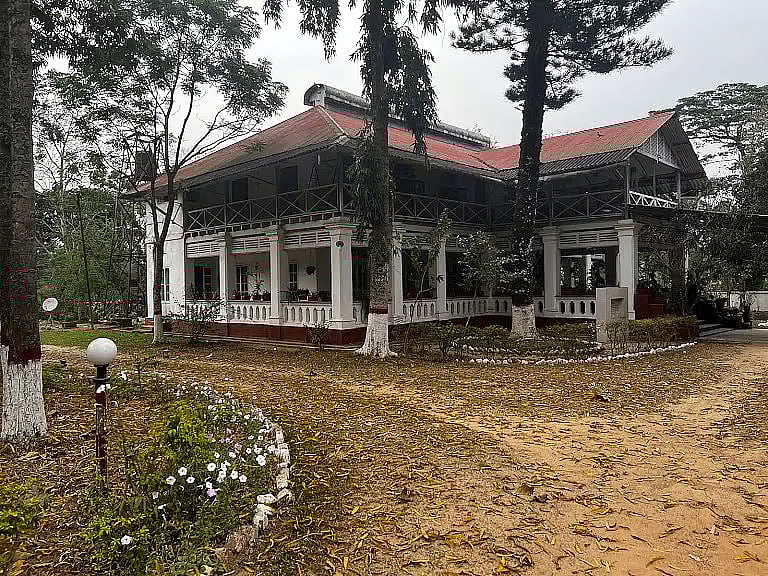
Govt wants to preserve historic Teliapara bungalow, tea workers object
The bungalow is historic as the first military headquarters of the Liberation War was established here in 1971. The government now wants to preserve it.
Located inside the Teliapara tea estate in Habiganj, the bungalow linked with the Liberation War is planned to be preserved and turned into a museum.
For this purpose, the Ministry of Liberation War Affairs has written to the Deputy Commissioner of Habiganj, requesting cancellation of the lease of the bungalow and related land under the state-owned National Tea Company (NTC).
However, the workers of the tea estate have raised objection to the plan as they fear disruption of their work and livelihoods if the lease is cancelled.
Government records show that since independence, attempts have been made several times to preserve the bungalow, but none were successful. Now, the interim government led by Professor Muhammad Yunus has taken steps to preserve it and turn it into a museum.
On 7 April, Colonel (retd) Mohammad Abdus Salam, Bir Protik, president of the Sylhet-based Shaheed Muktijoddha Smriti and Research Foundation, sent a letter to Liberation War Affairs Adviser Faruq-e-Azam.
The letter noted that the late Sector Commander Major General (retd) KM Shafiullah, Bir Uttam, had made several attempts to preserve the Teliapara tea estate bungalow but failed. The bungalow is currently under the NTC, whose ownership largely rests with the government. It could be maintained and presented as the first headquarters of the armed forces, serving as documentation of history.
Liberation War Affairs Secretary Israt Chowdhury told Prothom Alo that there are plans to build a museum at this important site tied to the Liberation War so that the people can learn about the history of the Liberation War. In that case, the NTC will be provided with building the construction at a different place.
Taking the matter into account, the ministry wrote to the Habiganj district administration, instructing them to take steps to cancel the lease of the bungalow and related land under NTC.
Later, the district administration informed the ministry that NTC would not object to a museum being built on the Liberation War site, provided they receive alternative facilities for their operations.
On 11 August, the ministry sent another letter to the Habiganj DC, asking for progress updates on the lease cancellation.
Habiganj DC Md Faridur Rahman told Prothom Alo on 30 August that workers of the Teliapara tea estate have opposed building a museum there. They do not want a museum at this location.
Regarding this, Secretary Israt Chowdhury said they have heard the workers’ concerns. The workers do not want visitors coming here. Meetings with tea board officials have already held and response was positive.
The Teliapara tea estate in Madhabpur upazila is 35 kilometers away from Habiganj town.
It was in the bungalow of the tea estate manager here that, on 4 April, 1971, a secret meeting took place. The meeting was led by Colonel (retd) MAG Osmani, who came from Agartala, India, to attend. He was later appointed Commander-in-Chief of the Liberation War.
A total of 27 army officers, including senior officers of the East Bengal Regiment, joined the meeting. Several crucial decisions for the Liberation War were made at the meeting. Among them were dividing the country into 11 sectors, forming multiple forces including the Z-Force, preparing the blueprint for the war, taking the oath to fight, and stressing the formation of a political government alongside direct combat. Since then, 4 April has been observed annually as Historic Teliapara Day.
According to the ministry, 1580 acres of government land are leased long-term to NTC for the Teliapara tea estate until 2037. Within the estate, 7.62 acres—including the bungalow and a Liberation War memorial—are not directly used for tea cultivation. This is where the bungalow stands.
Officials note that canceling the lease of this 7.62-acre parcel would not affect tea production. The government therefore wants this land released.
In 2022, the Habiganj district administration wrote to the Land Ministry, recommending lease cancellation of the land for preservation. The lease, however, was not canceled.
An official of the Liberation War Affairs ministry told Prothom Alo that many in the new generation are hardly aware of the historic first military headquarters of the Liberation War. After preserving the site, a museum and research center will be set up there.
Sources say the tea estate workers are anxious about their work and livelihoods. They want assurance about their future if the lease is canceled.
When asked why, despite repeated initiatives, the bungalow was never made into a museum, concerned officials said perhaps the politicians did not want the first military headquarters of the Liberation War to be glorified. Perhaps they thought it would diminish their own contributions.
There are also questions about how the museum would be managed once established. Some suggest forming a trust jointly coordinated by local freedom fighters and the Bangladesh Army to run the museum.
This bungalow holds many pivotal memories of the Liberation War. It witnessed several bloody battles with the Pakistani occupation forces. Yet, this historic site still serves as the manager’s bungalow of the tea estate.
Colonel (retd) Mohammad Abdus Salam, president of the Shaheed Muktijoddha Smriti and Research Foundation, told Prothom Alo that the Teliapara bungalow must preserved. Otherwise, this invaluable memorabilia of the Liberation War will be lost. The memory of the Liberation War must be kept intact and passed down from generation to generation.