Khulna’s six constituencies
Awami League, minority votes emerging as crucial in determining results
Dakop, a southern upazila of Khulna district, lies close to the Sundarbans. Visiting Chalna Bazar, the upazila headquarters, little election camping was visible. A few scattered banners could be seen, but when asked about voting, most people showed little interest. They did not say they would not vote, nor were they enthusiastic about the election.
In neighbouring Batiaghata Bazar, some election fervour was noticeable. However, here too, most voters were unwilling to speak openly about whom they would choose. A few mentioned that there would be competition between Bangladesh Nationalist Party (BNP) and Jamaat-e-Islami, but no one identified a clear frontrunner.
The Khulna-1 constituency encompasses Batiaghata and Dakop upazilas. Since 1991, no party other than the Awami League has won here. In this Awami League- and minority-dominated constituency, voter turnout is expected to be lower compared to other seats. Khulna district has six parliamentary constituencies. In the other five, election campaigning and enthusiasm appear somewhat stronger. In Khulna city and nearby constituencies, public interest in voting seems higher.
Local politicians, voters, and civil society representatives say that in most constituencies of Khulna, Awami League supporters and minority community voters are becoming crucial. Whichever way their votes go could tilt the balance. However, most voters from these two groups are not openly expressing their preferences. A few local leaders have aligned themselves with BNP or other parties, but general voters remain tight-lipped.
In five of Khulna’s six constituencies, BNP and Jamaat are the main contenders. In one constituency, Jamaat has not fielded a candidate; instead, the 11-party electoral alliance has nominated a candidate from Khelafat Majlis.
After touring Khulna city, Dakop, Batiaghata, Dumuria, and other areas, it was learned that BNP candidates Nazrul Islam Monju in Khulna-2 (Sadar–Sonadanga) and SK Azizul Bari Helal in Khulna-4 (Rupsha, Terokhada, and Dighalia) appear relatively comfortable. In the remaining constituencies, tight contests between BNP and Jamaat candidates are expected.
Multiple local sources said BNP candidates are quietly trying to attract Awami League votes in Khulna. Informal meetings are reportedly taking place.
A local Awami League leader, speaking to Prothom Alo on condition of anonymity, said Awami League supporters and minority voters want security. Many believe that regardless of Khulna’s results, BNP is more likely to form the government nationally. Therefore, if BNP loses in Khulna, Awami League supporters could face pressure after the election. As a result, Awami League supporters will make their final decision at the last moment after careful calculation.
Khulna-1: Krishna Nandi in focus
Since 1991, the Awami League has not lost the Khulna-1 seat in any national election. In 1996, Awami League president Sheikh Hasina herself won from this constituency. In other elections, Awami League leaders from minority communities have been elected as MPs.
Awami League activities are currently banned, and the party is not contesting this election. Jamaat-e-Islami, however, has drawn attention by fielding Krishna Nandi, a candidate from the minority community, for the first time. BNP’s candidate here is Amir Ejaz Khan, who has contested three times before but never won. A total of 12 candidates are contesting in this constituency, eight of whom belong to minority communities.
The voter composition explains why there are so many minority candidates. The constituency has 307,000 voters. According to the 2022 census, 54.44 per cent of Dakop’s population is Hindu, while in Batiaghata the figure is 27.56 per cent.
In past elections, BNP maintained a competitive position. In the 2001 and 2008 elections, BNP candidates were the nearest rivals. In 1991 and 1996, candidates from the Communist Party of Bangladesh (CPB) were the closest competitors to the winning Awami League candidates. Jamaat’s position here has traditionally been weak. In the 1996 election, Jamaat candidate Sheikh Md Abu Yusuf received only 2,308 votes.
Initially, Jamaat announced Abu Yusuf as its candidate for the 13th parliamentary election. Later, on 3 December, the party nominated Krishna Nandi, president of Jamaat’s Dumuria Upazila Hindu Committee.
Local residents say that earlier everyone assumed BNP would easily win this seat. But Jamaat’s nomination of Krishna Nandi has now made the contest appear competitive.
BNP candidate Amir Ejaz Khan is telling voters that Awami League has won repeatedly in the past, and since Awami League is not contesting this time and he has run three times before, voters should support him now.
However, after the fall of the Awami League government following the mass uprising, BNP’s local leaders and activists have faced allegations of shrimp farm grabbing, extortion, and case trading. Rival candidates are trying to highlight these issues during the campaign.
Krishna Nandi is campaigning on promises to ensure the safety of the Hindu community and stop extortion. He is presenting himself as a guardian of the Hindu community to seek support.
Opponents, however, are attempting to portray Krishna Nandi as an outsider by highlighting that his home is in Chuknagar of Dumuria.
Apart from BNP and Jamaat candidates, many voters believe CPB’s Kishor Kumar Roy is also in the race. He is a former vice-chairman of Dakop Upazila Parishad and has been active in various social movements.
An Awami League leader from Sutarkhali Union in Dakop, speaking anonymously, told Prothom Alo that Awami League and minority voters will play a decisive role here. Out of fear of harassment, many from these groups are seen campaigning alongside BNP and Jamaat candidates. It is impossible to predict beforehand where the final votes will go.
He added that a close contest between BNP and Jamaat candidates is likely.
Parwar vs Lobby: a crucial battle
Mia Golam Parwar is the central secretary general of Jamaat-e-Islami and the party’s candidate in Khulna-5 (Dumuria and Phultala).
Parwar was elected MP from this constituency in 2001 as a candidate of the four-party alliance. He also contested in 2008 and 2018 as a candidate of the BNP-led alliance but lost both times to Awami League candidates. The 2018 election, however, was marred by irregularities.
BNP has nominated Mohammad Ali Asghar Lobby for Khulna-5. He won a by-election in Khulna-2 in 2001 after Khaleda Zia vacated the seat and was widely discussed at the time as businessman Lobby. He has not contested any election since then.
A visit to Dumuria last Thursday suggested a strong contest between the two candidates. Faruk Hossain, a trader in Dumuria Bazar, said that initially it seemed Jamaat’s candidate would win easily, but competition has intensified over time.
Mintu Hossain of Chingra village said Jamaat’s main strength here lies with women voters. However, if Awami League and minority voters lean toward BNP, Ali Asghar Lobby could pull ahead.
More than 100,000 voters in this constituency belong to the Hindu community. Both candidates are making efforts to secure their votes. Jamaat has formed several Hindu committees in Dumuria, while Ali Asgar has also held Hindu gatherings.
BNP’s candidate is reported to have held several informal meetings with Awami League leaders at different levels.
According to the 2022 census, nearly 35 per cent of Dumuria’s population is Hindu, while in Fultola the figure is just over 8 per cent.
Manju dominates the city narrative
At the Zia Hall intersection in Shibbari Mor of Khulna city, a food court with multiple shops has developed. Numerous banners and festoons of BNP and Jamaat candidates are visible in the area. Both candidates regularly campaign and engage with voters. Conversations with around 30 voters revealed that all of them intend to vote.
Discussions indicated that BNP candidate Nazrul Islam Manju is in a strong position in Khulna-2 (City Corporation wards 16–31). He was elected MP from this constituency in 2008 and is a former president of BNP’s Khulna city unit. He is widely known as an organiser and grassroots leader.
Jamaat’s candidate here is Sheikh Jahangir Hossain, general secretary of the party’s metropolitan unit and a former councillor of Khulna City Corporation Ward No. 31. He also has recognition in the area.
In 2001, BNP chairperson Khaleda Zia won from this seat. In 1991 and 1996, former Speaker Sheikh Razzak Ali won here for BNP.
Bakul, Helal relatively comfortable
Khulna-3 consists of City Corporation wards 1–15, Jogipole, and Aranghata Union. This labour-dominated constituency has alternated between Awami League and BNP victories in the past. This time, BNP’s candidate is Rakibul Islam Bakul, the party’s student affairs secretary and known locally as a close associate of the BNP chairperson. Local residents say his position in the race is strong.
Jamaat has not fielded a candidate here since 1996, but this time the party has nominated its Khulna city amir, Mahfuzur Rahman. He is also actively campaigning and engaging voters.
Islami Andolon’s candidate in this seat is Md Abdul Awal, who finished second with 60,000 votes in the 2023 Khulna City mayoral election and is believed to have a vote bank.
In Khulna-4 (Rupsha–Terokhada–Dighalia), BNP candidate Azizul Bari Helal, former central president of Chhatra Dal, is considered to be in a comfortable position by his supporters.
Historically, contests here were between Awami League and BNP. This time, Awami League and Jamaat are not contesting. The 11-party electoral alliance has nominated SM Sakhawat Hossain of Khelafat Majlis.
Islami Andolon has fielded its secretary general Yunus Ahmad, while an independent candidate, SM Azmal Hossain, is contesting with the football symbol.
Khulna-6: Jamaat in an advantageous position
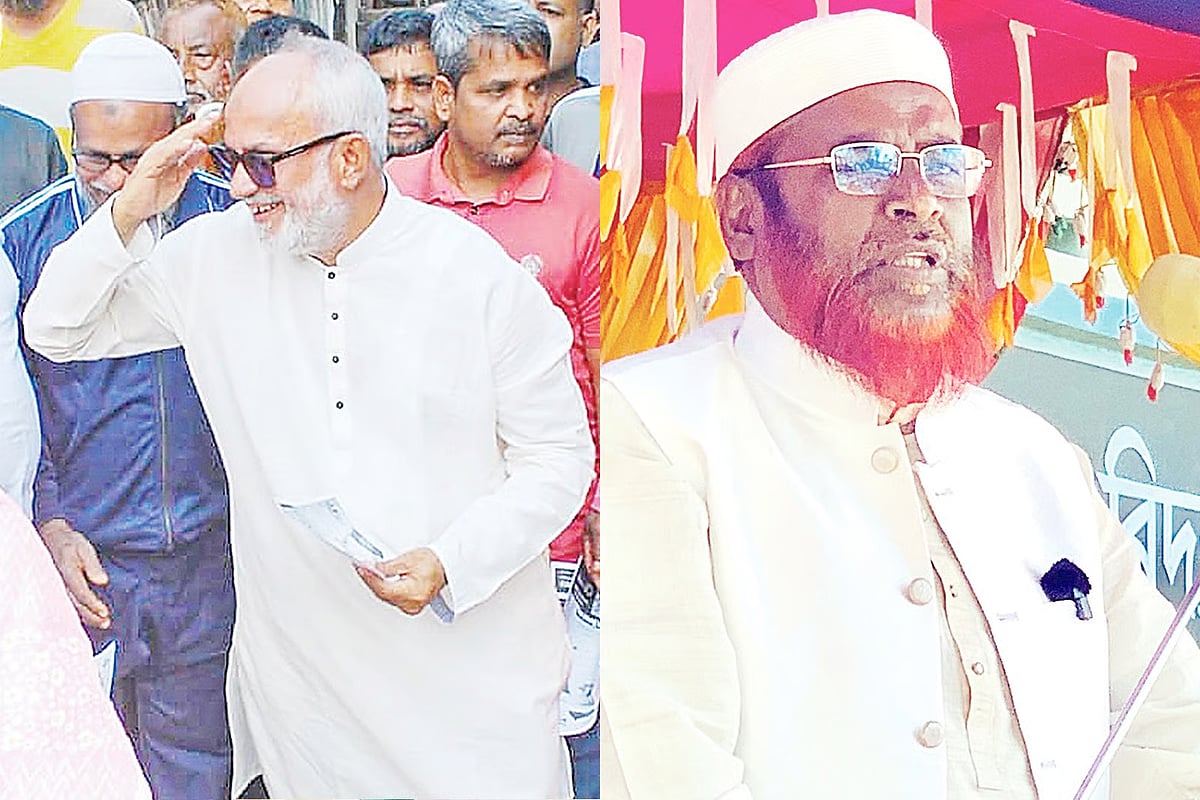
Khulna-6, comprising Koyra and Paikgachha upazilas, was traditionally left to Jamaat by BNP as an alliance partner. This time, BNP and Jamaat are contesting directly against each other. Five candidates, including BNP and Jamaat nominees, are in the race. Jamaat’s candidate, Md Abul Kalam Azad, is the only one who has contested elections before. The main contest is expected between BNP’s SM Monirul Hasan and Jamaat’s Abul Kalam.
Locals say BNP’s Monirul Hasan is not from the area—his home is in Rupsha—and there is some internal division within BNP locally.
On the other hand, Jamaat’s Abul Kalam Azad contested the 2018 election. Although the Awami League captured the seat in that controversial election, Jamaat won here in 1991 and 2001. Locals believe Jamaat’s candidate is in a favourable position.
Nearly 100,000 voters in this constituency belong to the Sanatan (Hindu) community. Minority and Awami League-aligned votes are also becoming crucial here.
However, Kudrat-e-Khuda, general secretary of Sujan’s Khulna district unit, believes young voters will be the biggest factor in this election, followed by Awami League and minority voters.
According to him, a significant portion of Awami League and minority voters will cast their ballots. Overall, Khulna is set to witness an intense electoral contest between BNP and Jamaat.