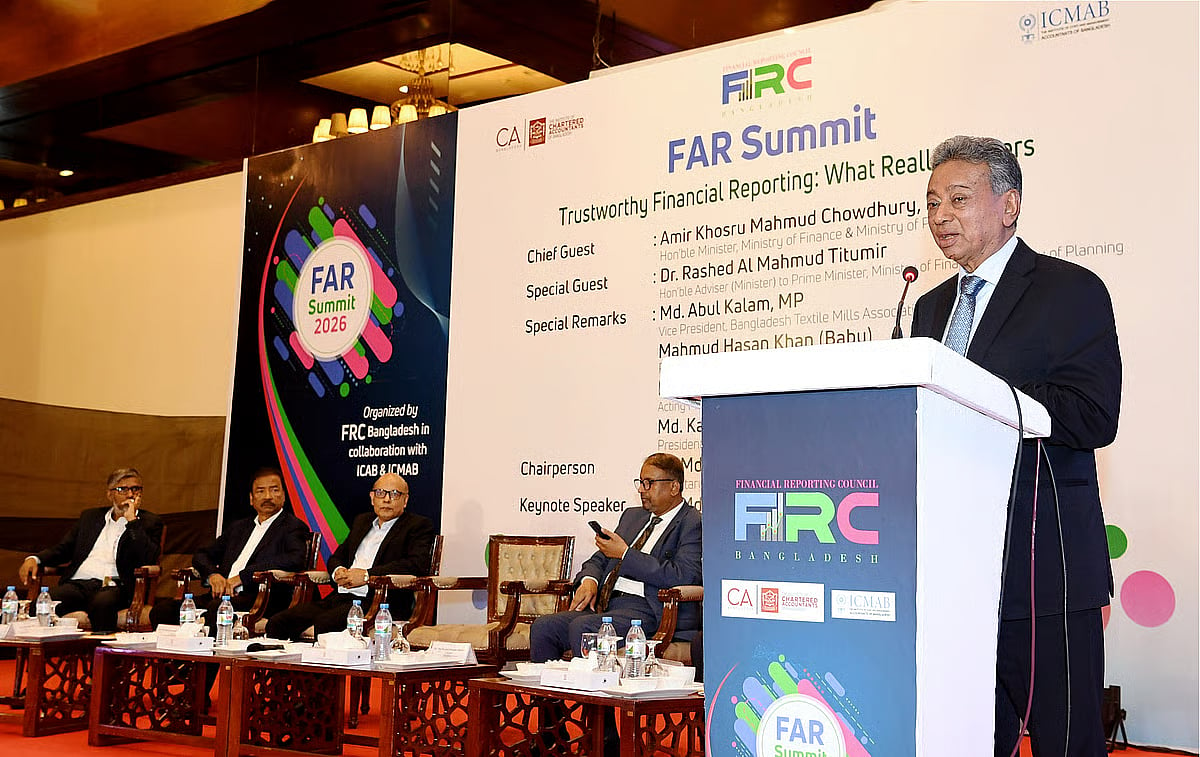
Even good companies now face capital shortages: Finance Minister
Finance and Planning Minister Amir Khasru Mahmud Chowdhury has remarked that even the country’s good companies are now suffering from capital shortages.
The finance minister said this has happened because fair competition does not exist. Depositors keep money in banks, while entrepreneurs sitting on boards approve loan applications because they own shares. In many cases, there is a lack of transparency and accountability.
Today, Wednesday, Finance Minister Amir Khasru Mahmud Chowdhury made these remarks as chief guest at the inauguration ceremony of the country’s first “Financial Accounting and Reporting (FAR) Conference” at the Pan Pacific Sonargaon Dhaka hotel in Dhaka. The conference was jointly organised by the Financial Reporting Council (FRC), Institute of Chartered Accountants of Bangladesh (ICAB), and Institute of Cost and Management Accountants of Bangladesh (ICMAB).
Prime Minister’s Economic and Planning Adviser Rashed Al Mahmud Titumir spoke at the event as special guest.
Bangladesh Garment Manufacturers and Exporters Association (BGMEA) President Mahmud Hasan Khan and Vice President of the Bangladesh Textile Mills Association (BTMA), Member of Parliament Md Abul Kalam, among others, spoke at the event.
The keynote paper was presented by FRC Chairman Md Sajjad Hossain Bhuiyan. The main theme of the conference was “Trustworthy Financial Reporting: What really matters?”
Two sessions were held after the inaugural ceremony. Chief financial officers (CFOs), auditors, and policymakers from the country’s leading institutions participated.
Self-regulation
Finance Minister Amir Khasru Mahmud Chowdhury called on accountants to adopt “self-regulation” in order to ensure transparency and accountability in the financial sector. He emphasised ensuring 100 per cent transparency and accountability to restore overall economic stability, achieve sustainable growth, and regain the confidence of domestic and foreign investors in the capital market and financial sector.
Arguing in favour of self-regulation, the finance minister recalled that authority to issue utilisation certificates for exports had once been handed over to BGMEA. During the previous government led by the Khaleda Zia-era BNP administration, he served as commerce minister.
The finance minister said there had been allegations of corruption against the Export Promotion Bureau (EPB) regarding the issuance of such certificates. Since the responsibility was handed to BGMEA, things have operated better.
BGMEA President Mahmud Hasan Khan said 7,200 institutions had once been registered with BGMEA. Now only 2,500 remain; the rest disappeared because they failed to maintain proper accounts. If accounts are artificially inflated, institutions eventually collapse.
Giving an example, the BGMEA president said he had recently tried to acquire a listed company. However, he found inconsistencies between its assets and liabilities. At the time of listing, the company had prepared exaggerated financial statements to obtain a higher premium from the capital market.
Mahmud Hasan Khan also said foreign buyers are now unwilling to purchase products if accounting systems are not transparent.
Transparency and accountability
Finance and Planning Minister Amir Khasru Mahmud Chowdhury said, “The current government wants to build an economic system with full transparency and accountability. Our economic future depends on how institutions such as the FRC, ICAB, and ICMAB function. No regulatory body can visit every day and detect irregularities. Therefore, accountants themselves and their respective organisations must first take on the role of self-regulation.”
The finance minister said, “The country’s institutions had become dysfunctional. Everyone knows the reasons behind this. To move from where we are now to where we want to go, all institutions must be made functional. The FRC was established in 2015. Now it is 2026. I do not know what the FRC has done all these years. But the type of financial irregularities that occurred over the years and the huge sums of money that left the banking system were in many cases made possible through false financial statements. Again, many companies got listed on the stock market using false information.”
Amir Khasru Mahmud Chowdhury highlighted the need for proper accounting systems to attract investment.
He said, “Every day some kind of fund manager contacts us—some from Hong Kong, some from London, even from JPMorgan. But as a nation, we have become such that it feels like everything must be accomplished overnight.”
Prime Minister’s Economic and Planning Adviser Rashed Al Mahmud Titumir said, “In the past, audit firms themselves acted as their own judges. Accounting practices often remained outside the law, and that is why today’s conference is extremely important. Past negligence has pushed the entire economy toward a kind of disaster. The chaotic condition we now see in the banking sector is something we inherited.”
Rashed Al Mahmud said ordinary investors had been deceived. Thousands of people invested in the capital market after seeing false financial reports and lost money. Share prices collapsed, and investors suffered indescribable hardship. Later it became clear that the real condition of those companies was entirely different.
The economic and planning adviser further said, “We know how the banking and financial sectors were weakened. Or how banks issued massive loans based on financial reports. Later those borrowers became defaulters, and banks fell into crisis. Honest entrepreneurs suffer the most from these situations. Dishonest competitors create disorder in the investment sector by showing inflated profits. Foreign investors do not want to come when they see such conditions. If I give someone money, I would want to know the state of their business. Financial reports provide that information, so the audit system must be overhauled to attract investment.”
Finance Secretary Md Khairuzzaman Mozumder delivered closing remarks at the inaugural ceremony.
He said, “Those who should not receive loans get them. Those who deserve loans are forced to go from bank to bank—that is the picture of the banking sector. When seeking loans, they present one type of account to banks. But when paying taxes, they show losses and submit another type of account to the National Board of Revenue. We must come out of this situation.”
What the paper said
The keynote paper stated that major challenges include family control over the boards of listed and non-listed companies, appointing independent directors based on personal connections rather than qualifications, family influence in decision-making, and preventing CEOs and CFOs from working independently because of fear, intimidation, and pressure.
Regarding reforms, the paper said expert personnel must be recruited into the organisation. Rules under the law must be formulated. Separate infrastructure facilities for the FRC must be ensured, an ethical corporate culture established, and management authorities must prepare high-quality, data-based financial statements. Coordination between the FRC and professional accounting bodies should be increased. Financial literacy among company board members should be improved. The use of technology and data analysis in supervision and evaluation should be expanded. Assets and liabilities must be properly assessed to reduce the risk of defaulted loans. Forensic accounting should be introduced. Skilled human resources for Shariah-based financial reporting and auditing should be developed. It is also essential to ensure competent auditors for banks, financial institutions, listed companies, and large industrial enterprises.
FRC Chairman Md Sajjad Hossain Bhuiyan said there is a lack of coordinated understanding among accounting and auditing professionals. There are also communication gaps among regulatory bodies. He noted that although nearly 300,000 institutions are registered, only 35,000 submit returns.