Roundtable
Recommendation to increase investment in energy sector
Economic and Planning Adviser to the prime minister Rashed Al Mahmud Titumir said, “For a long time, the country has followed a narrative of a consumption-led growth model. However, this model was never meant to be sustainable. We want to move quickly from a consumption-led model to an investment-driven model.”
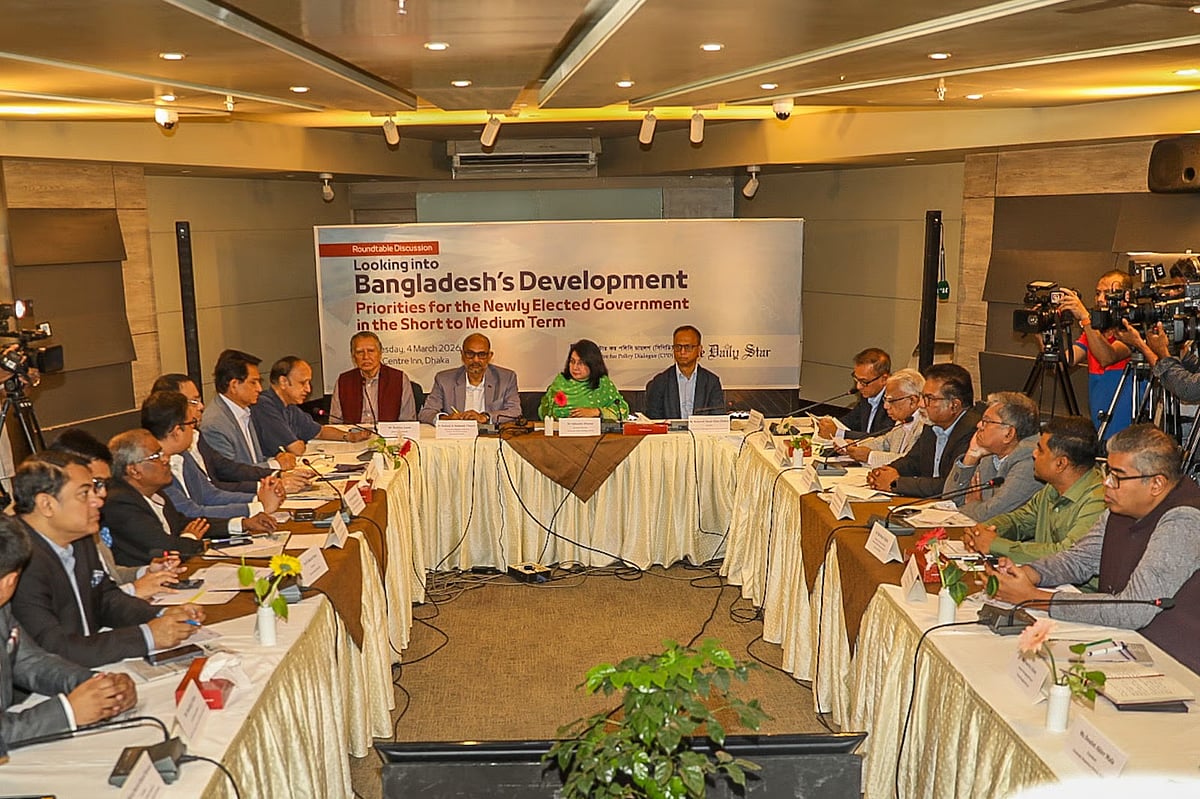
He made this remark yesterday, Wednesday, while speaking as the chief guest at a roundtable titled “Bangladesh’s development: Priorities of the new government in the short and medium term”, held at BRAC Centre Inn in Mohakhali, Dhaka.
During his address, he presented an integrated framework for restructuring the country’s economic structure.
He said the government has set a clear target to raise the tax-to-GDP ratio to 15 per cent by 2035 and to steer the country towards an investment-driven growth model.
At present, Bangladesh’s tax-to-GDP ratio remains among the lowest in the world.
Rashed Al Mahmud Titumir said the government has adopted a phased plan of progress rather than relying solely on mathematical calculations.
The plan sets interim targets, first increasing the ratio by 2 per cent and later by up to 10 per cent, before moving towards the final goal.
Research organisation Centre for Policy Dialogue (CPD) and The Daily Star jointly organised the discussion. Fahmida Khatun, executive director of the Centre for Policy Dialogue, moderated the event.
Rashed Al Mahmud Titumir said another feature of the previous model was excessive dependence on borrowing. He noted that a large volume of debt accumulated between 2009 and 2024.
At the same time, private-sector investment in relation to gross domestic product remained stagnant or negative. He emphasised that these two problems must be addressed.
The government has set a clear target to raise the tax-to-GDP ratio to 15 per cent by 2035 and to steer the country towards an investment-driven growth model.Rashed Al Mahmud Titumir, Economic and Planning Adviser to the prime minister
“One citizen, one card”
At the meeting, the prime minister’s economic adviser said the new government has already taken several initiatives within 10 days of assuming office.
He said the government waived agricultural loans of up to Tk 10,000, including interest, for 1.2 million (12 lakh) farmers after considering inflation, real wages and social protection needs.
He said, “We are working to reduce poverty and achieve our targets.”
Rashed Al Mahmud Titumir added, “Our major weakness is leakage or evasion. For example, many people who should receive social protection benefits are not included in the lists, while some who should not be included are listed. Our position is that in the future no service will be delivered without digital systems. Our goal is ‘one citizen, one card’.”
‘Increase investment in the energy sector’
Former president of Federation of Bangladesh Chambers of Commerce and Industry (FBCCI) and Managing Director of Ha‑Meem Group, AK Azad, advised the government to increase investment in the energy sector as a priority in order to expand employment.
He said the government must take strict action against those who received funds but failed to invest in business. Otherwise, the economy will not improve.
Editor of The Daily Star, Mahfuz Anam, offered two suggestions to the new government.
He said, “In many cases our bureaucracy performs very well, but in many cases it also creates obstacles. Managing the bureaucracy will be a major challenge for the new government. For this reason, digitalisation in every ministry and department is essential. In addition, important ministries should establish an advisory group that will provide guidance to the government every three months and monitor its progress.”
At the meeting, President of the garment manufacturers’ association Bangladesh Garment Manufacturers and Exporters Association, Mahmud Hasan Khan, said that policy-related issues remain one of the main challenges for businesses.
He noted that when the government formulates policies, it often fails to involve stakeholders adequately.
Vice-Chairman of the Policy Research Institute (PRI) of Bangladesh, Sadiq Ahmed, said the country cannot restore macroeconomic stability without simultaneous and coordinated reforms in three sectors: revenue, foreign exchange transactions and banking.
Rashed Al Mahmud Titumir also referred to the Tk 60,000 crore subsidy burden in the energy sector. He said the government has adopted three strategic approaches to reduce this substantial expenditure.
Government must take strict action against those who received funds but failed to invest in business. Otherwise, the economy will not improve.AK Azad, Former president, FBCCI
Employment opportunities must be expanded
Mohammad Helal Uddin, executive vice-chairman of the Microcredit Regulatory Authority, said that if the new government intends to generate large-scale employment within 180 days, relying solely on the formal sector will not be realistic.
He said the country must expand opportunities in the informal sector and promote self-employment.
President of the Bangladesh Textile Mills Association, Showkat Aziz Russell, said that creating employment within a short period by establishing new industries is not realistic.
He explained that setting up an industry requires several years, starting from purchasing land and resolving ownership issues to constructing infrastructure, importing machinery, and securing electricity and gas connections.
In this context, AKM Fahim Mashroor, chief executive officer of Bdjobs.com, said that a roadmap could be prepared to send between three and four million skilled workers to new overseas markets within the next two to three years.
Strict measures needed against loan defaulters
Professor Main Uddin of the Department of Banking and Insurance at University of Dhaka said the government must adopt a “zero tolerance” policy against defaulted loans in order to restore discipline in the banking sector.
He emphasised the need to ensure political commitment to implement such measures.
Former Chairman of the Association of Bankers, Bangladesh, Mohammad Nurul Amin, said that the time has come to take strict action to recover defaulted loans and to curb money laundering.
Chairman of Policy Exchange Bangladesh, M Masrur Reaz, said restoring discipline in debt management and budget implementation is currently the government’s most important task.
Others who spoke at the event included Mostafa Abid Khan, former member of the Bangladesh Trade and Tariff Commission; Shams Mahmud, former president of the Dhaka Chamber of Commerce and Industry; Syed Almas Kabir, former president of the Bangladesh Association of Software and Information Services; Asif Ibrahim, former director of the Bangladesh Garment Manufacturers and Exporters Association; energy expert Shafiqul Alam; M Asaduzzaman, former research director of the Bangladesh Institute of Development Studies; Amrita Makin Islam, deputy managing director of Picard Bangladesh; Doulot Akter, president of the Economic Reporters’ Forum; and Mirza Nurul Gani Shovon, president of the National Association of Small and Cottage Industries of Bangladesh (NASCIB), among others.