Naogaon
Paddy prices drop to Tk 800-950 per maund, farmers fail to recover costs
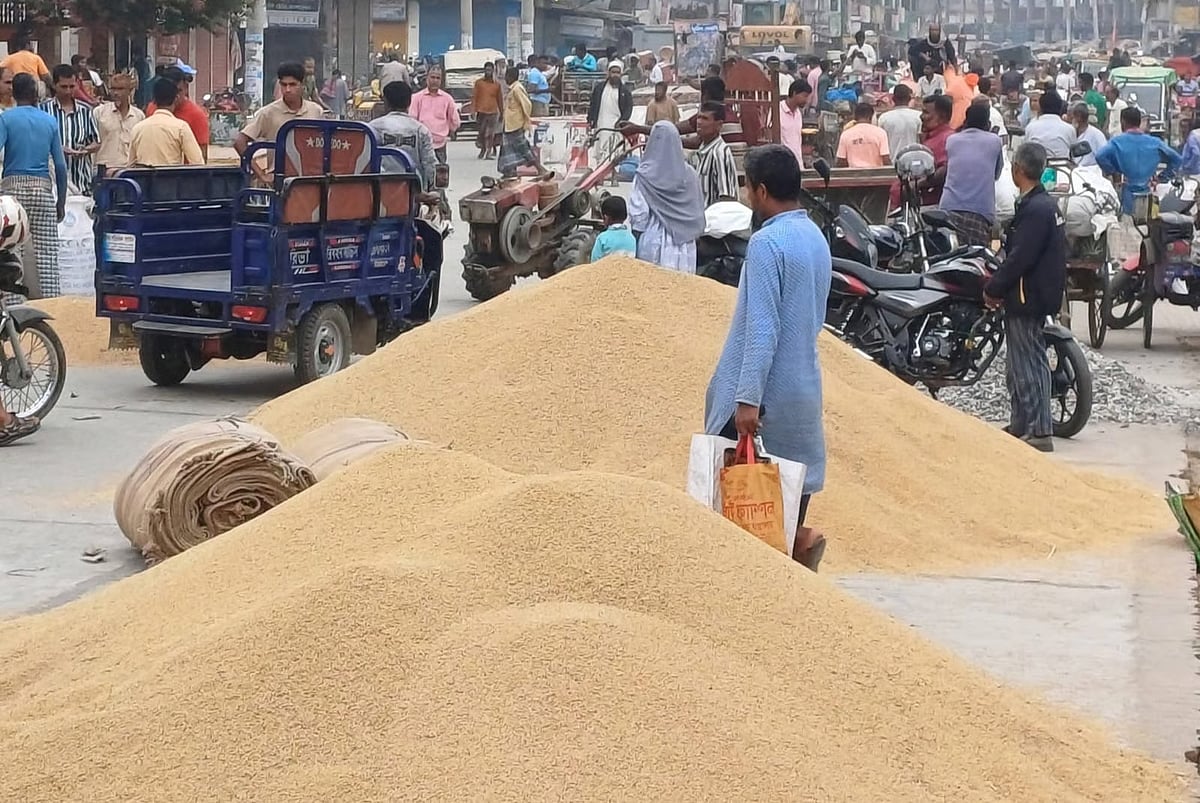
Naogaon, a district renowned for rice and paddy production, has seen a bumper Aus paddy harvest this year. But farmers are not smiling, as they are unable to recover their production costs by selling the crop. With prices remaining low, many are now frustrated.
A visit to several paddy markets in Naogaon found that a maund of Jirashail, Katari and BRRI-28 paddy is selling for Tk 800 to Tk 950. Farmers said the price has fallen by Tk 300 to Tk 400 per maund compared with last year. At the same time, production costs have increased because of higher prices of fertiliser, seeds, irrigation, pesticides and labour.
Despite farmers incurring losses from selling paddy, there has been no corresponding decline in rice prices at Naogaon’s wholesale rice markets. Both coarse and fine varieties of rice are still being sold at previous prices.
According to the local Department of Agricultural Extension, 51,300 hectares of land were brought under Aus cultivation in Naogaon last season. This year, the area increased to 58,573 hectares. The average cost of producing paddy per acre is Tk 64,000, which comes to around Tk 21,000 per bigha.
Several farmers from Naogaon Sadar, Mahadebpur, Manda and Niamatpur upazilas shared their struggles. They spent more than Tk 20,000 per bigha of land on labor, fertilizer, irrigation and land preparation. The yield was 20 to 22 maunds of paddy per bigha. By selling the paddy at Tk 800 to Tk 900 per maund, farmers got only Tk 17,000 to Tk 19,000 per bigha. They could not even recover their production costs.
Farmers need money immediately after the harvest. They must pay off loans and meet family expenses. Because of this, many farmers are forced to sell their paddy even when market prices are low.
Last Wednesday, Anwar Hossain, a farmer from Dangapara village in Mahadebpur, came to the local market to sell 10 maunds of Jirashail paddy. He told Prothom Alo, "What is the use of hearing the price? No one sees our struggles. I spent Tk 30 per maund on van fare to bring this paddy to the market. If I took it back unsold, I would have to pay another Tk 30 per maund. So, I was forced to sell it at BDT 880 per maund. Last year, I sold my Aus paddy for Tk 1,300 to Tk 1,400 per maund."
Another farmer, Selim Hossain of Gobindapur village in Niamatpur, came to the Chhatra market to sell his harvest. He cultivated Aus paddy on three bighas of rented land. He took a loan from a cooperative for this and spent about Tk 60,000 in total. Now, the drop in paddy prices has left him deeply worried about repaying the loan and running his household.
Shahidul Islam owns a paddy warehouse in Chhatra Bazar. He said paddy prices are falling. In just ten days, the price per maund has dropped by Tk 200 to Tk 300. Prices have been low since the beginning of the Aus season. Currently, Katari paddy is selling at Tk 900 to Tk 960 per maund. Jirashail is selling at Tk 850 to Tk 900 and BR-28 is selling at Tk 800 to Tk 820.
Monjur Rahman, Deputy Director of the Naogaon DAE, said the average cost of producing Aus paddy was Tk 64,000 per acre in the 2026-27 fiscal year. He noted that farmers would make a profit if they could sell their paddy for Tk 1,200 to Tk 1,300 per maund.
Meanwhile, the decline in paddy prices has had no impact on the local rice market. Naogaon rice mill owners explained the situation. They said the country has large stocks of rice. This is due to a bumper Boro harvest and heavy rice imports during the tenure of the interim government.
Because of this, rice sales at the mills have declined. As sales dropped, millers reduced their purchase of paddy.
Farhad Hossain Chakdar, General Secretary of the Naogaon District Rice Mill Owners Group said that a huge amount of rice was imported under the interim government. This reduced the demand for local rice.
He warned that this impact will continue during the upcoming Aman season. As a result, farmers might be deprived of fair prices during the Aman season as well.