Budget 2026-27
Proposed budget lacks adequate allocation for renewable energy sector: CPD
Only 2 per cent of the allocation for the power generation sector has been earmarked for renewable energy, while the remaining 98 per cent continues to favour fossil fuels.
The Centre for Policy Dialogue (CPD), a private research organisation, highlighted this finding in its review of the proposed national budget for the 2026–27 fiscal year.
According to the organisation, the revenue structure reflects the persistence of a fossil fuel-centric mindset within the government administration and the Ministry of Power, Energy and Mineral Resources.
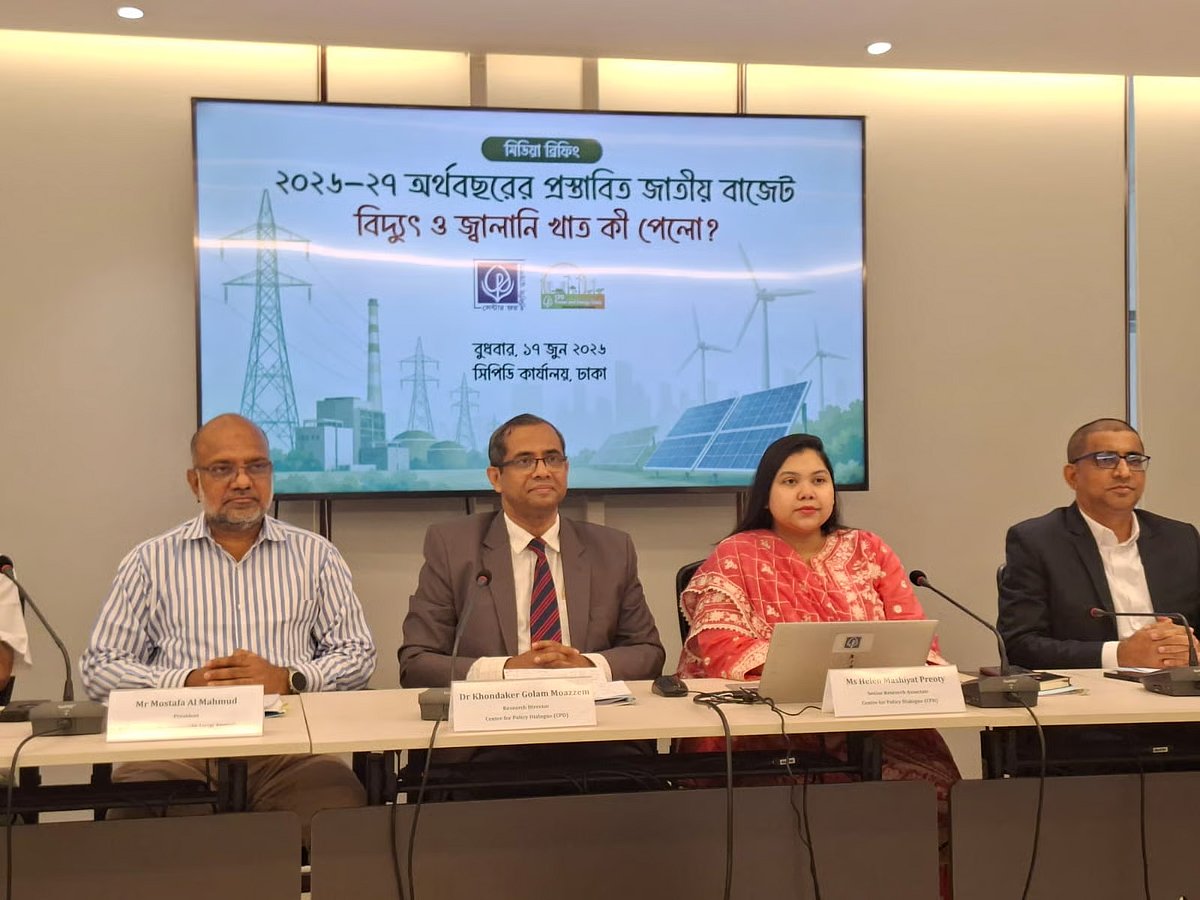
CPD presented the review during a media briefing titled “Proposed National Budget for FY2026–27: What has the power and energy sector received?” held on Wednesday morning at its office in Dhanmondi, Dhaka.
Helen Mashiyat Priyoti, senior research associate at CPD, presented the keynote paper.
The paper states that the proposed budget allocates a total of Tk 173.45 billion (17,345 crore) to the Ministry of Power, Energy and Mineral Resources. This represents an increase of 2.3 per cent compared with the revised budget for the current fiscal year.
Pointing out that the sector’s share of the national budget has declined from 2.15 per cent to 1.85 per cent, the keynote paper said, within this allocation, funding for the Power Division has fallen to Tk 149.96 billion (14,996 crore), a decrease of 3.9 per cent from the previous allocation.
In contrast, the allocation for the Energy and Mineral Resources Division has increased by approximately 72 per cent, primarily due to greater emphasis on gas exploration and extraction projects, it added.
According to CPD, the proposed budget has, for the first time, accorded special priority to the solar power sector. The government has proposed a zero tax for solar power generation projects until 2035. Consumers will receive a 5 per cent tax rebate against payments for solar electricity.
At present, aluminium or steel structures required for power plant installation, along with various types of electrical conductors, carry a tax burden ranging from 62 per cent to 93 per cent. The proposed budget seeks to reduce this burden to between 26 per cent and 38 per cent.
For lithium-ion batteries, the government has proposed reducing the current tax burden from 61.8 per cent to 26.3 per cent. The proposed budget also seeks to reduce taxes on other equipment, including solar inverters from 28.7 per cent to 20.7 per cent and solar panels from 28.7 per cent to 22.2 per cent.
In addition, the government has completely withdrawn taxes on electric vehicle (EV) charging stations and reduced registration fees. CPD has welcomed these initiatives.
However, the paper notes that the budget continues to exempt liquefied natural gas (LNG) imports from value-added tax (VAT), thereby maintaining LNG as the least-taxed energy source. At the same time, the government has extended customs concessions on coal imports for power plants until 2030. It has also prioritised domestic coal exploration and set a target of extracting 600,000 tonnes of coal during FY2026–27.
CPD criticised these proposals, arguing that they contradict the objectives of energy transition. The organisation stated, “Why does the government continue to provide increasing incentives for LNG when it says it will not import LNG at high prices?”
CPD also considers the decision to establish new coal exploration targets and extend customs benefits for coal-importing power plants until 2030 to be inconsistent with a sustainable energy transition.
Speaking at the media briefing, Khandaker Golam Moazzem, research director at CPD said, “They are providing one type of incentive outwardly, but internally they still prefer fossil fuels.”
Khandaker Golam Moazzem further observed that the proposed budget has failed to address disparities within the revenue structure.
He noted that CPD has identified positive changes in certain areas; however, revenue imbalances remain.
He said they urge the government to reduce the preferential treatment currently afforded to fossil fuels, LNG, coal and oil.
Other speakers at the media briefing included Mostafa Al Mahmud, president of the Bangladesh Sustainable and Renewable Energy Association (BSREA); Monowar Mostafa, general secretary of the Democratic Budget Movement; and Mohammad Javed Imran, chief risk officer of Infrastructure Development Company Limited (IDCOL), among others.