World Bank Report
Middle East war may push 1.2m more people into poverty in Bangladesh
Due to the Middle East war, around 1.2 million more people in Bangladesh may fall into poverty this year. Their real income may decline because of high inflation, preventing them from rising above the poverty line, according to the World Bank.
The World Bank released the April edition of its Bangladesh Development Update report today, Wednesday. It includes an estimate of how many people may fail to rise above the poverty line due to the Middle East conflict. Currently, any working individual earning less than $3 per day is considered poor.
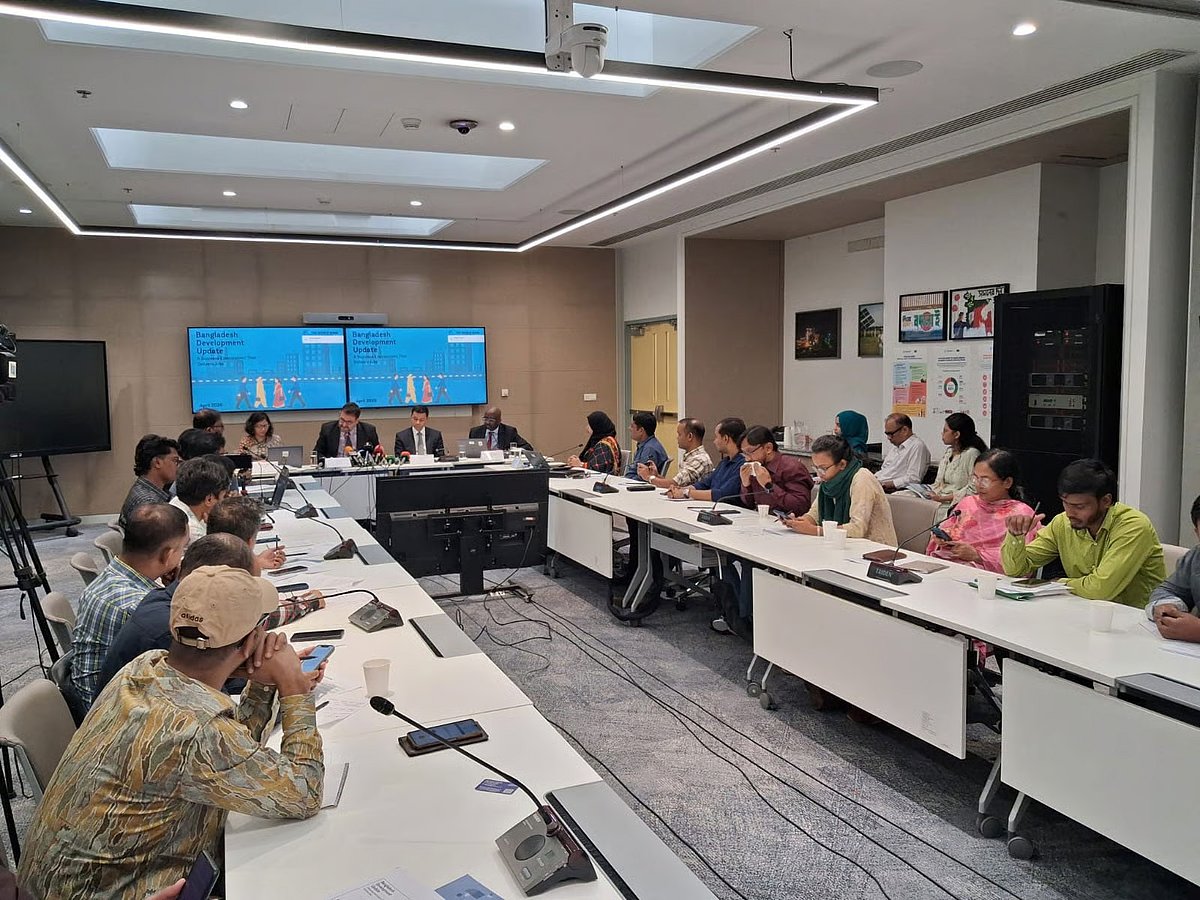
A press conference was held on Wednesday morning at the World Bank’s Dhaka office to mark the release of the report. Various aspects were presented by World Bank Senior Economist Dhruv Sharma.
The World Bank also says that due to the global situation, Bangladesh’s GDP growth for the current 2025–26 fiscal year may decline to 3.9 per cent.
War may increase poverty
The report states that poverty is rising due to high inflation and other factors. The poverty rate was 18.7 per cent in 2022, which increased to 21.4 per cent in 2025. In 2025, an additional 1.4 million people fell into poverty.
The World Bank further notes that before the Middle East war, it was estimated that 1.7 million people would rise above the poverty line this year. However, due to the war, only 500,000 people may do so. This means that around 1.2 million people will remain in poverty this year. Without the war, the poverty rate could decline to 19.3 per cent by 2028.
The report identifies several reasons for rising poverty, including high inflation, low wages, and slowing employment growth. It also forecasts rising inequality. According to the World Bank, due to the Iran war, poverty will decline by only 0.7 percentage points this year, whereas typically it decreases by more than 1 percentage point annually.
World Bank Division Director (Bangladesh and Bhutan) Jean Pesme said Bangladesh is not achieving expected revenue collection. Trade is being affected by reciprocal tariffs from the United States. He also noted that the pace of poverty reduction has slowed in recent years and emphasized the need to improve the investment climate for decent job creation.
Jean Pesme added that reform initiatives taken in the past must continue, although they will be challenging. He stressed the need for quick short-term measures after assessing different aspects of the Middle East crisis.
Impact of Middle East war on six sectors
The report says the Middle East war may affect at least six sectors in Bangladesh: (1) Stability of the current account balance may be disrupted due to impacts on imports, exports, remittances, and currency depreciation. (2) GDP growth may slow due to negative effects on consumption and investment. (3) Inflation may rise further if fuel prices and transport costs increase. (4) Around 1.2 million people may newly fall below the poverty line. (5) Fiscal pressure may increase, such as higher subsidies for fertiliser and fuel; and (6) Inequality may rise, with the Gini index projected to increase by 0.2 percentage points in 2026.
GDP growth at 3.9 per cent
The World Bank forecasts Bangladesh’s GDP growth at 3.9 per cent for the 2025–26 fiscal year.
Earlier in January, the World Bank had projected 4.6 per cent growth for the same fiscal year. This forecast has now been revised downward due to the Iran war.
The outgoing interim government set the growth target at 5.5 per cent for the current fiscal year. The new government has not yet revised its projection. According to the Bangladesh Bureau of Statistics (BBS), growth was 3.8 per cent in the 2024–25 fiscal year.
The World Bank notes that Bangladesh continues to face four key economic challenges: high inflation, low revenue collection, financial sector risks, and external pressures. These challenges have intensified due to the Middle East war.
The report also states that Bangladesh is in a vulnerable position with limited scope for immediate macroeconomic stabilization. This is due to constraints in increasing revenue, limited monetary policy space to control inflation, a fragile banking sector, and insufficient foreign exchange reserves.
Inflation may rise
The World Bank says that if the ongoing conflict in the Middle East persists, rising fuel prices and import costs may push inflation higher in Bangladesh. Inflation is currently around 8.5 per cent, which is already burdening low-income people.
The World Bank believes Bangladesh has limited capacity to withstand prolonged shocks due to constrained foreign reserves, tight fiscal and monetary policies, and a fragile banking sector. The most vulnerable populations are likely to be the hardest hit.
The organisation adds that economic recovery is possible if political stability is maintained after the 2026 elections and structural reforms progress quickly. It emphasizes restoring macroeconomic stability, increasing revenue, strengthening the financial sector, and improving the business environment.
Focus needed on reforms
The World Bank has urged a strong focus on reforms. It says that short-term priority reforms are needed to stabilize the economy and build the foundation for structural reforms, alongside expanding decent job opportunities.
Key reform priorities include strengthening macroeconomic fundamentals. When import costs rise, financial support should be provided to vulnerable groups. Inflation should be controlled through tight monetary policy targeting demand, while supply-side issues should be addressed through ensuring adequate supply and preventing corruption. Stability in the banking sector must also be restored.
The report notes that while large export-oriented sectors like ready-made garments contribute to growth, small and medium enterprises face high costs, weak infrastructure, and limited access to finance. To boost private sector-led growth and employment, it recommends easing targeted regulations, strengthening competition policy, ensuring a level playing field for state-owned enterprises, simplifying trade policies, and improving the reliability of electricity supply.
World Bank Senior Economist Dhruv Sharma said improving the business environment is crucial to absorb the rapidly growing workforce and sustain growth. Reducing regulatory uncertainty, increasing competition, and removing barriers for entrepreneurs would help boost private investment and employment.