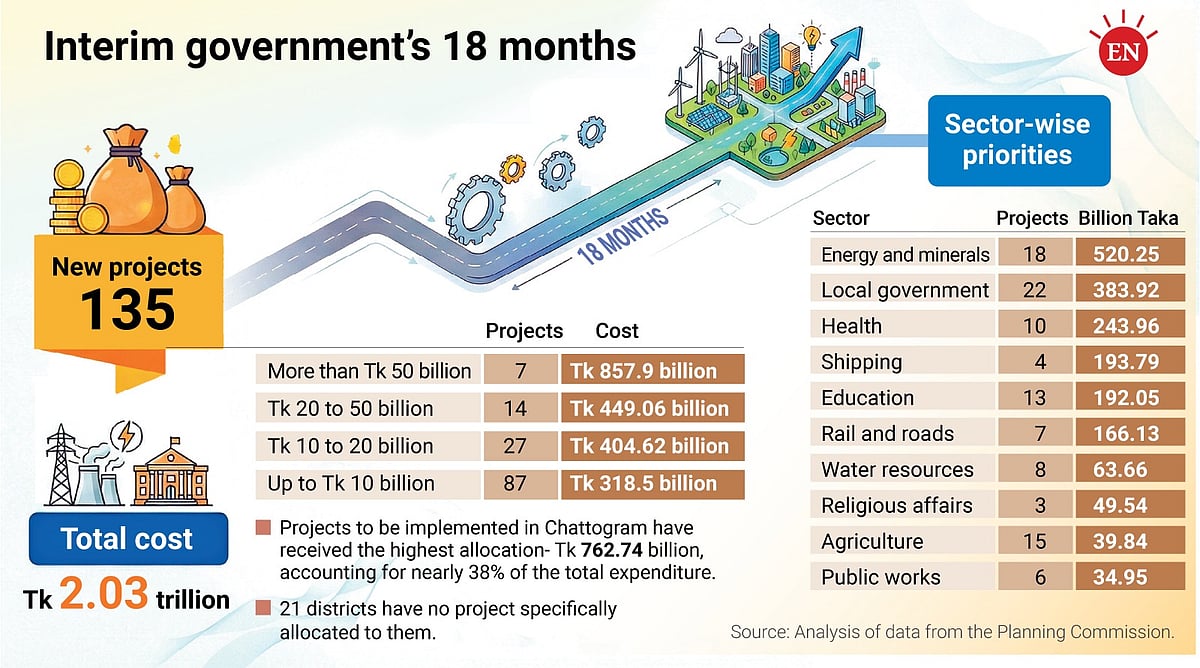
Highest allocation for Chattogram at Tk 762.74 billion, accounting for 38 per cent of total expenditure.
No projects for 21 districts.
Dhaka WASA is already heavily burdened with debt, amounting to around Tk 240 billion. Despite this, it has taken up another loan-dependent project titled Establishment of Dhaka WASA Training and Research Academy, with an estimated cost of Tk 7.21 billion. Through the project, Dhaka WASA plans to provide training not only for its own staff but also for employees of similar agencies in neighbouring countries.
Questions had already been raised about the necessity of such a project amid the government’s revenue shortfall. However, ignoring the criticism, the interim government approved the project at the final stage of its tenure.
After the schedule for the 13th national parliamentary election was announced, the project titled Establishment of Dhaka WASA Training and Research Academy was approved at the Executive Committee of the National Economic Council meeting on 23 December. For the project, Tk 5.71 billion will be taken as a loan from South Korea.
During the final phase of the interim government led by Professor Muhammad Yunus, 64 projects were approved between 1 December and 25 January, with a total estimated cost of Tk 1.06 trillion. Of these, 40 are new projects, which will require Tk 793.56 billion for implementation. While the list of new projects includes some necessary initiatives, it also contains projects considered “less urgent” as well as “controversial”.
Overall, the interim government has taken up 135 new projects over the past one and a half years, with a combined cost of Tk 2.03 trillion. An analysis of the nature of these new projects and the beneficiary districts shows that, in terms of expenditure, the energy and mineral resources sector received the highest priority.
The health sector lagged behind initially, but moved up the list following the approval of three major projects towards the end of the government’s tenure. In the education sector, most of the new projects relate to infrastructure development for new universities and educational institutions.
The period under the Awami League did not see any distinct emphasis on boosting employment, nor were any special short-term programmes undertaken to that end.
In allocating funds for new projects, the highest priority was given to projects to be implemented in Chattogram district. Alongside nationally significant projects, a number of initiatives related to urban services and infrastructure in Chattogram city were also approved. In contrast, no specific projects were taken up for 21 districts.
The reason behind the higher allocation for Chattogram was raised with planning adviser Wahiduddin Mahmud in August. He told Prothom Alo that water supply and sewerage services in Chattogram are not as developed as those in Dhaka. He also said that priority was given to upgrading infrastructure at Chattogram Port to boost exports, which is why Chattogram received a larger share of allocations.
At the tail end of its tenure, the interim government held a total of 19 ECNEC meetings. The most recent meeting took place on 25 January, when 14 new projects were approved with an estimated cost of Tk 191.65 billion. Earlier, at an Ecnec meeting on 23 December, another 14 new projects were approved, involving an expenditure of Tk 450.8 billion. Before that, a meeting held on 1 December approved 12 new projects with a combined cost of Tk 151.11 billion.
The schedule for the 13th national parliamentary election was announced on 12 December. After the announcement of the schedule, projects aimed at improving roads and rural infrastructure in various areas were approved. Analysts believe that some of these projects could benefit particular parties or candidates.
For instance, a project worth Tk 15 billion for rural infrastructure development under the Local Government Engineering Department (LGED) in Cumilla district was approved on 25 January duringAsif Mahmud Shibajeeb Bhuiyan, who resigned last December from his post as local government adviser.
Asif Mahmud is not contesting the election, but he serves as chairman of the National Citizen Party’s (NCP) election steering committee. The NCP has a candidate in one Comilla constituency and has also joined an 11-party electoral alliance with Jamaat-e-Islami, which has candidates in the other constituencies.
One month before the election schedule was announced, on 10 November, a project worth Tk 19.30 billion for rural infrastructure development in Satkhira district was approved. Cabinet Secretary Sheikh Abdur Rashid, whose residence is also in Satkhira, played a role in pushing the project forward.
Another project, titled “Widening of Key Upazila and Union Roads in Sylhet Division,” worth Tk 19.52 billion, was approved by the Executive Committee of the National Economic Council (ECNEC) on 23 December. Local BNP leaders have claimed on Facebook that the project was brought forward by BNP leader and former Sylhet City Corporation mayor Ariful Haque Chowdhury, who is contesting the Sylhet-4 seat (Gowainghat, Companiganj, and Jaintiapur). Attempts to obtain Chowdhury’s comment on the matter were unsuccessful.
On the same day, ECNEC also approved a Tk 4 billion rural infrastructure project for Patuakhali district, reportedly driven by a then Additional Secretary of the Ministry of Local Government (now serving in another ministry).
When asked, Planning Division secretary Shakil Akhter told Prothom Alo that these project approvals would not influence the elections, as none of the advisers involved are contesting. Moreover, they are not inaugurating anything on the ground, so there is no scope for a conflict of interest.
However, Transparency International Bangladesh (TIB) executive director Iftikharuzzaman told Prothom Alo that under a caretaker government, the rule is that they should not go beyond routine work. In the case of the interim government, the legal aspect is unclear.
He said it is evident that these projects have political connections and could influence election outcomes. Therefore, approving such projects after the election schedule is announced is both improper and indicative of failure.
Among the new projects approved in the last two ECNEC meetings are the development of Haji Mohammad Danesh Science and Technology University (Tk 5.77 billion), management and consolidation of Darul Arkam Islamic Education (Tk 2.42 billion), widening and upgrading three regional highways in Munshiganj to proper standards (Tk 13.59 billion), widening and upgrading the Rangamati–Mahalchhari–Khagrachhari regional highway (Tk 10.64 billion), and construction of district offices for the Department of Narcotics Control (first phase, Tk 1.20 billion).
Tk-2-trillion project
During the July mass uprising, the Awami League government, which was ousted after more than 15 years in power, approved hundreds of projects. Many of these projects involved huge expenditures, but their benefits remain questionable. After the interim government took office on 8 August 2024, a committee was formed under the leadership of economist Debapriya Bhattacharya to prepare a white paper reviewing the previous government’s tenure. The committee’s report stated that nearly Tk 295 billion was wasted in the name of development projects during the previous Awami League government. During this period, about Tk 720 billion was spent through the Annual Development Programme (ADP), with up to 40 per cent of development project funds reportedly misappropriated.
According to the Ministry of Finance, when the Awami League assumed office on 6 January 2009, the domestic and foreign debt stood at Tk 2.76 trillion. By the time they left office, the debt had risen to Tk 18.36 trillion. They left behind massive debts across various sectors, including electricity and energy. In this situation, the new government adopted a cautious stance, advising against approving large or non-essential projects.
According to media reports, in an ECNEC meeting on 18 September 2024, chief adviser Professor Muhammad Yunus said that mega projects should no longer be the priority, and public-interest projects should be given precedence. However, analysis of all new projects during the interim government’s tenure shows that there are still less important projects, and the government has approved some large-scale projects as well.
During the caretaker government’s tenure, seven projects were approved with a budget of Tk 50 billion or more. These include the modernisation and capacity expansion of Eastern Refinery at Tk 354.65 billion, the expansion of the Chittagong Port’s Bay Terminal at Tk 135.25 billion, and the construction of a bridge over the Karnaphuli River at Kalurghat, Chittagong at Tk 115.60 billion. Meanwhile, 48 projects were approved with a budget of Tk 10 billion or more.
Among the less critical new projects are the construction of a multi-storey building for government employees in the Azimpur government colony (Tk 77.5 billion), a multi-storey building for fire service officers (Tk 6.5 billion), and the construction of a tax building in Chittagong (Tk 43.7 billion).
During the previous government’s tenure, several projects were approved to build flats for government employees in Dhaka, including in Azimpur, Motijheel, and Mirpur. However, many of these flats are being rented out rather than occupied by the employees, leading the Public Works Department to cancel allocations in several cases.
Priority on energy sector
During the caretaker government’s tenure, the sector receiving the highest allocation was power, energy, and mineral resources. Thirteen projects were approved in this sector, of which 12 involved gas well drilling, exploration, and supply, while one focused on capacity expansion at Eastern Refinery. Amid a domestic gas shortage, the government emphasised increasing internal supply to reduce dependence on the global market.
Most projects undertaken by the Local Government Ministry were related to roads and rural infrastructure. Following these were projects under the health, shipping, education, rail and roads, water resources, religion, agriculture, and public works ministries.
Typically, the Ministry of Religion remains at the bottom in terms of project allocation. This time, it made it to the top due to a single large project: Mosque-based Public Education, aimed at improving moral and religious values, with a budget of Tk 46.45 billion.
None of the projects approved during the caretaker government were nationwide in scope. Each was allocated to a specific district, with 43 districts receiving projects. Chittagong received the highest priority, with 12 new projects approved to be implemented in the district, costing Tk 762.74 billion—equivalent to 38 per cent of total spending on new projects.
These projects include infrastructure development at Chittagong Port’s Bay Terminal, construction of a tax building, expansion of Eastern Refinery, and a railway bridge over the Karnaphuli River. Additionally, major projects for Chittagong’s sewerage, sewage treatment, and water supply were approved.
Where are the initiatives to address inequality?
The issue of regional inequality in Bangladesh first gained attention during the military-backed caretaker governments of 2007 and 2008. In 2008, a World Bank report highlighted a clear East-West divide in regional development. The Awami League government did not take significant measures to address income or regional disparities.
After the anti-inequality student movement and the July mass uprising that led to the fall of the Awami League government, the caretaker government set its goal on equitable and sustainable development. To achieve this, in September 2024, the Planning Ministry formed a 12-member task force to redefine economic strategies and mobilise necessary resources. The task force was chaired by KAS Murshid, former Director General of the Bangladesh Institute of Development Studies (BIDS).
The task force report noted that regional disparities exacerbate social inequalities. Regions such as Dhaka and Chittagong receive higher levels of investment and resources, while rural areas remain deprived of development opportunities.
When asked, KAS Murshid told Prothom Alo last Friday that the report had been submitted in January of last year. He observed that the government has not implemented many of the recommendations, although some are under the implementation process. He added that inclusive development is a complex task, and the current government has achieved limited progress in this area. However, he noted that several plans have been discussed in the National Economic Council (NEC).