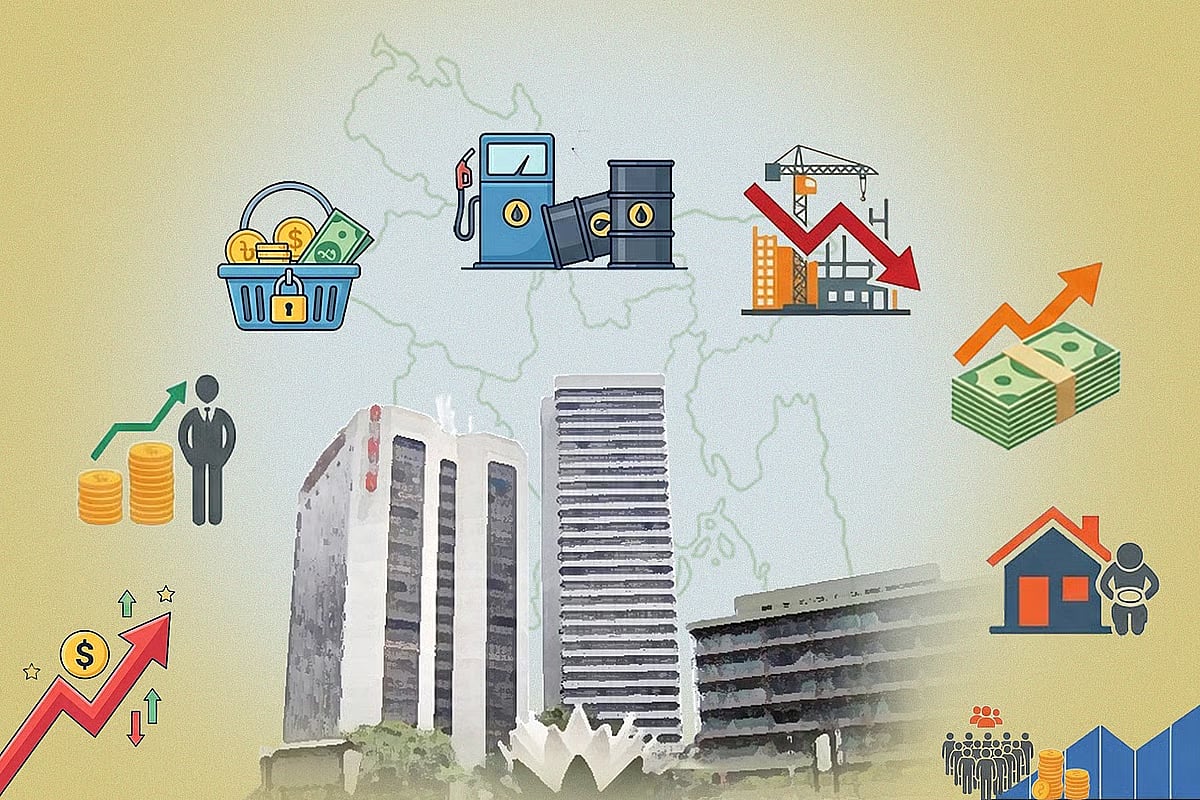
The new government has taken charge of the economy amid major challenges. For three consecutive years, GDP growth has declined. Private investment remains weak. As a result, the economy’s capacity to generate adequate new employment has declined.
The country’s financial sector is in crisis. The government has had to provide liquidity support to keep several banks operational. At the same time, inflation is above 8 per cent, which has reduced people’s purchasing power.
Low-income groups have been the worst affected. Due to declining revenue collection, the government’s ability to spend has shrunk. As a result, even if the government wants to stimulate the economy, it cannot increase spending.
Although pressure on the external sector has eased somewhat due to increased remittance inflows, exports have weakened further. Meanwhile, the war in the Middle East has increased economic risks. This could raise import costs, weaken exports, reduce remittances, and thereby widen the current account deficit.
Due to the Iran war, global fuel prices have increased. This raises the risk of further depreciation of the taka, which will push inflation even higher. If fuel subsidies increase now, the government’s fiscal space will shrink further.
Overall, the economy was already facing problems, with various structural weaknesses. Now, that economy is heading toward a deeper crisis. Analysts say that in this situation, to restore stability, rebuild confidence, increase private investment, and make the economy more sustainable, a well-coordinated macroeconomic stability strategy is needed, along with structural reforms.
1. First priority is to reduce inflation
Inflationary pressure in the country began during the Covid pandemic period. During the tenure of the previous Awami League government, no effective initiative to control inflation was observed. Toward the end, although the policy interest rate was increased to control inflation, it was already too late.
After the interim government took charge, the policy interest rate was gradually raised to 10 per cent. As a result, inflation has decreased slightly. The country has been under pressure from high inflation for three consecutive years.
According to the Bangladesh Bureau of Statistics (BBS), the current inflation rate is 8.71 per cent. Wage growth is 8.09 per cent. This means that expenses are rising faster than income. When real income declines, people usually spend less and try to increase savings. This reduces overall demand in the market. When demand falls, it affects business and industry. As a result, production declines, and new investment slows. All of this has happened in Bangladesh.
There is pressure on the new government to reduce interest rates to boost investment. However, reducing interest rates now would increase pressure on inflation. The government’s priority at the moment is controlling inflation. Otherwise, the economy will not be sustainable.
2. Will employment come under pressure?
The government now faces a dilemma regarding the economy. The conflict is between controlling inflation and reducing unemployment. Typically, when a government tries to reduce unemployment, it increases the money supply in the market. This puts money in people’s hands, increases demand, and in turn indirectly raises inflation.
On the other hand, to reduce inflation, interest rates have to be increased. This reduces investment and increases unemployment. The question is, which option the government will choose.
For Bangladesh, the major challenge now is not choosing one problem over the other; rather, it is finding a balance—how to increase employment while keeping inflation under control.
3. Stability first
Inflation must be brought under control first, and only then should attention shift to growth—not before that. Bangladesh had already deviated from its growth trajectory since the Covid period. Although high GDP growth figures were reported for two fiscal years in between, they were not considered credible.
From the 2022–23 fiscal year, growth has been declining continuously. In the 2024–25 fiscal year, growth stood at only 3.49 per cent. That means GDP growth has declined for three consecutive fiscal years.
After the pandemic, experts had suggested focusing on sustaining the economy rather than pursuing growth. Although the global economy initially faced difficulties due to Covid and later the Russia–Ukraine war, most countries have since recovered. Bangladesh is among the countries that have lagged behind.
Now it is not just about survival, but also about recovery. In its election manifesto, the BNP government has pledged to raise GDP to one trillion dollars by 2034. Achieving this will require high growth. Therefore, this is the first challenge for the new government. The Iran war has made this challenge even tougher.
4. Poverty back in focus
With incomes declining, the poverty rate has increased. The Bangladesh Bureau of Statistics (BBS) last conducted a survey in 2022, when the poverty rate was 18.7 per cent. No Household Income and Expenditure Survey (HIES) has been conducted since then.
However, according to a World Bank report published last November, the poverty rate in Bangladesh is now 21.2 per cent. By this estimate, around 36 million people in the country are living below the poverty line. About 1.4 million people fell into poverty in 2025 alone.
To halt this rise in poverty, people’s incomes must increase.
It has been observed that despite high growth, the pace of poverty reduction in the country has slowed since 2016. Growth is no longer reducing poverty at the same rate as before.
According to the World Bank, in Bangladesh, a 1 per cent increase in GDP reduces poverty by about 0.9 per cent on average, whereas in South Asia, a 1 per cent increase in growth reduces poverty by about 1.5 per cent.
This means that even when Bangladesh experiences growth, its benefits are not reaching everyone equally.
5. Inequality is weakening the economy
Bangladesh is now one of the countries in the world with high income inequality. According to the BBS Household Income and Expenditure Survey, the Gini coefficient was 0.458 in 2010 and increased to 0.499 in 2022.
Theoretically, when the Gini coefficient approaches 0.50, it indicates a high level of income inequality.
About 41 per cent of the country’s total income is now concentrated in the hands of just 10 per cent of the population, while the richest 5 per cent control nearly one-third of national income.
However, the most concerning issue is that the share of the middle class in national income has declined. This means consumer demand is decreasing. The slowing pace of the economy is evidence of this.
6. Growth is happening, but where are the jobs?
Although high growth was seen during the previous Awami League government, it was largely without creating adequate jobs. That is, GDP was increasing, but sufficient jobs were not being created to raise the incomes of a large number of poor people.
The World Bank said that between 2016 and 2022, about 14 million young people reached working age in the country; however, only 8.7 million new jobs were created in the labour market during this period.
That means nearly half of the youth did not get jobs. Moreover, among those who did find work, about 70 per cent were engaged in low-productivity agriculture. Employment in productive industrial sectors declined.
It is seen that between 2016 and 2022, the industrial sector grew at an average annual rate of 9 per cent; however, during the same period, employment in the industrial sector declined by nearly 10 per cent. Again, although about 82 per cent of the country’s total exports come from the ready-made garments sector, employment there accounts for only about 6 per cent. That is, despite export success, it has not created sufficient jobs.
The situation is worse for women. According to the Labour Force Survey, one in five young women in the country is not employed. Among educated young women, one in four does not get a job.
In urban areas, women’s participation in the labour force declined from 31 per cent in 2016 to 25 per cent in 2023. Many women are now working in agriculture, where they are mostly engaged in low-paid informal jobs—women now make up 58 per cent of workers in agriculture.
In contrast, women’s participation in the industrial sector has declined, which had previously increased due to the expansion of the ready-made garments industry. That is, women are moving out of jobs.
Youth participation in the labour force has also declined. In 2023, the youth unemployment rate was 8 per cent, and among university graduates it was 14 per cent. At the same time, 16 per cent of young people were not engaged in work, education, or training. Among these youths, 73 per cent are women and 63 per cent are urban residents.
Therefore, one of the biggest challenges for the new government is to create job opportunities for the 2.2 million people who enter the labour market each year.
7. New investment is needed
When the interim government took office, credit growth in the public sector was 11.61 per cent. At the same time, private sector credit growth was 9.86 per cent; now public sector credit has risen to 33.57 per cent, while private sector credit has declined further to 6.03 per cent. Even private investment compared to GDP has decreased significantly.
Such a poor state of investment was not seen even during the Covid pandemic. Problems in infrastructure, including energy, already existed, but even more significant was the lack of confidence. The government did not make efforts to gain the confidence of the private sector; rather, due to factory closures, at least 50,000 workers lost their jobs. In this situation, the biggest challenge for the new government is to increase investment.
8. How will confidence in investment return?
During the previous Awami League government, several groups of businessmen emerged in the private sector. These oligarchic business groups used political power to influence state policies and economic decisions. As a result, some good entrepreneurs fell behind, while others entered into competition to get closer to the government.
During the 18 months of the interim government, a notable step was taking action against those oligarchic business groups and initiating the process of recovering laundered money. Alongside continuing this process, the biggest challenge for the new government is to create a trustworthy investment environment. For this, the time and cost of doing business must be reduced.
9. The energy sector is now a major risk
The electricity and energy crisis is a major obstacle to investment. There are examples of factories being unable to start operations due to gas connection issues. During the previous BNP government (2001–06), this electricity and energy sector was described as the most corrupt.
On 26 September 2004, on behalf of 32 donor countries and agencies, the then World Bank Country Director Christine Wallich sent a letter to the then Prime Minister highlighting corruption and political interference in the power sector.
Now the crisis is multifaceted.
The ongoing Iran war has intensified the energy crisis further. As a result, the government faces greater challenges. Fuel will have to be purchased at higher prices and brought into the country. Due to rising fuel costs, the government has already formed a committee to adjust prices. If prices are increased, it will impact inflation. If not, the government’s subsidy burden will rise. Overall, the government is now in a dilemma regarding energy.
10. Not the time to reduce interest rates
Entrepreneurs are now blaming high interest rates as a barrier to investment. However, there is no clear evidence that high interest rates have reduced investment in Bangladesh; rather, there are more examples where investment has increased despite high rates. Still, entrepreneurs always prefer lower interest rates.
The central bank had increased policy interest rates to contain inflation. This is how inflation has been controlled worldwide; in fact, Bangladesh did not benefit because it delayed adopting such monetary policy.
The new BB governor under the BNP government, Mostaqur Rahman, has spoken about reducing interest rates after taking office. Although a meeting of the monetary policy committee was called for this purpose, it was cancelled at the last moment.
Interest rates are an important tool for controlling high inflation. Investment is also necessary in the country. However, economists have advised not to adjust interest rates for now. How much the government’s economic decisions are influenced by political pressure will be a major test.
11. Where will the money to fulfil promises come from?
The BNP government came to power making a number of promises. These include distributing family cards, waiving agricultural loans up to Tk 10,000, and providing unemployment allowances for a certain period. In addition, the interim government had already finalised the pay commission report. The government has also promised to return the deposits of customers of five collapsed banks; and now, subsidy pressures are mounting.
So, the government has to incur a substantial amount of expenditure. The question is: where will this additional money come from? Because government revenue has declined significantly. According to the World Bank, the tax-to-GDP ratio has fallen below 7 per cent for the first time in seven years.
The World Bank says Bangladesh needs a tax-to-GDP ratio of at least 15 per cent to sustain necessary development activities. However, revenue collection has slowed to such an extent that the government is struggling even to meet essential expenditures. For example, in the current 2025–26 fiscal year, the revenue shortfall is expected to exceed Tk one trillion. On top of that, there is a growing burden of debt repayment.
Therefore, increasing revenue is another major challenge for the government. Without it, election promises cannot be fulfilled, the government will have to rely on borrowing, the budget deficit will widen, investment will be hindered, and inflation cannot be brought under control.
12. No loans by printing money
To finance the budget deficit, the government usually borrows from the banking system in two ways. In the case of commercial banks, the government issues treasury bills and treasury bonds, which banks purchase. In effect, this means the government borrows depositors’ money through the banks and later repays it with interest.
On the other hand, the government can also borrow directly from Bangladesh Bank. When the central bank purchases treasury bills or bonds or provides overdraft facilities, new reserve money is created. That is why this process is often referred to as “printing money to lend.”
The Awami League government took a large amount of such loans by printing money. Former governor Ahsan H. Mansur also provided Tk 220 billion to support five merged banks. In theory, excessive borrowing from the central bank increases money supply in the market and creates inflationary pressure.
Due to declining revenue, the new government is also being forced to borrow more from the banking system. It has been observed that when the government borrows heavily from commercial banks, the share of credit available to the private sector declines. Therefore, there is little alternative for the government other than increasing revenue.
The new government has stepped back from reform initiatives in revenue administration. It remains to be seen how this will affect its ability to secure loans from donors. For now, the government is placing greater emphasis on foreign borrowing to address the current crisis.
13. No alternative to banking reform
Under the previous Awami League government, the banking sector was effectively opened up to certain individuals, enabling them to take loans without repayment and engage in capital flight. The interim government initiated several reforms in the banking sector. The BNP government has also promised reforms in its election manifesto.
These include rationalising interest rates, granting autonomy to Bangladesh Bank, abolishing the Financial Institutions Division under the Ministry of Finance and transferring the management and supervision of state-owned banks to the central bank, ending political interference and family dominance in bank management, taking action against those responsible for high default loans, and forming an economic reform commission comprising economists, researchers, bankers, and corporate leaders.
A new governor has already been appointed at Bangladesh Bank. The appointment of a businessman to the position has sparked debate. Now it remains to be seen when the Financial Institutions Division will be abolished, when the reform commission will be formed and with whom, and when the remaining promises will be fulfilled.
14. Default loans have crossed danger levels
In a 2019 report, the International Monetary Fund (IMF) said that in Bangladesh, the tendency among a certain group to take loans without repayment is deeply rooted. Some influential and well-connected wealthy businesspeople feel no obligation to repay loans. The report also noted that key decisions in the financial sector are often influenced by these powerful borrowers. It further stated that the actual volume of default loans in Bangladesh is much higher than officially reported figures.
During the interim government, central bank governor Ahsan H Mansur revealed these hidden default loans. Currently, total default loans stand at Tk 6.44 trillion, which is 35.73 per cent of total disbursed loans. Later, ahead of the elections, special provisions allowed loan rescheduling, reducing the default rate to 30.60 per cent. Even so, this remains the highest in Asia.
15. Pressure mounting on the new governor
The new governor of Bangladesh Bank, Mostaqur Rahman, was appointed on 25 February. His appointment has generated considerable discussion, as has the manner in which the former governor was removed.
Upon assuming office, the governor took steps to reduce interest rates, but the initial effort did not succeed. He has stated that controlling inflation will be his top priority. Now, his biggest challenge will be how to adjust interest rates without increasing inflationary pressure.
Several groups were unhappy with Ahsan H. Mansur, including the owners of the five banks he sought to merge. Many of these owners are still fugitives, while some are in prison. Some are also attempting to return. Successfully merging the five banks will be extremely difficult—and the responsibility now falls on the current governor.
The former governor had also initiated a process to recover laundered money, including investigations into financial irregularities involving 11 major business groups. Recovering these funds will be a complex and long-term task, as those involved are highly influential and possess vast resources. Some of them have become active again. The new governor will have to handle these pressures as well. Whether he will receive sufficient political backing remains a key question. The latest information is that investigations will initially proceed against six major groups.
The election manifesto also mentions strengthening and empowering Bangladesh Bank. It further states that the management and oversight of state-owned banks will be placed under the central bank. The first test of this will come during the restructuring of the boards of state-owned banks. After coming to power in 2009, the previous Awami League government appointed second- and third-tier party leaders as directors in various banks. Numerous financial scandals, including Basic Bank and Hallmark, were the result. It remains to be seen whom the BNP government appoints this time and what role Bangladesh Bank will play in the process.
16. No further new banks
At present, Bangladesh has a total of 62 scheduled banks, including six state-owned institutions and 43 private commercial banks. The first approval for private banks was granted during the rule of Hussain Muhammad Ershad (1982–90), when nine banks were established.
Following the fall of Ershad, the first tenure of the Bangladesh Nationalist Party (1991–96) saw the licensing of eight additional banks. Subsequently, during the 1996–2001 term, the Awami League authorised 13 new banks.
The only notable exception occurred during the BNP’s second term in office (2001–06), when the then Finance Minister M Saifur Rahman declared in the national budget that no further banking licences would be issued. Despite significant political pressure, no new banks were approved during that period.
However, upon returning to power, the Awami League once again issued licences for 13 banks.
In reality, most banking licences in Bangladesh have historically been granted on political considerations. With a new political government now in place, similar pressures are likely to re-emerge. In parallel, the process of establishing digital banks has been underway for some time. Ultimately, the recipients of these licences will also reveal the extent of political influence in the sector.
17. Maintaining macroeconomic stability: the real test
In the immediate term, the government’s most formidable challenge has been the fallout from the Iran war. Much of this remains beyond its direct control. Bangladesh is yet to fully recover from the economic aftershocks of the Russia-Ukraine War, and the escalation involving Iran has compounded global uncertainty.
Under these circumstances, effective macroeconomic management, anchored in prudent decision-making and timely reforms, will be critical. Rising energy prices, higher import costs, pressure on the exchange rate, subdued export growth, and the apprehension of a medium-term decline in remittance inflows (despite a temporary uptick) all threaten macroeconomic stability.
Ultimately, the trajectory of the country’s economy will depend on how effectively the new government navigates these overlapping pressures.
Q&A: Key economic challenges
1. What is the biggest challenge for the economy right now?
The principal challenge is managing multiple pressures simultaneously: curbing inflation, generating employment, restoring investors’ confidence, reforming the banking sector, and mitigating risks in the energy sector.
2. Why is inflation receiving the greatest attention?
Inflation currently stands at 8.71 per cent, while wage growth is 8.09 per cent. This means the cost of living is rising faster than incomes, eroding purchasing power and weakening consumer demand.
3. Where does the tension lie between reducing inflation and increasing employment?
To contain inflation, interest rates are typically kept elevated, which makes borrowing more expensive and can discourage investment. Conversely, increasing liquidity to stimulate job creation may fuel inflation. The government’s challenge is to strike a careful balance between these competing objectives.
4. Why is economic growth a concern now?
GDP growth for FY2024–25 has fallen to just 3.49 per cent, marking a third consecutive year of decline. Under such conditions, merely setting ambitious growth targets is insufficient; stabilising the economy must come first.
5. Why has poverty returned to the forefront of discussion?
High inflation, declining real incomes, and weak employment generation have contributed to a rise in poverty. According to the World Bank, the poverty rate stands at 21.2 per cent, meaning approximately 36 million people are living below the poverty line.
6. Why is income inequality a growing concern?
Bangladesh’s Gini coefficient has risen to 0.499, with nearly 41 per cent of total income concentrated among the top 10 per cent of the population. This indicates that the benefits of economic growth are not being distributed equitably.
7. How severe is the employment crisis?
According to the World Bank, between 2016 and 2022, around 14 million young people entered the workforce, yet only 8.7 million jobs were created. Youth unemployment stood at 8 per cent in 2023, rising to 14 per cent among university graduates—highlighting a structural mismatch between growth and job creation.
8. Why is investment not increasing?
The primary constraint is a lack of confidence. This is compounded by energy shortages, policy uncertainty, and weak credit flow.
9. Why is the banking sector such a major concern?
Non-performing loans have reached Tk 644,515 crore, equivalent to 35.73 per cent of total loans. Political interference, weak regulatory oversight, and capital flight have made the banking sector one of the economy’s most significant vulnerabilities.
10. What risks does the Iran conflict pose to Bangladesh’s economy?
The conflict has driven up global energy prices, increasing Bangladesh’s import costs and exerting pressure on the currency. It may also reignite inflation and create additional strain on exports, remittances, subsidy expenditures, and the current account balance. As such, it represents a major external test for the new government.