8 local, foreign businesses join billion-dollar club
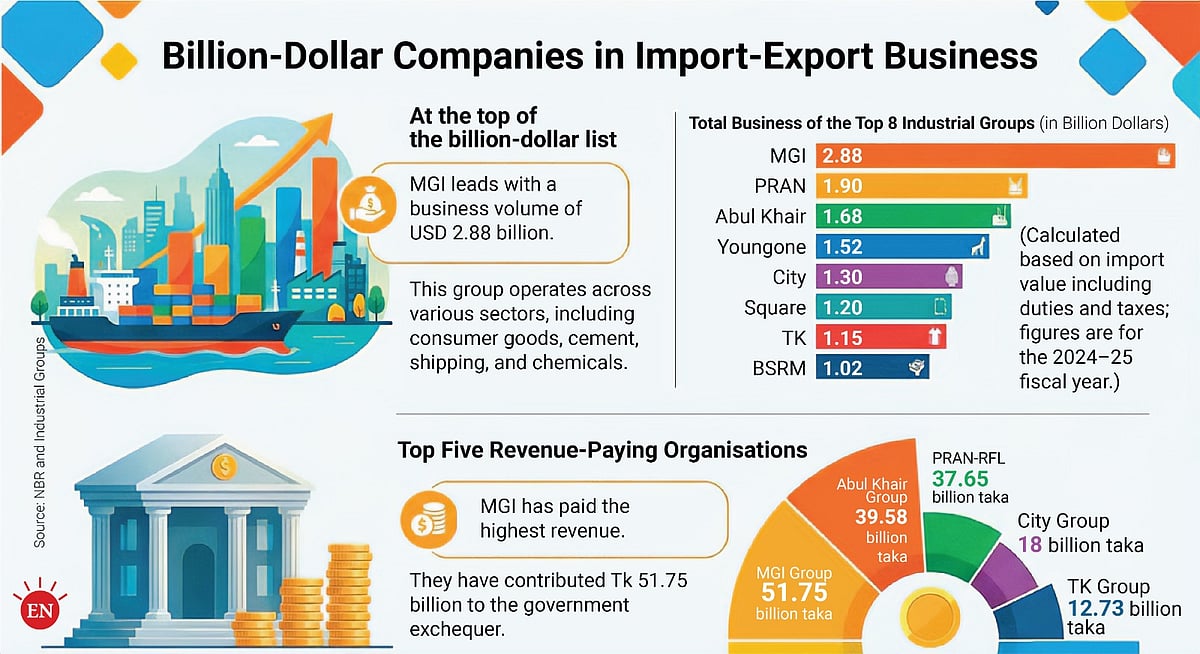
Major changes have taken place in the country’s production-oriented sectors. In the 2024–25 fiscal year, eight industrial groups recorded import–export transactions exceeding one billion US dollars, or more than USD 1 billion.
The eight industrial groups that joined the billion-dollar club are: Meghna Group of Industries (MGI), PRAN–RFL Group, Abul Khair Group, City Group, TK Group, Square Group, BSRM Group, and South Korea’s Youngone Corporation.
On the other hand, another local business group, Bashundhara Group, which was on the list in the previous fiscal year, dropped out in the most recent fiscal year.
Prothom Alo prepared the list by analysing the industrial groups’ import expenditures and export earnings in the 2024–25 fiscal year. In compiling the list, actual import and export data from the National Board of Revenue (NBR) were taken into account.
At the import stage, the declared values submitted by importers were used. Domestic imports or exports were not included in the calculations. This year, foreign industrial groups have also been included alongside domestic ones.
In the last fiscal year, the total import–export volume of the industrial enterprises included in the billion-dollar club amounted to USD 12.54 billion, accounting for 11 per cent of the country’s total imports and exports for that fiscal year.
These enterprises paid Tk 178.13 billion in revenue to the government during the same period and generated employment for approximately 525,000 people.
The expansion of factories and establishment of new facilities has increased raw material imports, leading to higher import–export transactions for Meghna Group of Industries.Mostafa Kamal, chairman, Meghna Group of Industries
According to NBR data, Bashundhara Group had entered the billion-dollar club in the 2023–24 fiscal year with import–export transactions worth USD 1.12 billion. However, in the 2024–25 fiscal year, its transaction volume declined to USD 510 million.
The group’s imports of consumer goods and industrial raw materials, including clinker, decreased significantly. After the interim government assumed power, various government agencies—including the Anti-Corruption Commission (ACC), the Criminal Investigation Department (CID), and the NBR—began investigations into several alleged irregularities involving the group.
Billion-dollar club
Three industrial groups in the billion-dollar club are also leading the country’s exports. These groups are Youngone, PRAN–RFL, and Square Group. All three recorded double-digit growth in their import–export transactions in the last fiscal year.
The remaining five groups primarily lead import-substituting industries in the country. As a result, many products are gradually shifting from import dependence to domestic production, with some limited export activities as well.
There is vast potential in the sectors in which we operate. If we can ensure further investment in these sectors, we will be able to perform even better in exports.Ahsan Khan Chowdhury, chairman, PRAN–RFL Group
MGI tops the list
Meghna Group of Industries (MGI) has long been a leader in the country’s production-oriented sectors. In the last fiscal year, the group imported goods worth USD 2.32 billion. It paid Tk 51.75 billion (USD 430 million) in revenue to the government.
Overall, the group’s total expenditure on importing various products amounted to USD 2.75 billion. During the same period, the group exported goods worth approximately USD 130 million.
Taken together, MGI’s total import–export transactions in the last fiscal year stood at USD 2.83 billion, representing a 3 per cent increase compared to the previous fiscal year.
MGI continues to expand its factories and invest in new sectors. The group has increased its fleet of ocean-going vessels and helicopters and has invested in steel rod manufacturing and glass factories. New employment opportunities are being created each year.
The MGI industrial conglomerate was founded nearly 50 years ago by entrepreneur Mostafa Kamal. The group’s flagship brand is ‘Fresh.’ Approximately 47,000 people are directly employed by the group, with an additional 15,000–17,000 employed on a temporary basis. In total, around 65,000 people are employed by the group.
When asked, MGI Chairman Mostafa Kamal told Prothom Alo that the expansion of factories and establishment of new facilities has increased raw material imports, leading to higher import–export transactions. He added that as production begins in newly established factories, raw material imports and employment will increase further.
PRAN–RFL advances two positions to second place
PRAN–RFL Group is advancing rapidly in the production-oriented industrial sector. Within a year, the group moved up two positions to secure second place. According to NBR data, the group ranked fourth in the 2023–24 fiscal year with transactions worth USD 1.59 billion. Over the course of a year, the group recorded 20 per cent growth, pushing its transactions beyond USD 1.90 billion.
In the last fiscal year, the group spent USD 1.46 billion on imports, while exports amounted to USD 446.1 million. The group employs approximately 167,000 people.
The group leads in exporting diversified products beyond ready-made garments. Its export portfolio includes nearly 1,500 products, and it has exported to 148 countries. At the same time, the group maintains a strong presence in the domestic market.
PRAN–RFL Group Chairman Ahsan Khan Chowdhury told Prothom Alo, "Imports of raw materials and investment machinery, along with increased exports of diversified products, have led to higher transactions in both areas for the PRAN–RFL Group."
"However, there is vast potential in the sectors in which we operate. If we can ensure further investment in these sectors, we will be able to perform even better in exports. By utilising our skilled human resources, we want to establish industrial factories in remote regions. In particular, we want to set up industries in areas where large-scale employment opportunities have not yet been created, such as Rajshahi, Rangpur, Bogura, Khulna, Jashore, and Bhola."
If the lead time for exporting goods from Bangladesh—from receiving purchase orders to shipment—can be reduced by two to three weeks, export growth will increase further.Ki Hak Sung, chairman, Youngone Corporation
Abul Khair Group expands heavy industry
Abul Khair Group, a leader in heavy industry, expanded its production capacity in the last fiscal year. At its electric arc furnace plant in Sitakunda, Chattogram, the group increased rod production capacity from 1.8 million tonnes to 3 million tonnes, making it the market leader in rod production capacity.
In addition to rods, the group ranks first in cement and corrugated sheets in Bangladesh, first in powdered milk, and second in tea and tobacco. The group also performs well in sanitary and consumer goods.
In the last fiscal year, the group paid Tk 39.58 billion (approximately USD 327.6 million) in revenue to the government at the import stage alone. Including this revenue, its total import expenditure amounted to USD 1.6 billion. Exports increased by 74 per cent within a year to USD 75.9 million. Export products include food items, tobacco, cement, bags, and tea. In the 2024–25 fiscal year, the group ranked third in the billion-dollar club, with total import–export transactions of approximately USD 1.68 billion.
The group was founded by industrialist Abul Khair in 1953 and later expanded by his children. The group employs around 55,000 people and operates 40 industrial enterprises across sectors such as steel, cement, shipping, and ceramics.
Foreign firm Youngone also in billion-dollar club
Youngone Corporation is the only foreign industrial group to enter the billion-dollar import–export club in production-oriented sectors. Owned by South Korean businessman Ki Hak Sung, the company produces fully export-oriented products.
Bangladesh’s top exporter imported raw materials worth USD 550 million in the last fiscal year and exported goods worth USD 970 million. The company also engages in indirect exports.
Youngone began operations nearly 45 years ago in Chattogram. The country’s first private export processing zone, the Korean EPZ in Anwara, Chattogram, was established under Youngone’s initiative. Currently, more than 73,000 people work at Youngone’s factories in Chattogram and Dhaka.
Regarding export prospects, Youngone Corporation Chairman Ki Hak Sung told Prothom Alo that, at present, the global business environment is experiencing some deterioration. As a result, the overall outlook for Bangladesh’s export growth is not very optimistic. Even so, if the lead time for exporting goods from Bangladesh—from receiving purchase orders to shipment—can be reduced by two to three weeks, export growth will increase further. To achieve this, improvements are needed in port operations, customs procedures, shipping, and the infrastructure sector.
We are optimistic that Square Group’s imports and exports will increase further in the coming days. However, much depends on the political situation.Tapan Chowdhury, managing director, Square Pharma
City Group’s diversified investments
City Group, a leader in the consumer goods industry, experienced a decline in import–export transactions. Compared to the 2023–24 fiscal year, transactions declined by 22 per cent in 2024–25. The group began investing simultaneously in multiple sectors—such as paper, liquefied petroleum gas (LPG), cement, cashew nuts, and tea gardens—to diversify away from consumer goods, which slowed growth.
As a result, the group dropped from third to fifth place in the billion-dollar club. In the 2024–25 fiscal year, City Group imported goods worth USD 1.29 billion, paid Tk 18 billion (USD 150 million) in revenue, and exported goods worth USD 10 million. Export products include food items, tea, edible oil, and animal feed.
Founded in 1972 by industrialist Fazlur Rahman, City Group has expanded significantly over the past two decades. The group’s flagship brand is ‘Teer.’
Square Group’s business expands
Square Group’s business is growing. Over the past year, its import–export transactions increased by 12 per cent, moving the group up two positions to sixth place.
In the last fiscal year, the group spent approximately USD 770 million on imports of industrial raw materials and machinery and exported goods worth USD 430 million. The majority of exports consist of ready-made garments, along with pharmaceuticals, cosmetics, and food products. The group also markets pharmaceuticals and consumer goods domestically. More than 80,000 people are employed by the group.
Square Textile Chairman and Square Pharma Managing Director Tapan Chowdhury told Prothom Alo, “We are optimistic that Square Group’s imports and exports will increase further in the coming days. However, much depends on the political situation. Becoming a billion-dollar company is the result of the collective efforts of everyone at Square Group. We actually work as a team. Maintaining good relationships among everyone is important for the stability of the organization. As this has existed at Square for many years, we are satisfied with every member. We have grown together and want to continue moving forward in the same way in the days ahead.”
Stable dollar prices enabled consistent imports, but there is a need to strengthen the rule of law and activate the stock market to sustain economic growth.Mohammad Mustafa Haider, director, TK Group
TK Group records double-digit growth
TK Group recorded 12 per cent growth in import–export transactions in the last fiscal year, maintaining its position in the billion-dollar club for the second consecutive year. The group imported goods worth USD 1.15 billion, mainly consumer goods such as edible oil and raw materials for corrugated sheets. It exported goods worth USD 4.5 million, including food items, footwear, yarn, and chemicals.
Founded more than 50 years ago by brothers Mohammad Abu Tayeb and Mohammad Abul Kalam, the group employs around 50,000 people. Director Mohammad Mustafa Haider told Prothom Alo that stable dollar prices enabled consistent imports, but emphasised the need to strengthen the rule of law and activate the stock market to sustain economic growth.
BSRM: Billion dollars from a single sector
BSRM Group entered the billion-dollar club through its iron and steel business alone. The group markets a wide range of rod and wire rod products and continues to expand operations.
In the last fiscal year, the group imported goods worth USD 1.02 billion, almost entirely iron raw materials. The group does not export regularly, though it previously exported rods to India on an irregular basis. Due to a downturn in the rod market, the group’s import–export transactions declined by 11 per cent compared to USD 1.14 billion in the 2023–24 fiscal year. Founded in 1952, the group is now led by the third generation.
BSRM Managing Director Amer Alihussain told Prothom Alo that BSRM Group mainly imports raw materials for manufacturing steel products. In the 2024–25 fiscal year, global prices of raw materials declined compared to earlier periods. As a result, import transactions also decreased.
Analyst’s view
Mustafizur Rahman, Distinguished Fellow of the Centre for Policy Dialogue (CPD), told Prothom Alo that domestic demand forms the foundation of industrialisation. Entrepreneurs have built import-substituting factories based on consumer demand in a country with a large population, pushing transactions beyond the billion-dollar mark. By meeting domestic demand, they are achieving competitiveness and gradually entering international markets. He stressed the need to ensure improved port management and uninterrupted power and energy supply for entrepreneurs in production-oriented sectors.