Study
Microplastic pollution: Karnaphuli River at greater risk
The Karnaphuli River is called the lifeline of Chattogram; but continuous encroachment and pollution have left it gasping for survival. Every day, untreated sewage and household waste flow directly into the river, threatening its biodiversity.
Now, researchers at the University of Chittagong have discovered ‘microplastic’ particles in the river’s water and sediment. A related research paper has recently been published.
According to the study, on average more than 5,000 tonnes of waste end up in the river daily. This includes industrial, tourism-related, residential, and commercial waste.
Along with this, microplastics are entering the river’s water and sediment. Microplastics are defined as plastic particles smaller than five millimeters.
These not only pollute directly but also absorb and carry other harmful chemicals and toxins. Fish, crabs, and shellfish ingest these particles, which then make their way into the human body through the food chain—escalating both health and environmental risks.
The research was led by Professor Md. Shoffikul Islam of the Department of Soil Science, University of Chittagong, along with Professor Md. Iqbal Sarwar of the Department of Geography and Environmental Studies, Lecturer Mumtahina Jui of the Department of Soil Science, and others.
Samples were collected in three phases: during the monsoon (September 2023), winter (January 2024), and summer (March 2024). From 24 locations along the river, both water and sediment samples were gathered and later analysed using advanced laboratory technology.
The findings were published in April this year in Marine Pollution Bulletin, a journal of the international publisher Elsevier. Researchers warn that microplastic pollution in Karnaphuli is extremely severe, and these particles are also spreading to the sea, putting marine biodiversity at risk.
The team identified six types of microplastics in the river, with fibres being the most prevalent: 45.24 per cent of particles in water and 57.49 per cent in sediment were fibres. These originate largely from garment industry waste, discarded fishing nets, and ropes.
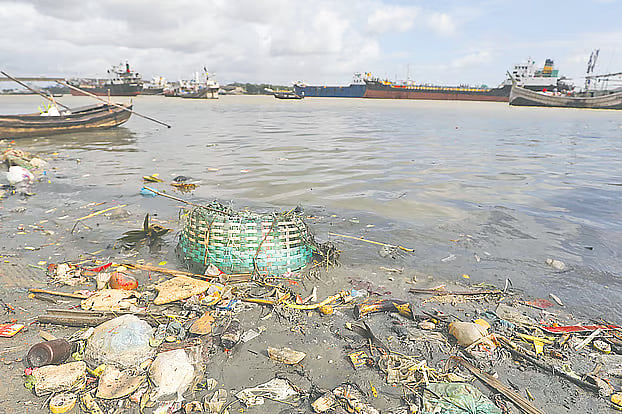
Last Tuesday afternoon, a visit to the city’s section of the river revealed a grim scene. Poly bags, plastic bottles, bottle caps, cork sheets, torn sandals, and pieces of fishing nets floated on the water. At Sadarghat area, the river water appeared black and filthy.
A river in dire state
The study found between 14.23 and 26.68 microplastic particles per cubic meter of surface water, and between 75.63 and 272.45 particles per kilogram of sediment. Samples collected in winter showed the highest levels, with downstream areas being the most contaminated. The majority of the particles measured 0.3 to 0.5 millimeters in size. By colour, black and blue were most common. Microplastics, researchers note, harm fish physiologically, causing digestive blockages, impairing reproduction and immunity, and reducing survival rates of juvenile fish.
The team identified six types of microplastics in the river, with fibres being the most prevalent: 45.24 per cent of particles in water and 57.49 per cent in sediment were fibres. These originate largely from garment industry waste, discarded fishing nets, and ropes.
The researchers pointed to Chattogram’s high population density and the presence of countless small and large factories along both banks of the river as major causes of the contamination. The paper also highlighted inadequate waste management and the indiscriminate dumping of plastic waste into the river. Although polythene bags were banned in Bangladesh in 2002, enforcement has been weak, worsening the problem.
Lead researcher Professor Shoffikul Islam told Prothom Alo, “To address this crisis, indiscriminate dumping into the river must be stopped. Initiatives should be taken to set up plants that generate energy from waste. The use of single-use plastics must also be reduced. Otherwise, the situation may become even more catastrophic.”
On the other hand, Karnaphuli is Chattogram’s main source of drinking water. Each day about 280 million litres are drawn from the river. The WASA treatment plants use various chemicals to make the water potable.
Professor Shoffikul Islam stressed that WASA must investigate whether the water is fully free of microplastics. However, WASA’s Chief Engineer Maksud Alam claimed, “There is no chance of microplastics or any other substances being present in the water we supply.”
A river in peril
Various studies and surveys have long warned that unchecked encroachment and pollution are killing the river. In 1990, the Karnaphuli measured nearly 900 meters wide at Bridgeghat in Chattogram city.
In 2006, construction began on the 950-meter-long Shah Amanat Third Bridge near Chaktai. Squatters and permanent structures occupied newly emerged sandbanks around the bridge. Six years earlier, river land had been leased out for building a fish landing centre. As a result, the river narrowed in that area to just 510 meters. Similar illegal structures have sprung up along other parts of the river.
In 2010, lawyer Manzil Murshid filed a writ petition on behalf of the environmental group Human Rights and Peace for Bangladesh, seeking protection for the river. In 2016, the High Court ordered the demolition of illegal structures along Karnaphuli, then numbering 2,112.
In February 2019, the district administration cleared encroachments between Sadarghat and Barik Building, while the port authority was tasked with the Barik Building–Patenga stretch. Together, they removed about a thousand structures. After that, the drives stopped.
According to the Chattogram River and Canal Protection Movement, there are now nearly 2,000 illegal structures on the river’s northern bank and over 500 on the southern side. Many of these encroachments are controlled by local political leaders and influential individuals.
Muhammad Mozammel Hoque, the first vice-chancellor of Chattogram University of Engineering and Technology (CUET) and president of the Chattogram River and Canal Protection Movement, told Prothom Alo, “Powerful individuals and certain vested groups have illegally occupied both sides of Karnaphuli. Due to negligence and lack of will by the district administration and past governments, these encroachments have not been removed. To save the river, a coordinated effort is needed, bringing together the administration, law enforcement agencies, and citizens.”