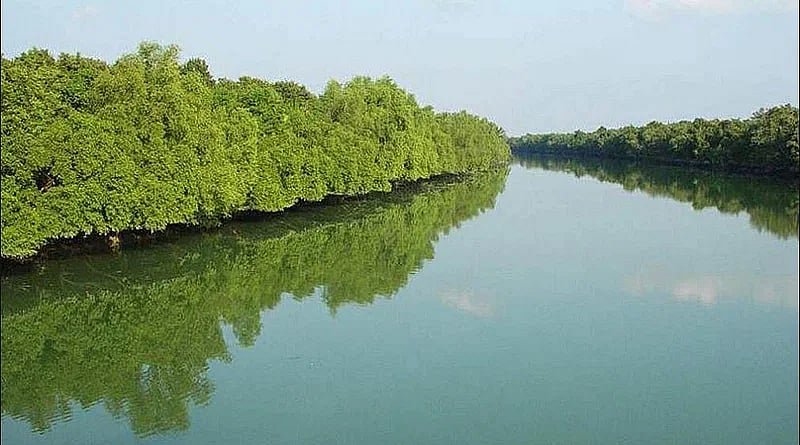
Sundarbans mangrove forest: Natural shield under pressure
Stretching across the tidal delta where the rivers of South Asia meet the sea, the Sundarbans stands as one of the most extraordinary ecosystems on Earth. This vast mangrove forest, bordering Bangladesh and India along the Bay of Bengal, is the largest mangrove forest in the world and one of the planet’s most important natural defences against coastal disasters.
Yet today this globally significant forest faces mounting threats from environmental change, human pressure and development activities. Preserving the Sundarbans has therefore become both an environmental necessity and a matter of national security for Bangladesh.
Size and global importance
The Sundarbans covers nearly 10,000 square kilometres, of which about 60 per cent lies in Bangladesh and 40 per cent in India. The Bangladesh portion alone contains roughly 494,000 hectares of forest land, crisscrossed by hundreds of rivers, tidal creeks and estuaries (Bangladesh Forest Department).
Because of its exceptional biodiversity and ecological importance, the Sundarbans was designated a World Heritage Site by the UNESCO in 1997. The forest is globally known as the habitat of the endangered Royal Bengal Tiger, the only tiger population in the world adapted to a mangrove environment.
Beyond its wildlife, the Sundarbans performs vital ecological functions. Mangrove forests protect coastlines from cyclones, storm surges and erosion. They absorb large amounts of carbon and serve as breeding grounds for many fish and crustaceans that support coastal fisheries. Scientists therefore regard the Sundarbans as one of the most valuable natural ecosystems in South Asia (United Nations Environment Programme).
People dependent on the forest
Despite its wild character, the Sundarbans is closely connected to human life. Millions of people living along the forest’s northern boundary depend on its resources for survival.
Studies suggest that around 3.5 million people depend directly or indirectly on the Sundarbans ecosystem for livelihoods (World Bank). In addition, approximately 600,000 people regularly enter the forest to collect natural resources such as fish, crabs, honey and golpata leaves used for roofing materials (Mongabay environmental reporting).
These resource collectors include fishermen, honey gatherers locally known as mouals, crab collectors and small traders. Many come from impoverished coastal communities where agricultural land is scarce and employment opportunities are limited.
For these families the forest acts as an economic safety net. During crop failures or natural disasters many households depend on forest resources to sustain their income and food supply.
Signs of ecological stress
Despite its resilience, the Sundarbans ecosystem is increasingly under pressure. Scientific studies show that a significant portion of the forest is experiencing declining ecological health due to rising salinity, erosion and environmental change.
Historical records indicate that about 451 square kilometres of mangrove forest have disappeared since the early twentieth century due to erosion, rising sea levels and human activity (environmental research published in regional forestry studies).
As a World Heritage Site, the Sundarbans is subject to international conservation standards established by UNESCO. These rules restrict large scale industrial development inside the protected forest and regulate resource extraction activities
Salinity in the region has also increased substantially during recent decades. Changes in freshwater flow and sea level rise have altered the delicate balance of the mangrove ecosystem, affecting vegetation patterns and wildlife habitats (Food and Agriculture Organization).
Cyclones such as Sidr and Aila have also damaged large areas of forest, destroying trees and increasing soil salinity in some zones.
Human pressure and environmental risks
Human activities have intensified environmental pressure on the Sundarbans. Industrial expansion near the forest zone has raised concerns among environmentalists. Increased shipping traffic transporting coal, oil and other materials through rivers inside the forest has created pollution risks and occasionally caused oil spills that threaten aquatic life.
Illegal logging, poaching and excessive harvesting of forest resources remain persistent challenges. Although entry into the forest requires official permits issued by the Bangladesh Forest Department, some individuals still enter protected areas without authorization to collect resources.
Shrimp farming in coastal regions surrounding the Sundarbans has also contributed to ecological stress. Converting agricultural land into saline shrimp ponds can damage nearby ecosystems and increase soil salinity.
Climate change presents perhaps the most serious long term threat. Rising sea levels could submerge parts of the forest while increasing salinity may alter the composition of mangrove vegetation.
Government conservation measures
Recognising the ecological importance of the Sundarbans, the Government of Bangladesh has taken several conservation initiatives. The forest is managed by the Bangladesh Forest Department, which regulates entry permits, supervises resource collection and conducts wildlife monitoring.
Three wildlife sanctuaries within the forest serve as core conservation zones where human activity is strictly limited. Together these protected areas cover nearly 139,700 hectares of the Bangladesh portion of the Sundarbans (UNESCO World Heritage Centre).
Anti-poaching patrols have been strengthened in recent years with the help of modern monitoring technologies including camera traps. These efforts have contributed to stabilizing the population of the Royal Bengal Tiger in Bangladesh.
The government has also launched mangrove replantation projects and community based conservation programmes aimed at restoring degraded forest areas.
UNESCO status and conservation rules
As a World Heritage Site, the Sundarbans is subject to international conservation standards established by UNESCO. These rules restrict large scale industrial development inside the protected forest and regulate resource extraction activities.
Anyone entering the forest must obtain official permits, and activities such as fishing, honey collection and wood gathering are controlled through licensing systems.
However, enforcing these rules remains difficult. Many coastal residents depend heavily on forest resources and sometimes enter restricted zones out of economic necessity. Balancing environmental protection with local livelihoods therefore remains one of the most complex management challenges.
Governance challenges
Several obstacles continue to complicate conservation efforts in the Sundarbans. Limited manpower and resources within the forest department make it difficult to monitor the vast network of rivers and islands. Illegal activities can therefore occur in remote areas.
At the same time poverty among coastal communities creates constant pressure on forest resources. Without viable alternative livelihoods, many people have little choice but to depend on the forest.
Industrial development, shipping traffic and climate change impacts add further complexity to the situation.
Experts therefore emphasise the need for stronger environmental governance, improved monitoring systems and greater regional cooperation between Bangladesh and India, since the forest ecosystem spans both countries.
A natural shield that must be protected
For Bangladesh the Sundarbans is far more than a forest. It serves as a natural shield that protects millions of coastal residents from cyclones and tidal storms. During major disasters the mangrove belt absorbs wind and wave energy, reducing damage to human settlements.
The future of the Sundarbans will depend on the country’s ability to balance conservation with economic realities. Expanding sustainable livelihood opportunities for coastal communities, strengthening environmental regulation and investing in climate resilience will be essential.
Protecting the Sundarbans is not simply about saving wildlife or preserving a natural landscape. It is about safeguarding the ecological security and economic future of Bangladesh itself.
* The author a freelance writer