Iran authorities signal intensified crackdown as unrest grows
Iran's authorities indicated on Saturday they could intensify their crackdown on the biggest anti-government demonstrations in years, with the Revolutionary Guards blaming unrest on terrorists and vowing to safeguard the governing system.
US President Donald Trump, who has repeatedly threatened to intervene in recent days, posted on social media on Saturday: "Iran is looking at FREEDOM, perhaps like never before. The USA stands ready to help!!!"
There were fresh reports of violence across Iran, although an internet blackout made it difficult to assess the full extent of unrest.
After nightfall on Saturday, new videos posted online purported to show fresh protests in a number of neighbourhoods in the capital Tehran and several cities, including Rasht in the north, Tabriz in the northwest and Shiraz and Kerman in the south. Reuters could not immediately verify the latest videos.
The exiled son of Iran's last shah, who has emerged as a prominent voice in the fragmented opposition, made his strongest call yet for the protests to broaden into a revolt to topple the clerical rulers.
State media said a municipal building was set on fire in Karaj, west of Tehran, and blamed "rioters". State TV broadcast footage of funerals of members of the security forces it said were killed in protests in the cities of Shiraz, Qom and Hamedan.
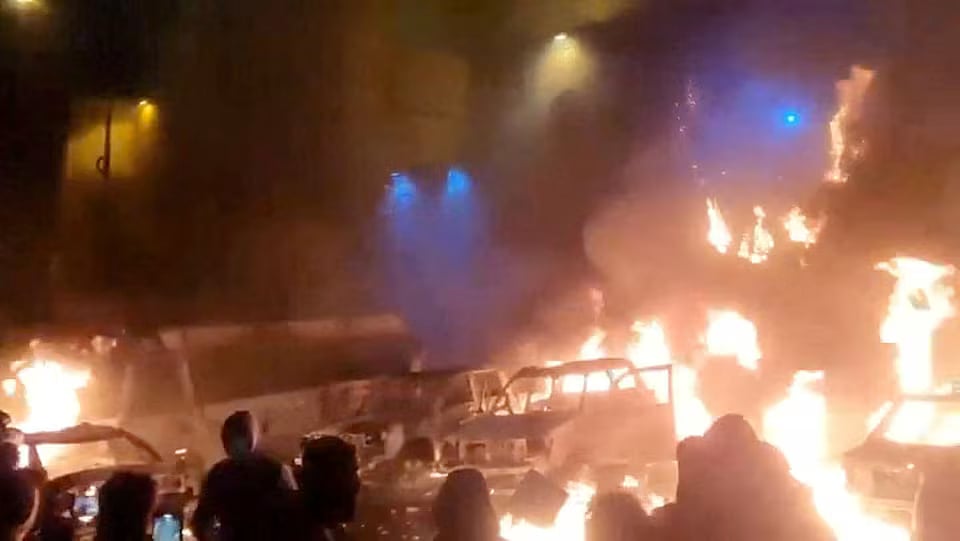
Footage posted on Friday on social media showed large crowds gathered in Tehran and fires lit in the street. In one video verified by Reuters showing a nighttime protest in Tehran's Saadatabad district, a man is heard saying the crowd had taken over the area.
"The crowd is coming. 'Death to the dictator', 'Death to Khamenei'," he said, referring to Supreme Leader Ayatollah Ali Khamenei.
Protests have spread across Iran since 28 December, beginning in response to soaring inflation, and quickly turning political with protesters demanding an end to clerical rule. Authorities accuse the US and Israel of fomenting unrest.
A senior US intelligence official described the situation as an "endurance game". The opposition was trying to keep up pressure until key government figures either flee or switch sides, while the authorities were trying to sow enough fear to clear the streets without giving the United States justification to intervene, the official said.
Iranian rights group HRANA says at least 50 protesters and 15 security personnel have been killed, and some 2,300 arrested.
Army says ‘terrorist groups’ seek to undermine security
A witness in western Iran reached by phone said the Revolutionary Guards (IRGC) were deployed and opening fire in the area from which the witness was speaking, declining to be identified for safety.
The semi-official Tasnim news agency reported the arrest of 100 "armed rioters" in the town of Baharestan near Tehran.
In a statement broadcast by state TV, the IRGC - an elite force which has suppressed previous bouts of unrest - accused "terrorists" of targeting military and law enforcement bases over the past two nights. It said several citizens and security personnel had been killed and public and private property set on fire.
Safeguarding the achievements of the Islamic revolution and maintaining security was a "red line", it added.
The regular military also issued a statement saying it would "protect and safeguard national interests, the country’s strategic infrastructure, and public property".
Pahlavi says goal is to ‘seize city centres’
In a video posted on X, US-based Reza Pahlavi, 65, whose father was toppled as Iran's shah in the 1979 revolution, said the Islamic Republic would be brought "to its knees". He called for people to seize the centres of their towns, and said he was preparing to return soon to Iran.
"Our goal is no longer merely to come into the streets; the goal is to prepare to seize city centres and hold them," he said.
A doctor in northwestern Iran said that since Friday, large numbers of injured protesters had been brought to hospitals. Some were badly beaten, suffering head injuries and broken legs and arms, as well as deep cuts.
At least 20 people in one hospital had been shot with live ammunition, five of whom later died.
Trump said on Thursday he was not inclined to meet Pahlavi, a sign that he was waiting to see how the crisis plays out before backing an opposition leader.
Iran's rulers have weathered repeated bouts of unrest, including student protests in 1999, over a disputed election in 2009, against economic hardships in 2019, and in 2022 over the death in custody of a woman accused of violating dress codes.
Trump, who joined Israel to strike Iran's nuclear sites last summer, has included Iran in lists of places in which he could intervene since sending forces to seize the president of Venezuela a week ago. On Friday, in a warning to Iran's leaders, he said: "You better not start shooting because we'll start shooting too."
Some protesters on the streets have shouted slogans in support of Pahlavi, such as "Long live the shah", although most chants have called for an end to rule by the clerics or demanded action to fix the economy.
On Friday, Khamenei accused protesters of acting on behalf of Trump, saying rioters were attacking public properties and warning that Tehran would not tolerate people acting as "mercenaries for foreigners".